forgottennewsmakers

Posts Tagged ‘History’

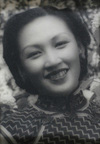
LI XIAQING (1912-1998) Aviatrix & Actress

In adventure, Biography, Chinese history, Feminists, Movies, People, People from China, Pilots, Trivia, Uncategorized, women on May 3, 2010 at 9:02 PM

Li XiaQing


Li was born in the Canton province of China to a wealthy, patriotic family. She was given the nickname “Dandan,” a homophone for the Chinese word for “bomb,” because her family used her baby carriage to stealthily transport explosives.  

At age 14, she wandered onto a movie set, and the director was smitten with her stunning looks.  He offered her the opportunity to act in a silent film, and she thought it would be fun.  Despite her lack of experience, Li, using the stage name Li Dandan, quickly won the admiration of audiences, which she capitalized on for six more films.   

Her most famous role was the title character in Hua Mulan Joins the Army in 1928.  Hua Mulan was the young girl who dressed as a boy to go to war, the basis for the Disney animated movie Mulan.  In order to play the role convincingly, Li learned martial arts, archery, boxing, fencing and horseback riding.  
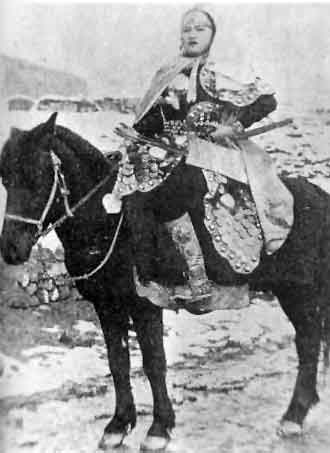
Li XiaQing as Mulan


These new skills gave her an edge off the set as well and made her a hero to the production company.   One night while they were on location, robbers snuck into the camp and stole the production money.  Li jumped on a horse, prevented the thieves from crossing a bridge, and after fighting with them for a while, tossed them over the bridge into the river.  

Li’s father wanted her to continue her education, so he sent her to Europe.  He was also ready to pass off responsibility for her to a husband.  He changed her name back to Li Xiaqing and hired a matchmaker.  She picked Zheng Baifeng who was educated at the Sorbonne in Paris and worked for China’s Foreign Service. This seemed like a match made in heaven, and the couple was married in 1929 and made their first home in Geneva.  Li was 17 years old and Zheng was almost 30.  

By 1932, Li had become a mother to a son and a daughter.  This new responsibility did not, however, interfere with her love of travel.  In 1933, Li attended the Paris Air Show and was enamored by flying.  Immediately upon returning to Geneva, she enrolled in flying lessons. One year later, Li made her first solo flight and was the first woman to receive a private pilot’s license in Geneva.  

Li’s reason for learning to fly was patriotic: to help her country advance through aviation.  In order to accomplish that, she needed to become a more proficient pilot and mechanic.  She enrolled at the Boeing School of Aeronautics in Oakland, California for advanced training.  By the time she graduated she could dismantle and reassemble an airplane engine and was versed in aerodynamics, meteorology, aircraft design and radiotelephony.  

The biggest thrill in flight for Li was aerobatics.  On May 15, 1935 she went up with instructor LeRoy B. Gregg over San Francisco Bay.  At about 2,200 feet Gregg started a barrel roll and turned the plane upside down.  When he looked back, he saw Li falling out of her seat trying to hang on.  Then, in shock, he watched her fall.  After a free fall of about 900 feet, Li remembered to pull the rip cord and activate the parachute she was wearing.  This eased her splash down into the icy cold bay.   

Li was an experienced swimmer, but her water-logged leather suit and the freezing water made it difficult for her to move.  Gregg dropped life preservers, but Li couldn’t get to them.  Luckily, airmen at the U.S. Naval Reserve Base in Alameda saw her fall and were on their way to rescue her in a Loening amphibious plane.  Unfortunately, the pontoons were stuck on this aircraft, and Li had to continue to tread water until a second one could arrive.  Li was in the water for 20 minutes until she climbed aboard the rescue aircraft.  A credit to her gender, Li only had two complaints: she was cold, and she lost a shoe.  In order to “get back on the horse,” Li went up over the Bay in the same stunt plane the following day.  Apparently, the cause of Li’s involuntary ejection was a broken seat belt, although she admitted to a reporter many years later that it was possible she had forgotten to fasten it.  

This harrowing experience earned Li membership in the Caterpillar Club, an exclusive organization of about 100,000 people with only one requirement to join.  You must have saved your own life through an emergency parachute exit from an airplane.   

On November 5, 1935, Li was the first woman to graduate from the prestigious Boeing School of aeronautics.  With a diploma, private pilot’s license and impressive experience, she returned to China.  

In 1934, General Chaing Kai-shek authorized private flying in China for the first time. After passing a demanding test, Li was the first woman to be issued a government pilot’s license, handed to her by General Chaing himself.  With this honor came responsibility.  She was given the use of a government plane and charged with inspecting all the airfields throughout China.   

Li didn’t really have time for family, and didn’t live with her husband and children. This independence had consequences.  In 1935 she divorced Zheng under the new constitutional laws which made Zheng lose face.  As a result, Li had to forfeit seeing her children until they were adults.   

Li wasn’t at a loss for romance, however.  She had met Peter Doo when she was in Europe and they corresponded while she was lived Oakland.  With Li finally a free woman, Doo went to work for her father to encourage a commitment from her.  The most she was willing to commit to was a long distance romance for eight years.  

In Shanghai, Li primarily taught flying and continued to be an example for women. For Chaing Kai-shek’s fiftieth birthday celebration she performed the first aerobatic flight by a woman.  For the finale, she dove straight at the podium full of dignitaries and pulled up at last minute, just a few feet above their heads.  Her popularity skyrocketed.  

In 1937 Japan invaded China.  Li saw this as the ultimate opportunity to use her skills to serve her country.  She was crushed when she was told she would no longer be allowed to fly because she was a woman, not even on courier missions. But she found another way to serve, by founding the First Citizens’ Emergency Auxiliary and using her own money to convert a hotel into the Red Cross Emergency Hospital.  She was driven, doing everything from administration work to assisting with surgery to organizing a refugee camp and orphanage to running the radio station that broadcast propaganda.   

The Japanese were not so appreciative of Li’s contributions and they put her on their black list, forcing her to leave Shanghai. She ended up back in San Francisco where she started working on her idea to fly around the United States raising money to support China.  She sold $7,000 worth of jewelry to buy an airplane and finance her excursions.   

Everywhere she went, Li was given a grand reception.  Audiences were surprised and captivated by her beauty and style.  The Idaho Statesman in Boise described her outfit of sharkskin slacks, no hose, leather sandals, finger and toenails polished to match the lipstick and a carnation behind her ear.  This flower became her trademark.   

Hollywood noticed her, too.  She revived her acting career as a Chinese aviatrix in the movie Disputed Passage starring Dorothy Lamour.  She took time out of her flight schedule for the three-day job, and she did her own stunts, donating her earnings to the war refugee fund.  

By 1939 Li had flown 10,000 miles and raised $10,000 for Chinese refugees.  She extended her efforts to two fundraising tours of South America, returning to Shanghai in May 1946.   

Back in Asia Li only flew for pleasure.  She met international businessman Li GeorgeYixiang (no relation).  Together they shared a love of travel, golf and horseback riding.  They settled in Oakland near where Li had studied at Boeing.  By this time, Li’s American pilot’s license had expired, and the Federal Aviation Administration would not recognize her license from Hong Kong.  So, in 1966, at 54 years old, Li began flight instruction to become recertified.   

Li never lost the thrill of flying.  One day while she was out driving, she saw a crop duster in a field.  She stopped and asked the farmer if she could take it for a spin.  She did tricks and aerobatic maneuvers, pushing the plane to its limits.  When she landed, she thanked the flabbergasted owner and walked away.  

Li was 86 years old when she died in Oakland. For her final resting place she wanted to feel the same expanse she felt while flying.  She had bought four adjacent plots in the Mountain View Cemetery and insisted that she be buried right in the center with lots of space around her.  

QUESTION: What nickname do people call you?  What significance does it have?  How has it influenced your relationship with them?  

                         ©2010 Debbie Foulkes All Rights Reserved  

Sources:  

Gully, Patti.  Sisters of Heaven.  San Francisco: Long River Press, 2008.  

http://www.airspacemag.com/history-of-flight/Chinas_First_Lady_of_Flight.html  

http://160.111.252.58/research/arch/findaids/pdf/Lee_Ya-Ching_Papers_Finding_Aid.pdf  

http://www.chinesemirror.com/index/2009/10/in-search-of-li-dandan-aviatrix.html  

http://softfilm.blogspot.com/2009/01/lee-ya-ching-flying-for-victory.html  

http://en.wikipedia.org/wiki/Caterpillar_Club  

http://www.caterpillarclub.org/irvin/irvin.htm  

HORACE RIDLER (1892–1969) Tattooed Sideshow Performer

In Biography, History, People, Sideshow Performers, Tattoos, Trivia, Uncategorized on April 26, 2010 at 6:26 PM

Horace Ridler as The Great Omi

Horace Ridler was dealt a life of privilege, but he didn’t want to play that hand.  Instead, he created a persona that was the total antithesis of his background. 

Ridler was born in Surrey, England to a wealthy family.  Growing up, he enjoyed all the privileges of education and travel such a life affords.  At the outbreak of World War I, he heeded the bugle call and served in the British Army, attaining the rank of major. 

In 1922, Ridler left military service and needed a job. This is where his life parted ways with the conventional.  After being a member of the rank and file, he wanted something that would let him stand out a little bit. The most promising prospect for him was the business of show.  He started getting pictorial tattoos and displayed his body art at small sideshows. Unfortunately, this didn’t turn out to be as profitable as he had hoped. 

Ridler decided that in order to earn more, he’d have to give the audience more.  In 1927 he started working with famed tattoo artist George Burchett who helped Ridler design a custom, whole-body look.  After 150 hours under the needle, Ridler was sporting full-body, zebra-like stripes that even covered his other tattoos.  

Through the physical transformation, Ridler created a character: The Great Omi.  He toured England and France but felt that the tattoos alone weren’t interesting enough to sustain audiences.  He amped up his look by piercing and stretching his ears with large-gauge jewelry, piercing his septum, and filing his teeth to a sharp point. 

To add entertainment value, Ridler created an elaborate explanation for his tattoos saying he was captured and tortured by natives in New Guinea.  His wife Gladys, who changed her name to Omette, got in on the act by describing Omi’s African ordeal as she introduced him. 

Ridler’s fame as Omi crossed the pond, and in 1939 The Great Omi appeared in the sideshow at the World’s Fair in Queens, New York.  When the fair closed, Robert Ripley hired him as the headliner in the Ripley’s Odditorium Theater.  During Ridler’s six month run, he appeared over 1,600 times, often doing ten shows a day.  

The Ringling Brothers and Barnum and Bailey Circus hired Ridler as Omi the Zebra Man for one season.  Success led to a solo act, and in 1941 and 1942 he toured Australia and New Zealand, worked the “World Fair Freaks” show in Vancouver, Canada, and appeared with some other traveling shows before heading back to England.  To keep things interesting, Omi and Omette wore increasingly outrageous costumes. Omi added nail polish and lipstick to complete his look, and he started giving autographs as the “Barbaric Beauty.” 

World War II brought out the patriotic in Ridler, and he tried to re-enlist in the British Army.  He was rejected, however, because his appearance was considered inappropriate for a soldier.  Back in England he served his country by giving free performances to soldiers and charity organizations and using his fame to sell war bonds.  

Ridler and his wife ultimately retired in Sussex, England, and he died in 1969.  Despite his appearance, he told a reporter he always believed that, “underneath it all, I’m just an ordinary man.” 

QUESTION:  Do you do anything to change your appearance (makeup, hair color, etc.)?  If you were to get a tattoo, what design would you choose? 

                                  ©2010 Debbie Foulkes All Rights Reserved 

Sources: 

http://en.wikipedia.org/wiki/Horace_Ridler 

http://thehumanmarvels.com/?p=17 

http://www.missioncreep.com/mundie/gallery/gallery22.htm 

http://www.google.com/imgres?imgurl=http://c3.ac-images.myspacecdn.com/images02/105/m_7c8c46c2225c4ff188adfa1730d1edc6.jpg&imgrefurl=http://www.myspace.com/thegreatomi&usg=__hXhK28uPSjbzz2B7e3F0E5BmEds=&h=211&w=170&sz=9&hl=en&start=13&um=1&itbs=1&tbnid=XrHiITrEsvQ1oM:&tbnh=106&tbnw=85&prev=/images%3Fq%3Dphotos%2BThe%2BGreat%2BOmi%26um%3D1%26hl%3Den%26sa%3DX%26rlz%3D1G1GGLQ_ENUS311%26tbs%3Disch:1

JOSEPHINE COCHRANE (1839-1913) Invented the Dishwasher

In American History, Biography, Entrepreneurs, Feminists, Inventions, Millionaires, People, Trivia, Victorian Women, women on April 20, 2010 at 9:03 AM

Josephine Cochrane

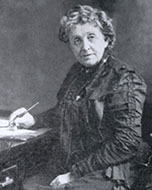
Josephine Cochrane believed that if you want something done right you better do it yourself.  But when it came time to doing the dishes, she really didn’t want to, so she invented a machine to wash them for her.

Cochrane’s early childhood is not known.  After her mother died and her sister moved out, she lived with her father, John Garis, in Ohio and Indiana.   He worked as a supervisor in mills and as a hydraulic engineer, perhaps instilling in Cochrane an instinctive knack for the mechanical.  She attended a private high school, but when it burned down, Garis sent his daughter off to live with her sister in Shelbyville, Illinois. 

After high school graduation, Cochrane’s life took a traditional turn.  At age 19 she married 27 year old William Cochran.  In 1857, after a disappointing four years trying to strike it rich in the California Gold Rush, he returned home to Shelbyville and made his mark and fortune in the dry goods business along with other investment opportunities.  No doubt the comfortable life he could offer his bride was one thing she was attracted to. 

In spite of her young age and the societal norm at the time, Cochrane was guided by her independent nature and personal confidence.  She assumed her husband’s name but preferred spelling it with an “e” on the end, a point of contention with his family. 

The Cochrans had a busy social life, and in 1870 when they moved into what could be considered a mansion, they had the perfect house for entertaining.  They threw dinner parties using heirloom china allegedly dating from the 1600s.  After one event, the servants did the washing up and carelessly chipped some of the dishes.  Cochrane discovered this the next morning while she was putting the dishes away.  She was furious and refused to let the servants handled the china any more. 

She may have regretted her decision, but she didn’t give in.  The morning after every subsequent dinner party she begrudgingly endured dishpan hands wondering why someone hadn’t invented a machine that could clean dirty dishes.  This was, after all, the late 19th century, and if someone could invent a machine to sew clothes and cut grass, then how hard could it be? 1 

One such morning while she was up to her elbows in soap suds, she had an epiphany.  Why not invent a dish washing machine herself?  Consumed with the idea, she immediately went into the library to think it through, forgetting she was holding a cup in her hand.  Within half an hour Cochrane had the basic concept for the first mechanical dishwasher.  Just like she had been doing by hand, it held the dishes securely (in a rack) while the pressure of spraying water cleaned them off.

William Cochran was a rising star in the Democratic Party, but too much alcohol led to a violent temper and illness.  While Cochrane was busy with the details of her invention, William went away for a rest. Unfortunately, he didn’t get well, and he died two weeks later in 1883.  

While the Cochrans appeared to be successful socialites to their friends, all was not well at home.  Her husband left Cochrane with a mound of debt and only $1,535.59.  Now, developing the dishwasher was not only for convenience, it was for survival.

Her creation had wire compartments for plates, cups and saucers.  They were put inside a wheel that lay flat inside a copper boiler.  A motor turned the wheel pumping hot soapy water from the bottom of the boiler over the dishes.  Cochrane showed her design to a few men for their input which ended up being a frustrating experience.  “I couldn’t get men to do the things I wanted in my way until they had tried and failed in their own,” she said.  “And that was costly for me. They knew I knew nothing, academically, about mechanics, and they insisted on having their own way with my invention until they convinced themselves my way was the better, no matter how I had arrived at it.” 2   Finally she got help with the construction from mechanic George Butters and received her first patent on the Garis-Cochran Dish-Washing Machine December 28, 1886. 

Cochrane’s first customers were not the housewives she thought she was helping. They didn’t want to spend the money on something they didn’t really need, so she turned to hotels.  After selling a dishwashing machine to the Palmer House hotel in Chicago, she had one recommendation.  Then she did one of the hardest things she’d ever done: she made a cold call to the Sherman House hotel in Chicago, waiting in the ladies’ parlor to speak with the manager.  “You asked me what was the hardest part of getting into business,” she once told a reporter. “…I think, crossing the great lobby of the Sherman House alone. You cannot imagine what it was like in those days … for a woman to cross a hotel lobby alone. I had never been anywhere without my husband or father —the lobby seemed a mile wide. I thought I should faint at every step, but I didn’t—and I got an $800 order as my reward.”2

In 1893 Cochrane convinced restaurants at the World’s Columbian Exposition in Chicago to use her invention, and it was an exhibit in Machinery Hall.  That success led to her opening her own factory in an abandoned schoolhouse.  Her customers extended to hospitals and colleges for whom the sanitizing effects of the hot water rinse were important.  Homemakers finally started using it, too.

In 1912, at 73 years old, Cochran was still personally selling her machines.  She died in 1913.  In 1916, her company was bought out by Hobart which became KitchenAid and is now Whirlpool Corporation.  Cochrane is considered the founder.

 QUESTION:  Which modern convenience do you think it would be impossible to live without?

                       ©2010 Debbie Foulkes All Rights Reserved

 Sources:

 1 http://www.enchantedlearning.com/inventors/1800a.shtml

 2http://www.americanheritage.com/articles/magazine/it/1999/2/1999_2_54.shtml

  http://www.invent.org/hall_of_fame/256.html