forgottennewsmakers

Posts Tagged ‘American History’

MATTHEW HENSON (1866-1955) First Person to Reach the North Pole

In adventure, American History, Arctic, Biography, Explorers, History, North Pole, People, Trivia on April 12, 2010 at 9:51 PM

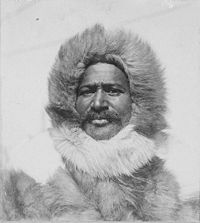
Matthew Henson

When Matthew Henson left home at age eleven he never looked back.  He didn’t have much to return to so he kept going, to the end of the earth. 

Henson’s parents were free-born tenant farmers who finally settled near Washington D.C.  His mom died when he was seven, and his father remarried. His father subsequently died and left young Henson and his siblings to their stepmother’s care. The problem was, she was burned out on farming and child care, so she often beat the children into compliance. Late one night after a severe beating, Henson made good on his promise to run away.  He used his brother’s knife to cut his wool blanket into squares that he wrapped around his feet as makeshift shoes. 

Fear of being caught and returned home kept Henson hiding in the woods until nightfall.  Then hunger and the cold forced him to seek refuge.  Janey Moore, the owner of Janey’s Home Cooked Meals Cafe, took him in and gave him food, shelter and a job.  Henson saved the $1.50 a week he earned and bought himself the first new clothes he’d ever had. 

A year later, Henson was ready to move on.  It wasn’t that he was ungrateful, but he dreamed of being a sailor.  “Aunt Janey” pressed a dollar into his hand and begrudgingly let him go. 

Henson walked from Washington D.C. to Baltimore where he ultimately met up with a Captain Childs and became his cabin boy on the ship Katie Hines.  For five years Henson traveled with Childs and learned literature, math and navigation.  Henson was 17 when Childs died, and he found himself doing odd jobs and bouncing around New England.

Henson was working as a clerk in a store in Washington D.C.  when Robert Peary, a lieutenant in the U.S. Navy, came in and learned of Henson’s maritime experience. Peary hired him to be his personal valet on a trip to Nicaragua.  Upon returning to the States, Peary kept Henson on as an errand boy in his office at the League Island Navy Yard.

 In 1891, Peary made his first of several trips to Greenland with Henson on the crew.  During these excursions, Peary mapped Greenland and made plans to find the geographic North Pole. Henson spent extensive time with the Inuit people, learning their language, customs, survival skills and gaining their respect and a permanent connection. 

While in the States, Henson married Eva Flint. He wasn’t too keen on the fact that she got pregnant while he was in Greenland, so he divorced her. Then he married Lucy Ross, but they never had children.  While in Greenland, however, Henson wasn’t deprived of companionship. He had a relationship and a son with an Inuit woman, his only offspring. 

In previous attempts at reaching the top of the world, Peary and Henson had collected the world’s largest meteorites and went the farthest north any human had ever traveled.  This was not, however, satisfying enough to stop trying to find the North Pole.

Peary and Henson made the final attempt in 1909 on the specially build ship the Roosevelt.  Accompanying them were several other Caucasian explorers, 39 Eskimos*, who traveled in families, and the husky dogs that would be pulling the sledges (sleighs).

Time on board the ship was used by the natives to make suits of reindeer skin and polar bear skin.  Henson was responsible for making the sledges, shaping the runners to curve up like a canoe to break through the ice.

On March 1, 1909, at 6:30am, Peary, Henson and the others left the comfort and security of the Roosevelt at Cape Sheridan at Canada’s northern tip to cross 413 nautical miles of ice to find the Pole.  Three days earlier the temperature had been 57 degrees below.  Only one mile into the trip Henson’s sledge broke, and he had to stop and fix it in gale force winds, exposing his hands to bore new holes and securely rethread the sealskin ties.

Every night they built igloos to sleep in, and they ate an Inuit specialty: dried meat pounded into powder and mixed with dried fruit call pemmican, and tea.

The explorers weren’t able to travel as fast as they’d have liked due to natural obstacles known as “leads,” a gap where the ice has suddenly split to expose water. On March 4 a lead opened up that made them waste seven days of good weather.  Finally, on March 11, with the temperature at 47 degrees below, the ice drifted back together, the lead closed, and they carried on with their journey.

On March 20, Peary started cutting the crew for the final push to the Pole.  By April 1, the only ones to make the last five marches over the ultimate 130 miles were Peary, Henson and four Inuits.

Despite the cold and exhaustion, they managed to sustain a relentless pace.  On April 3, Henson had a horrifying experience.  While he was pushing his sled, the ice underneath him broke away, and he slipped and fell into the freezing water.  He tried to grab the ice and pull himself up, but his gloves couldn’t get a grip.  While he was flailing about, the Inuit Ootah reached down, grabbed Henson by the nape of the neck and pulled him out.   Henson quickly changed into dry clothes, and when he caught up with the others, learned that Peary had also taken an unexpected dip.

With Henson in the lead breaking the trail, on April 6, 1909 they finally reached their goal, after 36 days of trekking over the ice. After they set up camp, Peary planted the American flag and Henson led a spontaneous cheer. Peary took measurements to confirm and document their location.  As it turned out, they had overshot the Pole. After retracing their steps, 49 year old Henson was actually the first person to step on the geographic North Pole.  It was a balmy 29 degrees below. 

This frozen tundra was not a place to just hang out. The six men scurried back to land in a quick 17 days.  Once back on the Roosevelt, Henson got his strength back by doing nothing but eating and sleeping for four days.  It wasn’t until July 17 that weather conditions allowed them to head home. They made it to Etah, Greenland on August 17, and they arrived back in New York on October 2.

When Peary and Henson returned to the States, Peary received all the credit and notoriety for the incredible accomplishment. Henson, being African American, was ignored. He slipped into obscurity working a non-descript job at the Customs House in New York.

Eventually Henson received due recognition for his achievement.  Finally, in 1937, when he was 70 years old, he was granted an honorary membership in the prestigious Explorers Club.  Henson was also awarded several honorary degrees, and in 1954 he received a personal commendation from President Eisenhower for his role in discovering the North Pole.  A stamp from the United States Postal Service was issued in 1988 with the pictures of Peary and Henson.
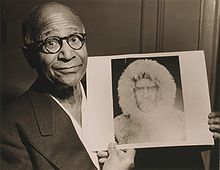
Henson With a Picture of Himself

Henson died in 1955.  He was buried next to his wife in New York.  After some politicking from his biographer, in 1988 Henson and Lucy were reinterred next to Commander Peary and his wife in Arlington National Cemetery.  His Inuit son and family were in attendance at the ceremony.

 * Today in Canada and Greenland the term “Eskimo” is considered derogatory.  It is the term used by Henson in his memoir. The Inuit people are a group of Eskimos found in northern Alaska, Canada and Greenland. 

QUESTION:  What obstacles keep you from trying to do something you really want to?

                                 ©2010 Debbie Foulkes All Rights Reserved

 Sources:

 Henson, Matthew, A Negro Explorer at the North Polehttp://fliiby.com/file/208493/ajb1dly8gl.html

http://www.matthewhenson.com/index.html

http://en.wikipedia.org/wiki/Matthew_Henson

http://news.nationalgeographic.com/news/2003/01/0110_030113_henson.html

http://www.polarconservation.org/education/explorers/matthew-alexander-henson
http://www.matthewhenson.org/North_Pole_Trip2.htm

CHRISTOPHER EVANS (1847-1917) & JOHN SONTAG (1862-1893) Train Robbers

In adventure, American History, Biography, California History, History, Horses, outlaws, People, Train Robberies, trains, Trivia, Tulare County California on March 30, 2010 at 9:15 AM

Chris Evans asserted until he died that he never robbed a train and that he only killed in self defense.  His exploits with John Sontag divided people in Tulare County: those who believed the evidence to the contrary and those, who despite evidence, were united in friendship and revenge.    

 The Southern Pacific Railroad made inroads in transportation in California, but it also made enemies. In the name of the greater good, the railroad company put progress over people, and displaced many from their property, including Evans.

 Chris Evans had an adventuresome spirit.  He worked at many different jobs as a laborer and lived in a house with a barn in Visalia. His marriage to Molly Byrd yielded seven children. 

 John and George Sontag were brothers.  John worked for Southern Pacific Railroad and was injured in an accident.  He had several broken ribs which put pressure on his lungs and a broken leg which caused a permanent limp.  He was no longer fit to work for the railroad company, so they canned him.  He lived with Evans for a while working odd jobs.  Younger brother George was also on the scene, but not as much is known about him.

 On August 3, 1892, men dressed as tramps hopped on a train bound for Fresno.  They each wore masks, had a double barrel shotgun and a revolver.  In response to an invitation to get off the train, the men opened fire.  Then they blew up the express car and absconded with over $10,000 dollars in gold and silver coins.  Accomplices who were hiding behind the nearby school house helped the robbers escape. 

 Coincidentally, the following day Evans was seen in Visalia after a long absence, and John Sontag suddenly appeared claiming to have been in the East.  The sheriffs were suspicious. They knew that George Sontag was a passenger on that train, so they assumed he was a collaborator, took him to the station for questioning, and then locked him up. 

 Trying to play it cool and not make a scene, Detective Smith and Deputy Sheriff Witty decided to arrest John next and then go back for Evans the following day.  When they arrived at Evans’ house, the law men were greeted with a spray of bullets.  Not being able to react fast enough, Smith and Witty were wounded, chased off the property and forced to leave their horse and rig behind.  

 Evans and Sontag headed for the hills.  They returned the next morning and hid with the horse and buggy in the barn.  The sheriffs came back for their transportation and set up a stake out. When they knew the outlaws were back, they started shooting into the barn.  The robbers returned fire and killed one man.  The sheriff’s bullet did hit a target, and the groans of someone dying were heard.  When they entered the barn to make an arrest, the sheriff’s horse was dying, and Evans and Sontag had escaped on foot.

 Evans and John Sontag had been the presumed perpetrators of previous train robberies, including one in Minnesota, but there was never enough proof to pin it on them.  For this so called Collis Robbery, however, they were wanted, and Southern Pacific Railroad put up a $5000 reward for each, dead or alive. 

 Thus began a ten month man hunt.  Since sentiment against the Southern Pacific was so strong and the Evans had lots of friends, the runaways got help at every turn.  Several posses followed numerous leads and often got close.  In one incident, Evans’ oldest daughter, Eva, overheard talk that a posse knew where to find her dad and his accomplice.  Eva and Evans were very close, and she wanted to do something to help.  She hopped on her horse and bravely followed the posse into the woods to warn the fugitives.  She fired a warning shot into the air that alerted the bandits.  Her plan was successful. Evans and Sontag eluded capture, and Eva returned home unscathed. 

 After being on the lam for ten months, Evans and John Sontag were exhausted, and Sontag’s railroad injuries made it extremely difficult for him to stay on the move.  They devised a plan to escape to South Africa, but they needed money. Evans got word to his wife to wire Sontag’s dad and ask for $100. 

 On June 11, 1893, the sheriffs got wind the outlaws were going to sneak back to the Evans’ Visalia home to pick up the dough.  The sheriffs were waiting and picked off the men as they approached.  During the thirty minute gun battle, both Sontag and Evans were wounded.  Sontag’s injuries were nearly fatal, and he begged Evans to finish the job.  Evans couldn’t bring himself to do it, so Sontag tried to do it himself.  He held his gun to his head, but he was too weak to pull the trigger.  He lay unconscious in a bed of straw until the sheriffs came back the next morning and carted him off to jail. He died there on July 3.

 Evans was debilitated but managed to run away.  He ended up at widow Perkins’ house and because they were friendly, she invited him in. Her son saw immediate benefit in having Evans around.  He rode to Visalia and offered to tell the sheriffs Evans’ whereabouts for the reward.  When the posse showed up at the Perkins’ home, boy Perkins carefully removed the gun from under the sleeping Evans’ pillow and invited the posse in.  Evans surrendered and was taken to jail without incident. 

 The exploits of Evans and Sontag quickly became the stuff of legend.  After one week of rehearsal, on September 19, 1893, a play opened in San Francisco reenacting their saga. “Evans and Sontag or The Visalia Bandits” played to cheering, standing room only crowds.  Audiences went wild when the real Molly and Eva Evans walked on stage to play themselves. Understudies played the roles so the women could attend Evans’ trial, but they resumed performing when the play went on tour.

 Evans was convicted of murder and sentenced to life imprisonment.  His life in the Fresno jail was comfortable, and he had dinner with his wife almost every night.  On December 28, a guy named Morrell brought the Evanses their dinner tray and hid two pistols under it.  Evans had a kid paid off to spread a rumor that another train robbery was about to happen, and this preoccupied the sheriffs.  Having a gun pointed at him convinced the guard to let the men walk, and after killing one man on their way out, Evans and Morrell were free.  Molly Evans had no previous knowledge of the plan and was not arrested as an accomplice.

 For a couple of months Evans and Morrell managed to stay ahead of the sheriffs. On February 13, 1894, a posse snuck up on their camp and fired three shots.  The bullets missed, and Evans and Morrell high tailed it out of there leaving everything behind.  They eluded the sheriffs for another month or so.

 The outlaws ended up at Grandma Byrd’s home in Visalia, and Evans was reunited with his family.  When the lawmen learned where the criminals were hiding, they again formed a posse and surrounded the house.  News of a possible capture spread quickly, and a crowd gathered eager to watch the events unfold first hand.  Evans exchanged notes with Sheriff Kay via Evans’ son.  His only demand was to get rid of the crowd and for Kay and one other man to come up to the house. Evans and Morrell walked out onto the porch unarmed.  Evans kissed his children goodbye and both men surrendered. 

 Evans served the rest of his time at Folsom prison.  As an inmate, he worked in the hospital and library.  He wrote a book called Eurasia about a country with a socialist government. Evans was released on parole in 1911 and joined his wife who had moved to Portland, where he died six years later.

 George Sontag was convicted for his part in the train robbery, and Morrell was convicted for his efforts in helping Evans escape from jail. Both men ended up at Folsom.  George made one unsuccessful escape attempt.  Both were eventually released. 

 QUESTION:  Would you be able to help a friend die if they asked you to? 

                                     © 2010 Debbie Foulkes All Rights Reserved

 Sources:

Maxwell, Hu,  Evans & Sontag. Fresno, CA: Panorama West Books, 1981.

 Menefee, Eugene L. and Dodge, Fred A.,  “History of Tulare and Kings Counties, California,” Historic Record Company, Los Angeles, California, 1013.

 Smith, Wallace, Prodigal Sons. Boston: The Christopher Publishing House, 1951.

EUGEN SANDOW (1867-1925) First Bodybuilder and Perfect Physical Specimen

In Biography, Bodybuilders, Bodybuilding, Entrepreneurs, Exercise, History, Inventions, People, People from Germany, Uncategorized, Vaudeville Acts, Victorian Women on March 15, 2010 at 9:15 PM

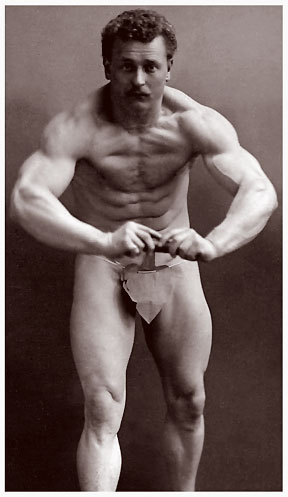
Eugen Sandow

Eugen Sandow had a body that men envied and women drooled over, and it brought him fame and fortune.  The only person who didn’t appreciate his success was his wife. 

Sandow was born Friedrich Muller, the son of a green grocer in a German city in East Prussia.  He was a draft dodger and changed his name to Eugen Sandow to avoid conscription.  His family didn’t appreciate that.  When his parents said, “What are you going to do, join the circus?” Sandow said yes, and ran away with one that was passing through town.  

He toured and performed as an acrobat until the circus went bankrupt in Brussels.  In this city he met Louis Attila who helped Sandow develop his physical structure and showmanship.  Together they made ends meet showing off their strength in music halls.  In 1889 Attila moved to London and sent word to Sandow of an irresistible challenge.  

The popular duo Sampson and Cyclops were posing as strongmen on stage with a cleverly choreographed act that concealed their lack of strength.  Each night Sampson issued a challenge to the audience: he would pay 500 pounds to anyone who could match the stunts he performed on stage.  Sandow was intrigued, so he went to London and briefly resumed training under Attila.  One night he answered Sampson’s call to prove his physical prowess and handily won the prize. 

This turned Sandow into a sensation, and he spent the next four years touring the music halls of Britain, wowing audiences with his feats of strength.   In 1893 he followed fame and fortune to New York where his act was under appreciated, perhaps because he had to share the stage with some third rate burlesque talent.  

This was not the American dream he was promised until one patron noticed how the women in the audience responded to Sandow’s flexing and posing.  Florenz Ziegfeld took him under his wing and coached Sandow to play to the audiences’ fascination with his bulging muscles.  He downplayed the heavy lifting for these “muscle display performances” and added some sensationalism such as breaking a chain around his neck.  Ziegfeld used the World’s Columbian Exposition in Chicago to debut Sandow’s new routine.  The audiences went wild, and for the next three years, Ziegfeld and Sandow toured extensively.  They continually added new ways to demonstrate Sandow’s physical prowess such as fighting a lion, or tearing apart furniture. In addition, Sandow made a short film with Thomas Edison featuring his poses.  (http://www.youtube.com/watch?v=-wLJtjEv-Ik)  

Sandow got the inspiration for his manly physique from Greek and Roman statues.  He measured the sculptures and crafted his body to their exact proportions, thereby creating “The Grecian Ideal” as the representation of the perfect male body.  After a thorough examination, doctor and Harvard professor Dudley Sargent pronounced Sandow “the most perfectly developed man in the world.”  His stage performances exploited this image by featuring him standing on a rotating pedestal encased in glass.  With physical perfection came lots of female attention, and Sandow became a sex symbol, something he didn’t seem to mind at all.  

The intense schedule and demands of celebrity caused Sandow to have a nervous breakdown.  At some point on a trip to England, Sandow had married Blanche Brookes.  When he became ill, he retreated back to England and the care of his wife. 

Away from the limelight, Sandow became passionate about helping people maintain personal fitness.  He created a place for people to learn about and practice bodybuilding and exercise called Institutes of Physical Culture.  The popularity of these gyms inspired other teachers to do the same, and a fitness craze started gaining momentum.  In order to reach the masses, Sandow published a magazine and five books.  The book that gave the sport its name, Body Building or Man in the Making, was published in 1904.  In Body Building, Sandow states his intention.  “What I live to teach is the gospel of health, and the bringing of the body to the condition to which Nature intended it.”  He outlined his system for achieving maximum physical potential as well as exercises for both men and women that dealt with specific ailments such as constipation, digestion and liver problems. (http://www.sandowplus.co.uk/sandowindex.htm#lied

Sandow capitalized on his success by developing equipment to enhance the efficacy of the exercises.  His spring-loaded dumbbell and weighted resistance band were available through mail order, which made it possible for the general population to get in shape in the comfort of home. In Body Building, he insisted, however, that rote repetition of the exercises was not enough. He emphasized the connection between the body and the mind. “The secret of success does not lie in the construction of the apparatus, but in the proper application and use if it, and this can only be obtained through the brain.  In other words, it is not a question as to how much you exercise, but how you exercise.” 

Sandow’s entrepreneurial spirit extended beyond the gym.  He produced Sandow Cigars and Sandow Health and Strength Cocoa.  In addition, he was one of the first proponents of mandatory physical education in school.  He believed that employers should give their employees time off for daily exercise, and he developed exercises for pregnant women to ease the pain of childbirth. 

Perhaps his biggest contribution to the sport of bodybuilding came in 1901.  Sandow organized the first bodybuilding contest, called the “Great Competition,” held in Royal Albert Hall in London to a standing room only crowd.  One of the judges was Sir Arthur Conan Doyle, author of the Sherlock Holmes stories. 

Being a perfect physical specimen and sex symbol had its price. Despite his physical strength, Sandow’s emotional weakness for women did him in.  When he died, the public story was that he had a stroke, but many believed he had succumbed to syphilis.  In retaliation for his philandering, his wife insisted that he be buried in an unmarked grave. 

Sandow hasn’t faded into total obscurity, however.  He has been immortalized by a bronze statue sculpted in his image which is the prize for winning the Mr. Olympia contest. It is called The Sandow. 

QUESTION: What physical feature do other people appreciate most about you? 

                              © 2010 Debbie Foulkes All Rights Reserved 

Sources: 

http://www.eugensandow.com/story1.html 

http://en.wikipedia.org/wiki/Eugen_Sandow 

http://www.statemaster.com/encyclopedia/Eugen-Sandow 

http://findarticles.com/p/articles/mi_g1epc/is_bio/ai_2419201071/ 

http://www.youtube.com/watch?v=-wLJtjEv-Ik 

http://www.sandowplus.co.uk/sandowindex.htm#lied