forgottennewsmakers

Archive for the ‘Uncategorized’ Category

EUGEN SANDOW (1867-1925) First Bodybuilder and Perfect Physical Specimen

In Biography, Bodybuilders, Bodybuilding, Entrepreneurs, Exercise, History, Inventions, People, People from Germany, Uncategorized, Vaudeville Acts, Victorian Women on March 15, 2010 at 9:15 PM

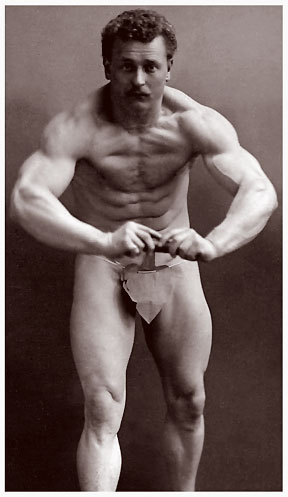
Eugen Sandow

Eugen Sandow had a body that men envied and women drooled over, and it brought him fame and fortune.  The only person who didn’t appreciate his success was his wife. 

Sandow was born Friedrich Muller, the son of a green grocer in a German city in East Prussia.  He was a draft dodger and changed his name to Eugen Sandow to avoid conscription.  His family didn’t appreciate that.  When his parents said, “What are you going to do, join the circus?” Sandow said yes, and ran away with one that was passing through town.  

He toured and performed as an acrobat until the circus went bankrupt in Brussels.  In this city he met Louis Attila who helped Sandow develop his physical structure and showmanship.  Together they made ends meet showing off their strength in music halls.  In 1889 Attila moved to London and sent word to Sandow of an irresistible challenge.  

The popular duo Sampson and Cyclops were posing as strongmen on stage with a cleverly choreographed act that concealed their lack of strength.  Each night Sampson issued a challenge to the audience: he would pay 500 pounds to anyone who could match the stunts he performed on stage.  Sandow was intrigued, so he went to London and briefly resumed training under Attila.  One night he answered Sampson’s call to prove his physical prowess and handily won the prize. 

This turned Sandow into a sensation, and he spent the next four years touring the music halls of Britain, wowing audiences with his feats of strength.   In 1893 he followed fame and fortune to New York where his act was under appreciated, perhaps because he had to share the stage with some third rate burlesque talent.  

This was not the American dream he was promised until one patron noticed how the women in the audience responded to Sandow’s flexing and posing.  Florenz Ziegfeld took him under his wing and coached Sandow to play to the audiences’ fascination with his bulging muscles.  He downplayed the heavy lifting for these “muscle display performances” and added some sensationalism such as breaking a chain around his neck.  Ziegfeld used the World’s Columbian Exposition in Chicago to debut Sandow’s new routine.  The audiences went wild, and for the next three years, Ziegfeld and Sandow toured extensively.  They continually added new ways to demonstrate Sandow’s physical prowess such as fighting a lion, or tearing apart furniture. In addition, Sandow made a short film with Thomas Edison featuring his poses.  (http://www.youtube.com/watch?v=-wLJtjEv-Ik)  

Sandow got the inspiration for his manly physique from Greek and Roman statues.  He measured the sculptures and crafted his body to their exact proportions, thereby creating “The Grecian Ideal” as the representation of the perfect male body.  After a thorough examination, doctor and Harvard professor Dudley Sargent pronounced Sandow “the most perfectly developed man in the world.”  His stage performances exploited this image by featuring him standing on a rotating pedestal encased in glass.  With physical perfection came lots of female attention, and Sandow became a sex symbol, something he didn’t seem to mind at all.  

The intense schedule and demands of celebrity caused Sandow to have a nervous breakdown.  At some point on a trip to England, Sandow had married Blanche Brookes.  When he became ill, he retreated back to England and the care of his wife. 

Away from the limelight, Sandow became passionate about helping people maintain personal fitness.  He created a place for people to learn about and practice bodybuilding and exercise called Institutes of Physical Culture.  The popularity of these gyms inspired other teachers to do the same, and a fitness craze started gaining momentum.  In order to reach the masses, Sandow published a magazine and five books.  The book that gave the sport its name, Body Building or Man in the Making, was published in 1904.  In Body Building, Sandow states his intention.  “What I live to teach is the gospel of health, and the bringing of the body to the condition to which Nature intended it.”  He outlined his system for achieving maximum physical potential as well as exercises for both men and women that dealt with specific ailments such as constipation, digestion and liver problems. (http://www.sandowplus.co.uk/sandowindex.htm#lied

Sandow capitalized on his success by developing equipment to enhance the efficacy of the exercises.  His spring-loaded dumbbell and weighted resistance band were available through mail order, which made it possible for the general population to get in shape in the comfort of home. In Body Building, he insisted, however, that rote repetition of the exercises was not enough. He emphasized the connection between the body and the mind. “The secret of success does not lie in the construction of the apparatus, but in the proper application and use if it, and this can only be obtained through the brain.  In other words, it is not a question as to how much you exercise, but how you exercise.” 

Sandow’s entrepreneurial spirit extended beyond the gym.  He produced Sandow Cigars and Sandow Health and Strength Cocoa.  In addition, he was one of the first proponents of mandatory physical education in school.  He believed that employers should give their employees time off for daily exercise, and he developed exercises for pregnant women to ease the pain of childbirth. 

Perhaps his biggest contribution to the sport of bodybuilding came in 1901.  Sandow organized the first bodybuilding contest, called the “Great Competition,” held in Royal Albert Hall in London to a standing room only crowd.  One of the judges was Sir Arthur Conan Doyle, author of the Sherlock Holmes stories. 

Being a perfect physical specimen and sex symbol had its price. Despite his physical strength, Sandow’s emotional weakness for women did him in.  When he died, the public story was that he had a stroke, but many believed he had succumbed to syphilis.  In retaliation for his philandering, his wife insisted that he be buried in an unmarked grave. 

Sandow hasn’t faded into total obscurity, however.  He has been immortalized by a bronze statue sculpted in his image which is the prize for winning the Mr. Olympia contest. It is called The Sandow. 

QUESTION: What physical feature do other people appreciate most about you? 

                              © 2010 Debbie Foulkes All Rights Reserved 

Sources: 

http://www.eugensandow.com/story1.html 

http://en.wikipedia.org/wiki/Eugen_Sandow 

http://www.statemaster.com/encyclopedia/Eugen-Sandow 

http://findarticles.com/p/articles/mi_g1epc/is_bio/ai_2419201071/ 

http://www.youtube.com/watch?v=-wLJtjEv-Ik 
http://www.sandowplus.co.uk/sandowindex.htm#lied 

ANNIE KOPCHOVSKY LONDONDERRY (1870? – 1947) Rode A Bicycle Around the World

In adventure, American History, Biography, Entrepreneurs, Feminists, History, People, Trivia, Uncategorized, Victorian Women, women on March 9, 2010 at 12:56 PM

Annie Londonderry

Annie Kopchovsky left her husband and young children to circumnavigate the globe in order to prove women were as capable as men.  Was she crazy and irresponsible or courageous and heroic?    

Although Kopchovsky was born in Latvia, she became an American as a young child, moving with her family to Boston.  At 18 she married Max Kopchovsky, a peddler, and within the next four years they had three children.    

A master at self promotion, it’s not totally clear which details of the story are true or created by Kopchovsky to enhance her ability to make money.  Nevertheless, the inspiration for this incredible journey is attributed to a bet.  Two wealthy Bostonians were sitting around their club discussing the fairer sex.  One asserted that the modern woman could do just about anything a man could, and his companion took the bait.  They shook on a wager that a woman could ride a bicycle around the world in 15 months and earn $5,000 along the way.  The precedent for this challenge was Thomas Stevens who completed a similar feat in 1887.    

It’s not clear why she felt compelled to do this since she had never ridden a bicycle before, but Kopchovsky was likely caught up in the craze of women who were using the vehicle to express new freedoms.  Susan B. Anthony was quoted in the New York World in 1896 as saying bicycling had “done more to emancipate women than anything else in the world.”   

On June 27, 1894, 24-year-old Kopchovsky hopped on her 42-pound Columbia woman’s bike wearing the long skirt, corset and high collar of the time.  Perhaps creating the first Mr. Mom, she waved goodbye to her husband and three small children and some fans from the local cycling club as she headed off for New York.  One newspaper reported her departure saying she “sailed away like a kite down Beacon Street.” She carried with her only a change of clothes, a pearl-handled pistol and a lot of chutzpa.  The Londonderry Lithia Spring Water Company offered her $100.  In return for their sponsorship, she agreed to carry their placard on her bike and adopt the name “Annie Londonderry.”   

From New York she rode to Chicago arriving on September 24th.  By then she had lost 20 pounds and realized that if she was to continue, she would have to make some major changes.  First, the bicycle was too heavy, so she switched to a 21-pound Sterling model with a man’s frame, one gear and no brakes.  Second, it was impossible to ride a man’s bike in woman’s attire, so she first donned bloomers and then eventually wore a man’s riding suit for the rest of the trip.   

Her original plan was to continue riding west, but the impending winter made it necessary for her to switch direction.  She rode back to New York and sailed to Le Havre, France, arriving there in early December.  Things did not go well at first.  Her bike was impounded by customs officials, her money was stolen, and the French press declared that she was too muscular to be a woman, thereby assigning her to the category of “neutered beings.”  Somehow she was able to turn things around, and, despite inclement weather, she made it from Paris to Marseilles in two weeks via cycling and train.  In Marseille, Londonderry (as she was now known) boarded the steamship “Sydney.”  Ports of call included Alexandria, Colombo, Singapore, Saigon, Hong Kong, Shanghai, Nagasaki and Kobe.  To prove that she had actually been there, she had to get the signature of the United States Consul in each location.      

Londonderry became a real entrepreneur.  She kept herself going with income from displaying advertising banners on her bike and her person and telling her story.  Telling the truth was less important than fundraising, and she concocted many stories about her background.  In France she intrigued people with tales of being an orphan, an accountant, a wealthy heiress, a lawyer, a Harvard medical student, the inventor of a new method of stenography, the cousin of a U.S. congressman and the niece of a U.S. senator.  In addition she sold promotional photos, silk handkerchiefs, souvenir pins and autographs.   

Londonderry returned to America via the San Francisco harbor on March 23, 1895.  From there she pedaled to Los Angeles and then through Arizona and New Mexico to El Paso. She headed north and arrived in Denver on August 12 and then continued on to Cheyenne where she jumped on a train that carried her through Nebraska.  From there she hopped back on the bike bound for Chicago, where she arrived on September 12.  It’s assumed that she rode the train home to Boston where she arrived on September 24, 15 months from when she left.   

During her trip across America, Londonderry captivated audiences with stories from exotic places and earned enough money from her lectures to supplement the other earnings and make the $5,000 as required in the challenge.  She described hunting tigers with German royalty in India and a brush with death, nearly being killed by “Asiatics” because they thought she was an evil spirit.  She became involved in the Sino-Japanese war of 1895.  On the front lines she fell through a frozen river and ended up in a Japanese prison with a bullet wound in her shoulder.  Whether true or invented, audiences loved her tales and the press ate them up.   

After returning to Boston, Londonderry was accused of traveling more “with” a bicycle than “on” one, but that didn’t dampen the enthusiasm for her achievements.  On October 20, 1895 the New York World described her trip as “the most extraordinary journey ever undertaken by a woman.”   Both the newspaper and Londonderry wanted to cash in further on her triumph, so she accepted the offer to write feature articles under the by-line “The New Woman.”  Seeing more potential from her peddling adventure than in her husband’s peddling business, she moved her family to New York for her new journalism career.  Her first article was about her round-the-world bicycle adventure.  “I am a journalist and ‘a new woman,’ ” she wrote, “if that term means that I believe I can do anything that any man can do.”   

QUESTION:  What is the most interesting, daring or challenging thing that you have known one of your parents to do?  How did it influence your life?   

                                   © 2010 Debbie Foulkes All Rights Reserved   

     Sources: 

“Champion of Her Sex,” New York Sunday World, 2 February 1896, p. 10.   

http://www.csmonitor.com/2006/0828/p20s01-algn.html   

http://www.experienceplus.com/reading_room/books/around_the_world_on_two_wheels.html   

http://www.annielondonderry.com/learn.html   

http://en.wikipedia.org/wiki/Annie_Londonderry   

http://cyclingsisters.org/node/5019   

http://en.wikipedia.org/wiki/Thomas_Stevens_(cyclist)   

http://www.ahands.org/cycling/thomas_stevens.html   

http://nicomachus.net/writing/womens-liberation-through-cycling/

RICHARD LAWRENCE (1800?-1861) First Person to Attempt to Assassinate an American President

In American History, American Presidents, Andrew Jackson, Biography, History, People, Trivia, Uncategorized on March 2, 2010 at 9:11 AM

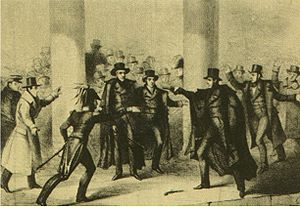
Jackson Assassination Attempt

Richard Lawrence’s attempt to assassinate President Andrew Jackson was not politically motivated.  Even though he had never met the president, he had a personal score to settle.  

Lawrence was born in England, and made his way to America when he was young.  He ended up working as a painter but became unemployed in the early 1830s.  This coincided with a decline in his mental stability.  He suffered from delusions of grandeur and believed that he was King Richard III of England, who, inconveniently, ascended to the throne in 1483.  His fallacies grew and started manifesting themselves physically.  He exchanged his normal conservative dress for more flamboyant outfits and grew a mustache, perhaps to create a disguise.  

 Lawrence convinced himself that his lack of work was inconsequential because the U.S. government owed him money, and that President Jackson was personally preventing him from receiving it.  He was confident that as soon he obtained the funds, he would be able to begin his reign as the King of England.  Lawrence also held the president directly responsible for killing his father in 1832.  Never mind that his father had died about a decade earlier and had never set foot on American soil.  

 In Lawrence’s mind, these grievances had to be avenged, leaving him no alternative but to eliminate his antagonist.  He plotted to assassinate President Jackson on a damp day in January 1835.  Leaving nothing to chance, he had two loaded pistols and a clear shot at point blank range.  

 On January 30 President Jackson was at the Capitol to attend the funeral of Congressman Warren R. Davis of South Carolina.  After paying his respects and filing past the casket, President Jackson exited the building. Lawrence was waiting for his opportunity behind a pillar. As the president walked past, Lawrence emerged from his hiding place, aimed and shot at his target. The gun misfired, and immediately Lawrence pulled the second pistol out of his pocket and pulled the trigger.  That gun misfired, too.  President Jackson heard a commotion and turned around to observe Lawrence being wrestled to the ground. The president himself further subdued his assailant by punching him in the stomach with his cane.  

 During the investigation Lawrence’s guns worked perfectly, and it was determined that the odds of both guns misfiring were 125,000 to 1.  The weapons Lawrence used were known not to be reliable in moisture, so it was the weather that actually saved President Jackson’s life.   

Two and a half months later Lawrence was brought to trial and prosecuted by Francis Scott Key, the writer of The Star Spangled Banner. The jury needed only five minutes of deliberation to find him not guilty by reason of insanity.  There was speculation that the toxic chemicals in his paints were a contributing factor to his irrational mental state.  Lawrence stayed in several institutions before he became a permanent resident of the Government Hospital for the Insane in Washington D.C. until his death in 1861. 

QUESTION:  What is the biggest or worst thing you’ve ever gotten away with?  

                                 © 2010 Debbie Foulkes  All Rights Reserved  

Sources:  

http://en.wikipedia.org/wiki/Richard_Lawrence_(failed_assassin)  

 http://www.americanheritage.com/articles/web/20070130-richard-lawrence-andrew-jackson-assassination-warren-r-davis.shtml  

 http://www.digitalhistory.uh.edu/historyonline/assassinations.cfm