forgottennewsmakers

Archive for the ‘People’ Category

JOSEPHINE COCHRANE (1839-1913) Invented the Dishwasher

In American History, Biography, Entrepreneurs, Feminists, Inventions, Millionaires, People, Trivia, Victorian Women, women on April 20, 2010 at 9:03 AM

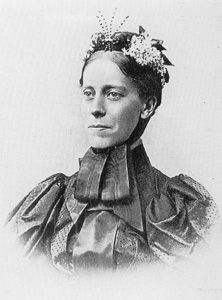
Josephine Cochrane

Josephine Cochrane believed that if you want something done right you better do it yourself.  But when it came time to doing the dishes, she really didn’t want to, so she invented a machine to wash them for her.

Cochrane’s early childhood is not known.  After her mother died and her sister moved out, she lived with her father, John Garis, in Ohio and Indiana.   He worked as a supervisor in mills and as a hydraulic engineer, perhaps instilling in Cochrane an instinctive knack for the mechanical.  She attended a private high school, but when it burned down, Garis sent his daughter off to live with her sister in Shelbyville, Illinois. 

After high school graduation, Cochrane’s life took a traditional turn.  At age 19 she married 27 year old William Cochran.  In 1857, after a disappointing four years trying to strike it rich in the California Gold Rush, he returned home to Shelbyville and made his mark and fortune in the dry goods business along with other investment opportunities.  No doubt the comfortable life he could offer his bride was one thing she was attracted to. 

In spite of her young age and the societal norm at the time, Cochrane was guided by her independent nature and personal confidence.  She assumed her husband’s name but preferred spelling it with an “e” on the end, a point of contention with his family. 

The Cochrans had a busy social life, and in 1870 when they moved into what could be considered a mansion, they had the perfect house for entertaining.  They threw dinner parties using heirloom china allegedly dating from the 1600s.  After one event, the servants did the washing up and carelessly chipped some of the dishes.  Cochrane discovered this the next morning while she was putting the dishes away.  She was furious and refused to let the servants handled the china any more. 

She may have regretted her decision, but she didn’t give in.  The morning after every subsequent dinner party she begrudgingly endured dishpan hands wondering why someone hadn’t invented a machine that could clean dirty dishes.  This was, after all, the late 19th century, and if someone could invent a machine to sew clothes and cut grass, then how hard could it be? 1 

One such morning while she was up to her elbows in soap suds, she had an epiphany.  Why not invent a dish washing machine herself?  Consumed with the idea, she immediately went into the library to think it through, forgetting she was holding a cup in her hand.  Within half an hour Cochrane had the basic concept for the first mechanical dishwasher.  Just like she had been doing by hand, it held the dishes securely (in a rack) while the pressure of spraying water cleaned them off.

William Cochran was a rising star in the Democratic Party, but too much alcohol led to a violent temper and illness.  While Cochrane was busy with the details of her invention, William went away for a rest. Unfortunately, he didn’t get well, and he died two weeks later in 1883.  

While the Cochrans appeared to be successful socialites to their friends, all was not well at home.  Her husband left Cochrane with a mound of debt and only $1,535.59.  Now, developing the dishwasher was not only for convenience, it was for survival.

Her creation had wire compartments for plates, cups and saucers.  They were put inside a wheel that lay flat inside a copper boiler.  A motor turned the wheel pumping hot soapy water from the bottom of the boiler over the dishes.  Cochrane showed her design to a few men for their input which ended up being a frustrating experience.  “I couldn’t get men to do the things I wanted in my way until they had tried and failed in their own,” she said.  “And that was costly for me. They knew I knew nothing, academically, about mechanics, and they insisted on having their own way with my invention until they convinced themselves my way was the better, no matter how I had arrived at it.” 2   Finally she got help with the construction from mechanic George Butters and received her first patent on the Garis-Cochran Dish-Washing Machine December 28, 1886. 

Cochrane’s first customers were not the housewives she thought she was helping. They didn’t want to spend the money on something they didn’t really need, so she turned to hotels.  After selling a dishwashing machine to the Palmer House hotel in Chicago, she had one recommendation.  Then she did one of the hardest things she’d ever done: she made a cold call to the Sherman House hotel in Chicago, waiting in the ladies’ parlor to speak with the manager.  “You asked me what was the hardest part of getting into business,” she once told a reporter. “…I think, crossing the great lobby of the Sherman House alone. You cannot imagine what it was like in those days … for a woman to cross a hotel lobby alone. I had never been anywhere without my husband or father —the lobby seemed a mile wide. I thought I should faint at every step, but I didn’t—and I got an $800 order as my reward.”2

In 1893 Cochrane convinced restaurants at the World’s Columbian Exposition in Chicago to use her invention, and it was an exhibit in Machinery Hall.  That success led to her opening her own factory in an abandoned schoolhouse.  Her customers extended to hospitals and colleges for whom the sanitizing effects of the hot water rinse were important.  Homemakers finally started using it, too.

In 1912, at 73 years old, Cochran was still personally selling her machines.  She died in 1913.  In 1916, her company was bought out by Hobart which became KitchenAid and is now Whirlpool Corporation.  Cochrane is considered the founder.

 QUESTION:  Which modern convenience do you think it would be impossible to live without?

                       ©2010 Debbie Foulkes All Rights Reserved

 Sources:

 1 http://www.enchantedlearning.com/inventors/1800a.shtml

 2http://www.americanheritage.com/articles/magazine/it/1999/2/1999_2_54.shtml
  http://www.invent.org/hall_of_fame/256.html

MATTHEW HENSON (1866-1955) First Person to Reach the North Pole

In adventure, American History, Arctic, Biography, Explorers, History, North Pole, People, Trivia on April 12, 2010 at 9:51 PM

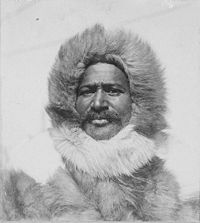
Matthew Henson

When Matthew Henson left home at age eleven he never looked back.  He didn’t have much to return to so he kept going, to the end of the earth. 

Henson’s parents were free-born tenant farmers who finally settled near Washington D.C.  His mom died when he was seven, and his father remarried. His father subsequently died and left young Henson and his siblings to their stepmother’s care. The problem was, she was burned out on farming and child care, so she often beat the children into compliance. Late one night after a severe beating, Henson made good on his promise to run away.  He used his brother’s knife to cut his wool blanket into squares that he wrapped around his feet as makeshift shoes. 

Fear of being caught and returned home kept Henson hiding in the woods until nightfall.  Then hunger and the cold forced him to seek refuge.  Janey Moore, the owner of Janey’s Home Cooked Meals Cafe, took him in and gave him food, shelter and a job.  Henson saved the $1.50 a week he earned and bought himself the first new clothes he’d ever had. 

A year later, Henson was ready to move on.  It wasn’t that he was ungrateful, but he dreamed of being a sailor.  “Aunt Janey” pressed a dollar into his hand and begrudgingly let him go. 

Henson walked from Washington D.C. to Baltimore where he ultimately met up with a Captain Childs and became his cabin boy on the ship Katie Hines.  For five years Henson traveled with Childs and learned literature, math and navigation.  Henson was 17 when Childs died, and he found himself doing odd jobs and bouncing around New England.

Henson was working as a clerk in a store in Washington D.C.  when Robert Peary, a lieutenant in the U.S. Navy, came in and learned of Henson’s maritime experience. Peary hired him to be his personal valet on a trip to Nicaragua.  Upon returning to the States, Peary kept Henson on as an errand boy in his office at the League Island Navy Yard.

 In 1891, Peary made his first of several trips to Greenland with Henson on the crew.  During these excursions, Peary mapped Greenland and made plans to find the geographic North Pole. Henson spent extensive time with the Inuit people, learning their language, customs, survival skills and gaining their respect and a permanent connection. 

While in the States, Henson married Eva Flint. He wasn’t too keen on the fact that she got pregnant while he was in Greenland, so he divorced her. Then he married Lucy Ross, but they never had children.  While in Greenland, however, Henson wasn’t deprived of companionship. He had a relationship and a son with an Inuit woman, his only offspring. 

In previous attempts at reaching the top of the world, Peary and Henson had collected the world’s largest meteorites and went the farthest north any human had ever traveled.  This was not, however, satisfying enough to stop trying to find the North Pole.

Peary and Henson made the final attempt in 1909 on the specially build ship the Roosevelt.  Accompanying them were several other Caucasian explorers, 39 Eskimos*, who traveled in families, and the husky dogs that would be pulling the sledges (sleighs).

Time on board the ship was used by the natives to make suits of reindeer skin and polar bear skin.  Henson was responsible for making the sledges, shaping the runners to curve up like a canoe to break through the ice.

On March 1, 1909, at 6:30am, Peary, Henson and the others left the comfort and security of the Roosevelt at Cape Sheridan at Canada’s northern tip to cross 413 nautical miles of ice to find the Pole.  Three days earlier the temperature had been 57 degrees below.  Only one mile into the trip Henson’s sledge broke, and he had to stop and fix it in gale force winds, exposing his hands to bore new holes and securely rethread the sealskin ties.

Every night they built igloos to sleep in, and they ate an Inuit specialty: dried meat pounded into powder and mixed with dried fruit call pemmican, and tea.

The explorers weren’t able to travel as fast as they’d have liked due to natural obstacles known as “leads,” a gap where the ice has suddenly split to expose water. On March 4 a lead opened up that made them waste seven days of good weather.  Finally, on March 11, with the temperature at 47 degrees below, the ice drifted back together, the lead closed, and they carried on with their journey.

On March 20, Peary started cutting the crew for the final push to the Pole.  By April 1, the only ones to make the last five marches over the ultimate 130 miles were Peary, Henson and four Inuits.

Despite the cold and exhaustion, they managed to sustain a relentless pace.  On April 3, Henson had a horrifying experience.  While he was pushing his sled, the ice underneath him broke away, and he slipped and fell into the freezing water.  He tried to grab the ice and pull himself up, but his gloves couldn’t get a grip.  While he was flailing about, the Inuit Ootah reached down, grabbed Henson by the nape of the neck and pulled him out.   Henson quickly changed into dry clothes, and when he caught up with the others, learned that Peary had also taken an unexpected dip.

With Henson in the lead breaking the trail, on April 6, 1909 they finally reached their goal, after 36 days of trekking over the ice. After they set up camp, Peary planted the American flag and Henson led a spontaneous cheer. Peary took measurements to confirm and document their location.  As it turned out, they had overshot the Pole. After retracing their steps, 49 year old Henson was actually the first person to step on the geographic North Pole.  It was a balmy 29 degrees below. 

This frozen tundra was not a place to just hang out. The six men scurried back to land in a quick 17 days.  Once back on the Roosevelt, Henson got his strength back by doing nothing but eating and sleeping for four days.  It wasn’t until July 17 that weather conditions allowed them to head home. They made it to Etah, Greenland on August 17, and they arrived back in New York on October 2.

When Peary and Henson returned to the States, Peary received all the credit and notoriety for the incredible accomplishment. Henson, being African American, was ignored. He slipped into obscurity working a non-descript job at the Customs House in New York.

Eventually Henson received due recognition for his achievement.  Finally, in 1937, when he was 70 years old, he was granted an honorary membership in the prestigious Explorers Club.  Henson was also awarded several honorary degrees, and in 1954 he received a personal commendation from President Eisenhower for his role in discovering the North Pole.  A stamp from the United States Postal Service was issued in 1988 with the pictures of Peary and Henson.

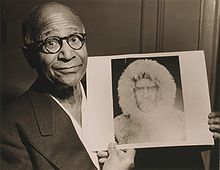
Henson With a Picture of Himself

Henson died in 1955.  He was buried next to his wife in New York.  After some politicking from his biographer, in 1988 Henson and Lucy were reinterred next to Commander Peary and his wife in Arlington National Cemetery.  His Inuit son and family were in attendance at the ceremony.

 * Today in Canada and Greenland the term “Eskimo” is considered derogatory.  It is the term used by Henson in his memoir. The Inuit people are a group of Eskimos found in northern Alaska, Canada and Greenland. 

QUESTION:  What obstacles keep you from trying to do something you really want to?

                                 ©2010 Debbie Foulkes All Rights Reserved

 Sources:

 Henson, Matthew, A Negro Explorer at the North Polehttp://fliiby.com/file/208493/ajb1dly8gl.html

http://www.matthewhenson.com/index.html

http://en.wikipedia.org/wiki/Matthew_Henson

http://news.nationalgeographic.com/news/2003/01/0110_030113_henson.html

http://www.polarconservation.org/education/explorers/matthew-alexander-henson

http://www.matthewhenson.org/North_Pole_Trip2.htm

MARY KINGSLEY (1862-1900) African Explorer

In adventure, Africa, Biography, Explorers, Feminists, fish, History, People, People from England, Trivia, Uncategorized, women on April 6, 2010 at 10:11 AM

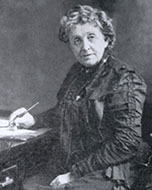
Mary Kingsley

Mary Kingsley was conceived out of wedlock, her parents marrying only four days before her birth.  She kept this fact a secret, but perhaps it, and a lack of religious education, imbued in her the impulse to defy the expectations of a Victorian woman.  

During her childhood in England, Kingsley was mostly left to her own devices.  Her mother was sickly, and her father was a doctor who spent most of his time traveling abroad.  True to the double standard of the time, younger brother Charley was educated at Cambridge, and Kingsley was not given any opportunity to go to school except for some lessons in German to help her father translate scientific texts. She took it upon herself to read volumes of books in her father’s library, especially those about science and foreign lands.  The tales from her father’s adventures piqued her curiosity and gave her a window to a life she would dream about. 

Kingsley played the role of dutiful daughter for 30 years.  As her mother’s health declined, Kingsley’s household duties included nurse.  Dr. Kingsley contracted rheumatic fever on a trip and also became bedridden. 

In early 1892 both parents died within three months.  There are no indications that she had any suitors, so Kingsley was resigned to live with her brother, a total flake.

In 1982, Kingsley took a brief trip to the Canary Islands, and it left her wanting more.  She was searching for a purpose and decided to travel to West Africa to follow up on some of her father’s projects.  When Charley went to Asia in 1983, Kingsley seized the opportunity.

She sought the counsel of friends and experts before leaving, all of whom cautioned her not to go. Ignoring their advice, in August 1893, Kingsley arrived in Angola. Despite the hot climate, she wore the skirts, blouses, high buttoned shoes and hats she wore at home, feeling that even in Africa she couldn’t justify dressing in an undignified manner.  As a white spinster, Kingsley was an anomaly in Africa.  The only other western women there were wives of missionaries.

She did have a mission.  Some doctors and scientists who advised her to stay home suggested that if she were to go anyway, she could help them by collecting specimens of fish and plants, which she did.

In December 1893 Kingsley returned to England and began preparing for her next African expedition.  One year later she again found herself in the villages and jungles of West Africa.  Kingsley fearlessly explored areas that no white person had ever been to before.  She rowed a canoe up the Ogowe River in Gabon and was the first woman to climb Mount Cameroon, with a summit of 13,700 feet.

Her encounters with animals were often hair-raising, and she had a healthy respect for their natural abilities. “Whenever I have come across an awful animal in the forest and I know it has seen me I take Jerome’s advice, and instead of relying on the power of the human eye rely upon that of the human leg, and effect a masterly retreat in the face of the enemy.”  She declared the leopard, “the most lovely animal I have ever seen.”1

In dealing with the native people, the explorer had a very non-judgmental approach.  She knew that travelers, especially female, were oddities to the Africans, so she became a textile trader selling cloth for rubber and ivory.  Integrating into the societies instead of just observing and documenting endeared her to the natives more readily.  She described her interactions with the Fang (Fan), a cannibalistic tribe, saying, “A certain sort of friendship soon arose between the Fan and me. We each recognized that we belonged to that same section of the human race with whom it is better to drink than to fight.”1  

She had a very high regard for the indigenous life of the natives.  It surprised Kingsley that she became fond of them.  She wrote, “I confess I like the African on the whole, a thing I never expected to do… I went to the Coast with the idea that he was a degraded, savage, cruel brute; but that is a trifling error you soon get rid of when you know him.”1

When Kingsley returned to England in November 1895, she told her stories to curious journalists and captivated audiences, but not everyone agreed with her acceptance of the native lifestyle.  She understood how tribal life functioned, and her support of that way of life contradicted the aims of the Church of England and British colonization.  She upset the Church by defending the practices of the aboriginal Africans and criticizing the missionaries’ efforts to change them. 

Kingsley settled into her brother’s home and wrote Travels in West Africa, a detailed, candid account of her experiences.  The book was a best seller and led to a very busy schedule on the lecture circuit.  Always trying to enlighten as well as entertain, one lecture she gave to the staff and students at a London medical school was called “African Therapeutics from a Witch Doctor’s Point of View.”  Her stories were so popular that she wrote another book, West African Studies, in quick succession that included all the anecdotes she left out of the first one.

Kingsley’s legacy was not only sociological.  Of all the plants and fish specimens she brought back, three fish species were previously unknown and named after her.  In 1899, the intrepid adventurer went back to Africa, this time looking to collect fresh-water fish from the Orange River in South Africa.  When she arrived in Cape Town, the Boer War was going strong.  The best way for Kingsley to become involved was to nurse Boer prisoners at a camp in Simon’s Town.  Typhoid infiltrated the camp, and Kingsley became infected.  On June 3, 1900, she succumbed to typhoid and, at her insistence, was buried at sea.

QUESTION:  Where would you like to explore, and what do you think it would be like? 

                                ©2010 Debbie Foulkes All Rights Reserved

   Sources:

 1Kingsley, Mary, Travels in West Africahttp://ebooks.adelaide.edu.au/k/kingsley/mary/west/west.html

 http://www.royalafricansociety.org/index.php?option=com_content&task=view&id=169&Itemid=165

 http://www.billgreenwell.com/lost_lives/index.php?key_id=583

 http://en.wikipedia.org/wiki/Mary_Kingsley

 http://africanhistory.about.com/library/weekly/aa011002a.htm http://africanhistory.about.com/library/weekly/aa011002a.htm