forgottennewsmakers

Archive for the ‘Feminists’ Category

MANUELA SÁENZ (1797-1856) Simon Bolivar’s Mistress and Political Rebel

In Biography, Dictators, Feminists, History, Simon Bolivar, South American history, Trivia, Uncategorized on July 26, 2010 at 9:49 PM

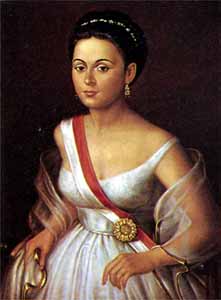
Watercolor of Manuel Saenz wearing the Order of the Sun Medal

Manuela Sáenz would learn very early in her life that marriage was not as important as love.  Her mother, Joaquina Aizpuru, was not married when she became pregnant with Sáenz, the result of an affair with a family acquaintance in a higher social class.  To avoid the humiliation of such bad judgment, Aizpuru was sent away to keep her pregnancy secret, and forced to relinquish her daughter to the care of nuns in a convent in Quito.  She died by the time Sáenz was seven.  Simón Sáenz de Vergara was a wealthy businessman and successful politician with a wife and six children.  A scandal could have ruined his life, but to his credit, he acknowledged Sáenz, paid the one thousand-peso dowry for his daughter to be given a proper upbringing in the convent, and introduced her to his legitimate children, giving her life some family context.

Sáenz’s father took responsibility for his daughter’s future by arranging a marriage to a much older, wealthy Englishman, and the newlyweds moved to Lima.  As a young wife, Sáenz socialized with Peru’s social, political and military elite.  She became sympathetic to the rebel cause, and against her husband’s orders, she joined the patriots to liberate Peru from the tyranny of Spain.  For her involvement, Sáenz received the Order of the Sun, an award given to those who made an exceptional contribution to the campaign.

Her appetite for political adventure having been whetted, Sáenz left her husband and moved back to Quito in 1822. She unapologetically abandoned her marriage in a time when women had few options in life.  There Sáenz met Simon Bolivar, “El Libertador” of South America. 

Back in her hometown, Sáenz again immersed herself in the independence movement.   Bolivar was to parade through town to celebrate victory in the battle that gave Quito independence.  On a fateful day, Sáenz’s participation was not militant.  She had the decidedly female job of beautifying the homes along the parade route to make a good impression on the esteemed soldier.  That evening, the two met at a reception and began their legendary love affair.

FOLLOWING HER HEART        At first, Sáenz was assumed to be another notch on the belt of a great womanizer.  As scandalous as their affair was, the couple had an immediate deep, passionate connection.  When Bolivar left Quito, Sáenz did not retreat back to her family, or even her marriage, as a spurned lover.  She followed him and integrated herself into his life.

Sáenz and Bolivar’s romantic partnership could not be distinguished from their political alliance. She became the official keeper of Bolivar’s personal archive, guarding his private papers and personally maintaining the secrecy of the army’s military strategy.  Her commitment to the cause superseded any fear she may have had of battle.  Sáenz organized troops and rescued and nursed those injured on the battlefield.  In one letter to Bolivar, Colombian General Antonio José de Sucre called Sáenz a hero for her contribution in the Battle of Ayacucho, and he recommended that Bolivar make her a Colonel of the Colombian army, which he did.  This appointment was so controversial because Sáenz was a woman that, in an irate letter to Bolivar, Colombian Vice-President Francisco Paula de Santander accused him of nepotism.  But Bolivar defended the bravery that earned Sáenz the recognition.

WHAT SHE DID FOR LOVE       When the wars for independence were over, Sáenz was 29, and she moved into Bolivar’s official residence.  She was well known as his mistress, but her influence extended beyond the personal to the role of gatekeeper for those wanting to meet with Bolivar.  And she didn’t need permission to act on his behalf.  In 1827 in Lima, the conditions for the troops were so bad that the army officers threatened a rebellion that would totally undermine the new constitution that Bolivar had established.  While Bolivar was away, Sáenz visited the soldiers wearing a colonel’s uniform and contributed money for food to dissuade them from being influenced by rebels with an ulterior political agenda.  She was rewarded for her initiative by being arrested and expelled from Peru, but her commitment to Bolivar’s cause never wavered. 

Sáenz not only dedicated herself to Bolivar’s political mission, but she was directly responsible for saving his life on at least two occasions.  In August 1928 Bolivar was to attend a party that Sáenz was not invited to.  She had received word that at midnight he would be assassinated, and she begged him to skip the event.  He ignored her warnings thinking she was just jealous at not being on the guest list.  At about 11:00, Sáenz showed up wearing a military uniform, but she was denied entry by the guard who turned out to be one of the conspirators.  She made another desperate attempt to preempt the assassination attempt by dressing up in dirty rags like an old crazy woman.  She positioned herself outside and yelled, “Que viva el Libertador!” (“Long live the Liberator!”)  Sáenz’s behavior was becoming an embarrassment to Bolivar, so he left the party to reprimand her.  At midnight, when the conspirators came to kill him, Bolivar was gone. 

Six weeks later, the couple was at home when Bolivar’s enemies entered the house with the same goal.  Sáenz ran to the sleeping man, supplied him with a sword and gun and forced him to jump out the window.  Bolivar resisted, instinctively wanting to stay and fight, but finally he trusted her judgment and left.  When the would-be assassins confronted her, she said legitimately that she didn’t know where he was, and he successfully escaped.  For this heroic effort, Bolivar called her “Libertadora del Libertador” (“Liberator of the Liberator”). 

Bolivar was a hero for emancipating South America from Spanish rule, but there was trouble in determining the governments.  Bolivar proclaimed himself as the dictator of the Gran Colombia in August 1828 in an effort to save the unified republic he fought so hard to establish and maintain his leadership. That did not appease the insurgents in Venezuela and Ecuador.  In 1830 he resigned and prepared to flee to Europe in self-imposed exile.  He died of tuberculosis in Columbia before he could leave. 

A REBEL WITHOUT A CAUSE   Sáenz’s association with Bolivar did not endear her to the incoming leaders, and she was exiled to Jamaica three years later.  Even from a distance, she attempted to stay involved in the political process of establishing the boundaries between Colombia, Ecuador and Peru through correspondence.  Over time, however, she became increasingly less relevant. 

Her final years were in stark contrast to the heady adventures with Bolivar.  After an attempt to return to Ecuador was refused, Sáenz settled in a port city in northern Peru, selling tobacco and translating letters for North American whalers to send to their lovers in Latin America.  She fell when the termite-eaten stairs of her home collapsed and became permanently disabled.  In 1856, at 59 years old, Sáenz died during a diphtheria epidemic and was buried anonymously in a mass grave.

Sáenz was eventually given proper respect for her role in South America’s liberation from Spain.  On July 5, 2010 symbolic remains of her body along with soil from her original grave were reinterred next to the tomb of her lover and compatriot, Simon Bolivar.  Venezuelan President Hugo Chavez and Ecuadorean President Rafael Correa presided over the ceremony at the National Pantheon in Caracas, Venezuela.

QUESTION:  What is the craziest or most daring thing you’ve done to show your love for someone?

©2010 Debbie Foulkes All Rights Reserved

Sources:

http://worldhistoryconnected.press.illinois.edu/7.1/foote.html

http://en.wikipedia.org/wiki/Manuela_S%C3%A1enz

http://www.latinamericanstudies.org/liberators/saenz.htm

http://en.wikipedia.org/wiki/Sim%C3%B3n_Bol%C3%ADvar

http://www.vheadline.com/readnews.asp?id=94055

Murray, Pamela S. For Glory and Bolivar, The Remarkable Life of Manuela Sáenz                      http://books.google.com/books
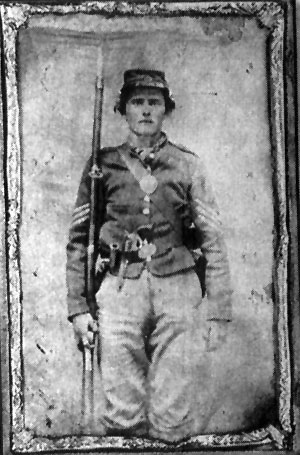
SARAH ROSETTA WAKEMAN (1843 – 1864) Female Soldier in the Civil War

In American History, Biography, Civil War, Female Soldiers, Feminists, History, People, Trivia, U.S. Army, Uncategorized, women on June 28, 2010 at 9:24 PM

Female Soldier in the Civil War

The lyrics to the Four Seasons’ song “Walk like a man. Talk like a man,” would have been good advice for Sarah Rosetta Wakeman.  Since she was a girl, she didn’t come by that naturally.  But learning how to do just that gave her a purpose and an adventure way beyond the family farm in Chenango County, New York.

By the time Wakeman was 17 years old, she had had some schooling, but  it was necessary for her to work as a domestic to help support her eight younger siblings and help her father pay off his debts.  Her future wasn’t looking too bright, so she decided that dressing like a man would increase her options.

When she was 19 she donned her disguise and worked as a coal handler on a barge on the Chenango Canal.  For four trips, she made $20.  At the end of her first trip she met some soldiers who tried to recruit her to sign up with the 153rd Regiment, New York State Volunteers.  She had three more river trips to think about it and decided that the $152 signing bonus for enlisting was too tempting. 

 PRIVATE LIVES                                                                                                            Wakeman changed her first name to Lyons and lied about her age, instantly maturing to 21 years old.  The rest of the information on her regimental descriptive roll was true: five feet tall with a fair complexion, brown hair, blue eyes and the occupation of “boatman.”  Wakeman’s gender was probably accepted at face value because of the cursory physical examination soldiers were given at the time of enlistment, often nothing more than a firm handshake.  Since there were a lot of pre-adolescent boys that edged their way into both the Confederate and Federal forces, it wasn’t unusual to have beardless recruits with higher pitched voices.

In corresponding with her family, Wakeman initially signed her letters “Rosetta,” confident her secret would not be detected.  She described army life and inquired about life back home.  She promised her father she would send money from her $13 a month salary for him to buy food and clothes for the family.  Unfortunately, she had to explain later that she had naively lent it to the first lieutenant and sergeant and received a promissory note in return for the whole amount including interest.  She sheepishly admitted that she had been taken advantage of by these officers and that she had learned her lesson. 

About three months into her military career, Wakeman got the measles and was hospitalized for seven days.  There didn’t seem to be any lasting effects of the disease, and she often expressed how much she enjoyed being a soldier, in contrast to her life on the farm. She had good clothes, enough food and no responsibilities except to handle a gun.

 AN EASY JOB                                                                                                                          In July 1863, the 153rd Regiment moved from Alexandria, Virginia to Washington, D.C.  to help protect the capital against potential riots in connection with the newly instituted draft.  Wakeman appreciated the spacious barracks, the well water for drinking and the salty river water for bathing.  She complained that Colonel Edwin Davis was so strict that the soldiers were hoping to be sent to the front lines, away from his command.

A month later, Wakeman was assigned to guard the prison that housed Rebel prisoners and officers.  With easy duty and a comfortable environment, she felt invincible.  She didn’t believe it was possible for her to die in battle, but if that was God’s will, she would submit to it.  She reminded her parents that she was “as independent as a hog on ice.”

In October, Wakeman reported that her days were filled with drilling exercises: company drill in the morning and battalion drill in the afternoon.  She enjoyed doing them and was proud that she could drill as well as any man in her regiment, and definitely better than the soldier in Company C who fell down, got a bayonet in his leg and “bled like a stuck hog.”

Home was feeling increasingly distant, and Wakeman stopped believing she would ever see her family again.  This spurred a confession that she had sinfully given in to lots of temptations in the army.  She admitted to getting into one fight, and after Stephen Wiley hit her, she gave him three or four good punches in return, putting him in his place.  God’s spirit had since worked in her, she believed, and she prayed that she wouldn’t go astray again.

FIGHTING THE ENEMY                                                                                              With the new year came new orders, and finally the 153rd was going to see some action.  They left Washington on February 18, 1864 and marched to Alexandria, Virginia.  From Alexandria they continued on to New Orleans, finally settling at Camp Franklin in Algiers, Louisiana, just across the Mississippi River. 

Wakeman’s regiment fell under the command of Major General Nathaniel P. Banks.  His mission was to establish a strong Union presence in Texas, and he planned to follow the Red River north to Shreveport, near the Texas border.  An order went out saying that no women (nurses, laundresses, officers’ wives, etc.) would be allowed to accompany the command except by written authority from Headquarters. The commanding officers still had no idea that at least one member of the rank and file was in direct defiance of that order.

Wakeman’s group marched 16 days, over 300 miles, making stops to unload supplies.  When they encountered Confederate forces lying in wait, the two-day Battle of Pleasant Hill ensued.  On the second day, Wakeman was in the front lines under fire for four hours, until the fighting was halted by darkness. She spent the entire night lying on the battle field listening to the cries of the wounded and dying. 

Wakeman’s life was spared, but the Federal troops were still in danger.  On April 21, 1864, General Banks ordered a forced march totaling over 100 miles back to Alexandria with the enemy on their tails.  Two days into the march, Wakeman’s brigade was ordered to lie along the river and wait for the opportunity to attack Confederate forces.  As the enemy came closer and surrounded them, the only way out was to fight. Wakeman’s group charged the enemy and defeated them.  The next morning, the regiment continued back to Alexandria only to get lost in the woods.  Exhausted, they finally arrived there on April 25. 

Wakeman had proven herself a worthy soldier, but her prediction about not coming home came true.  She was admitted to the hospital on May 3 with chronic diarrhea, the most deadly disease of the Civil War.  She was sent to the Marine U.S.A. General Hospital in New Orleans on May 7 but didn’t arrive until May 22.  Thanks to a Rebel attack which destroyed river transportation downstream of Alexandria, access on the Mississippi River was shut off for over a week.  Wakeman was 21 years old when she died one month later on June 19.  There is no record of any hospital staff discovering her real identity, and she was given a soldier’s burial in New Orleans.

QUESTION:  In today’s society, is it easier to be a man or a woman?  Why?

©2010 Debbie Foulkes All Rights Reserved

Sources:

Wakeman, Sarah Rosetta (Lauren Cook Burgess, ed.).  An Uncommon Soldier: The Civil War Letters of Sarah Rosetta Wakeman, alias Pvt. Lyons Wakeman, 153rd Regiment, New York State Volunteers, 1862-1864.  Pasadena, Maryland: The Minerva Center, 1994.

VICTORIA C. WOODHULL (1838 – 1927) First Woman to Run for U. S. President

In American History, American Presidents, Biography, Feminists, History, People, Presidential Candidates, Trivia, Victorian Women, women on June 14, 2010 at 9:21 PM

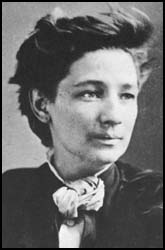
Victoria C. Woodhull

While Victoria California Woodhull’s endeavors did not all end successfully, she was very successful at laying a foundation for women to build on in business and politics.

Woodhull’s childhood was unstable.  Her family was poor, and love seemed to be a commodity her parents, Roxanna and Reuben Buckman Claflin, couldn’t afford.  The best way Claflin knew to deal with his ten children was to beat them.  Ironically, he had acquired wealth through real estate speculations, but lost everything when Victoria, the seventh child, was three.  Roxanna was born into money, the heiress of a rich Pennsylvania German family.  Being waited on hand and foot limited her motivation, and she never became literate or gained any ability to fend for herself.   

Woodhull’s formal education copied her mother’s.  She only spent a few years in school because she was pressed upon to help out so much at home, being treated almost like a slave.  Woodhull missed going to school and was an excellent student, but she acquired knowledge from other sources.

 BEING GUIDED BY THE SPIRIT                                                                              Woodhull believed in angels and lived with them as friends.  Every day she went into a trance and communicated with them, often sitting on the roof of the house for hours to escape the cruel, demanding life inside.  She had a simple faith in God, and took great comfort in relating to the angels and receiving channeled messages from them.  She credits these beings with giving her the ability to retain everything she read.

The angels were not imaginary beings but the spirits of people close to Woodhull.  When she was three, her nurse died suddenly.  Woodhull clearly remembered joining the nurse on her journey to the spirit world, being carried there by her.  Her mother recounted that her daughter’s body lay immobile, as if she were dead, for the three hours of this experience.  Woodhull also lost two sisters who died in childhood, and they became invisible playmates to her.  She also claimed to receive a prophecy from a spirit who confirmed that she would one day be a writer and publisher and leader of her people.

THIRD TIME’S A CHARM                                                                                           On the way to fulfilling her destiny, Woodhull married at age 14.  Her husband was 28, and it was not a happy union.  For two years she had become increasingly sick with the fever, and eventually Dr. Canning Woodhull was called to treat her.  When she recovered, he escorted Woodhull to a picnic and on the way home proposed marriage. This terrified her but her parents accepted the offer, and four months later they were married.  Dr. Woodhull’s fidelity lasted two days before he resumed his life as a philanderer and a drunk who lived beyond his means.

Within two years they had a baby boy, and it was born developmentally disabled.  Woodhull and the baby returned to her family and she earned her living with her clairvoyance and wisely invested her money. Then she had a healthy baby girl by another drunken philanderer.

Woodhull finally met her soul mate in Col. James H. Blood, a loving and compassionate man who was also a Spiritualist.  They were married spiritually if not legally, and Woodhull retained the name she was known by.  When Woodhull would go into a trance and channel the messages of the angels, Blood would diligently write down every word.

GOING WHERE NO WOMEN HAD GONE BEFORE                                          In 1869 Woodhull turned her attention to business and with her sister, Tennie, became the first female brokers on Wall Street when they established Woodhull, Claflin & Company.  They were supported partly by Woodhull’s investments and the respect and deep pockets of Cornelius Vanderbilt, who appreciated Woodhull’s clairvoyant abilities.  The sisters did not participate in the daily operations of the company, but they were nevertheless mocked in the press for being women in influential positions in finance.

The following year, these entrepreneurs started a journal called Woodhull & Claflin’s Weekly which became a platform for their views on politics, finance and women’s issues.  If they weren’t controversial before, they were now.  Their opinions varied widely from the mainstream, and no topic was off limits.  They advocated the elimination of the gold standard, graduated income tax, legalized prostitution, spiritualism and vegetarianism.  They promoted women’s rights including sex education and “free love.” Woodhull believed in monogamy, but also that a woman retained the right to determine with whom she had sex.  And, contrary to the social mores of the time, she strongly defended a woman’s right to leave a bad marriage.  Woodhull quickly became a leader in the women’s suffrage movement preaching equality, freedom of choice, and the right to vote.  

IT’S AN HONOR TO BE NOMINATED                                                                 In 1871 Woodhull received a message from the same spirit that had earlier predicted her future, telling her to run for President.  Her husband dismissed the notion as ridiculous, and the friends that she consulted laughed at her.  But, the idea grew on her, and she trusted her spirit’s guidance. She announced her intention to run, and in June 1872, she was officially nominated as the candidate to represent the newly created Equal Rights Party.  Frederick Douglas, a former slave, was nominated as her running mate, but he did not accept. Woodhull’s platform was to advance women’s political equality with men. She received support from trade unions, socialists and women’s rights advocates, but some of her ideas were so radical that more conservative suffragists like Susan B. Anthony would not support her.

Woodhull’s nomination was controversial not only because of her gender, but the legality of it was suspect.  Technically she was ineligible because she wouldn’t be 35 years old, as mandated by the Constitution, until six months after the inauguration.  However, since Ohio, her birth state, didn’t require birth certificates until 1867, Woodhull’s age couldn’t be confirmed.  Also, the 19th Amendment giving women the right to vote wasn’t ratified until 1920, which implied that a woman couldn’t run for President either.  And some believed that because she was a woman she was not a citizen, also a requirement for President.

Ulysses S. Grant easily won reelection, leaving Woodhull’s destiny unfulfilled.  In 1876 she divorced Colonel Blood and a few months later moved to England with her children.  She earned her living on the lecture circuit.  Wealthy banker John Biddulph Martin attended one of her talks and ended up becoming Woodhull’s third husband when she was 45 years old.  This time she assumed his name.  As Victoria Woodhull Martin, she and her daughter published a magazine called the Humanitarian until she was widowed.   She died in England on June 9, 1927.

QUESTION:  What are the best and worst things about being President of the United States?

© 2010 Debbie Foulkes All Rights Reserved

Sources:

http://www.victoria-woodhull.com/tiltonbio.htm

http://en.wikipedia.org/wiki/Victoria_Woodhull

http://en.wikipedia.org/wiki/United_States_presidential_election,_1872

http://www.spartacus.schoolnet.co.uk/USAWwoodhullV.htm

http://ocp.hul.harvard.edu/ww/people_woodhull.html