forgottennewsmakers

Archive for the ‘Biography’ Category

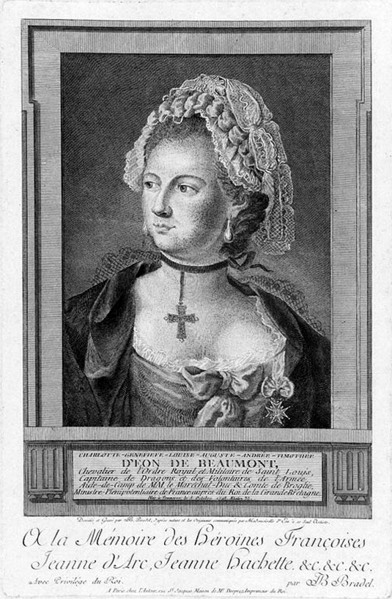
CHARLES-GENEVIÈVE- LOUIS-AUGUSTE-ANDRÉ-TIMOTHEE d’ÉON de BEAUMONT (1728 –1810) Cross-dressing French Spy

In Biography, French History, French-English Diplomacy, History, People, Transvestites, Trivia on July 6, 2010 at 1:27 PM

Engraving of the Chevalier d'Eon Dressed as a Woman

Charles d’Éon’s life was full of deception.  Was he a spy or a diplomat?  Was he a man or a woman?  The answer to both questions is oui.

To all appearances, d’Éon’s childhood was normal.  He was bookish with lots of friends.  He loved languages, excelled at memorization and received a law degree at age 21.  In his first jobs he had the time and opportunity to do what he loved. His uncle got him work in a finance office where he wrote his first book on French government finances.  Then he became a royal censor where he got paid well to read books.

KEEPING SECRETS                King Louis XV created the Secret du Roi (King’s Secret), a network of spies acting outside the purview of the government and accountable directly to the King.  When d’Éon entered politics in his 20s, he joined the Secret, and his first assignment was in Russia as the assistant to the chargé d’affaires for the Foreign Minister. Empress Elizabeth was looking for a private tutor and secretary, but she would only take a woman into her inner circle.  It was believed that d’Éon had been born a girl and forced into the identity of a boy by his parents.  That and his many other skills made him the perfect person to befriend the Empress. D’Éon reluctantly accepted the assignment, living a dual identity. 

During the Seven Years War, d’Éon joined the army to enhance his reputation and advance his career. He was commissioned as captain in the elite brigade, the Dragoons. D’Éon fought in one campaign and sustained wounds in his head and thigh.  His service and sacrifice were rewarded with the Cross of Saint-Louis.  This recognition raised d’Éon to a noble rank giving him the title of Chevalier.

D’Éon proved himself to be a brave and respected soldier, but his skills as a diplomat were needed again.  He was sent to London as a member of a team to negotiate peace with England.  After the treaty was signed, there was an opening for ambassador.  When he was 35 years old, D’Éon was appointed as interim ambassador.

The treaty was a political and financial disaster for France.  King Louis XV, unbeknownst to his ministers, wanted to rectify the situation by invading England, and members of the Secret were tasked with finding ways to facilitate that.  Again d’Éon had a dual role to fulfill, as temporary ambassador officially representing the government and as a clandestine member of the Secret. 

ABUSE OF POWER                      Three months after his appointment, d’Éon’s rising star started falling fast, putting his career and life in jeopardy.  It seems that he took his position and influence a little too seriously.  Since he came from the Burgundy region of France, wine was a passion and a means of influence.  He lavishly entertained with bottles he’d imported to England at the French government’s expense.  One invoice indicates that d’Éon received 2,800 bottles in one shipment. Then he had the audacity to ask his superiors to advance him money as his personal finances were also a mess. D’Éon was quickly becoming more of a liability than an asset.

When the new ambassador arrived in England, d’Éon was to be demoted to Secretary to the Ambassador, a decision that he aggressively fought.  He wrote scathing letters to his superiors and directly confronted the French foreign minister.  His impudence was alarming, and it was feared that the Secret’s mission would be compromised. 

Upon arrival of the new ambassador, the foreign minister ordered d’Éon back to France, twice. Both times d’Éon refused to comply because the order had not come directly from the King.  In retaliation, d’Éon published all his private letters and papers except those concerning the plans of the Secret. This breach of diplomatic etiquette put the French government in a very difficult situation, especially since the British foreign minister refused to respect an order of extradition because d’Éon had not broken any British laws. 

D’Éon came around to the possibility of returning to France provided several specific conditions were met.  The ultimate compromise was that he could remain in London as a private citizen.  He had generated such valuable contacts, however, that he remained an active member of the Secret.

WHAT ARE THE ODDS           For reasons not fully understood, in 1770 rumors about d’Éon’s gender started spreading throughout the business and political societies of London.  One newspaper claimed as fact that d’Éon was a woman. It became such a hot topic that businessmen were placing bets with the odds at 3:2 that d’Éon was a man. 

D’Éon was very upset by this widespread speculation of such a personal matter, and because he refused to reveal his sex, he became increasingly concerned about his security.  He went into hiding for six weeks and then spent much of the next six years at a friend’s country estate.  By now people on both sides of the channel fully believed that d’Éon was a woman who had been dressing as a man, but he figured out how to use that to his advantage.

CLOTHES MAKE THE MAN   D’Éon knew his political career was at a dead end, and he wanted to return to France.  Louis XV had died, and Louis XVI disbanded the Secret, recognizing it and its mission for the bad political strategy that it was.  D’Éon saw the handwriting on the wall and started negotiating with the King for safe return to France, one of his points being that now he wanted to be recognized as a woman. In order to save the French government embarrassment, d’Éon had to justify his female to male transvestism. His back story explained that his mother was a noble and his father had squandered her dowry, sending the family into debt.  Her family would give them a large inheritance if she had a son.  D’Éon was born a girl but was immediately dressed and treated as a boy to fulfill this requirement. In the creation of this mythical background, d’Éon intimated that the cross-dressing position in Empress Elizabeth’s court was fabricated.

An agreement was reached between d’Éon and King Louis XVI allowing d’Éon to retain the military honors he’d achieved as a man. The King insisted, however, that d’Éon dress and act like a woman.  He acquiesced and in 1779 she became the Chevalière d’Éon and returned to her homeland, spending the next six years living with her mom.  During this time she converted from Catholicism to being a devout Christian, putting her faith in Christ and becoming a devotee of Jansenism.

APPEARANCES ARE DECEIVING   In 1785, d’Éon returned to England and moved in with a widow, Mrs. Cole, depending largely on her for financial support. Although her declining health confined her to the apartment, and often her bed, d’Éon wrote her autobiography which was never published.

D’Éon died in 1810.  As Mrs. Cole was preparing the body for visitation, she was stunned to discover that d’Éon was a man.  She had a professor of anatomy, two surgeons, a lawyer and a journalist all examine the body to determine and report on d’Éon’s true gender.  It was concluded that d’Éon was not female or a hermaphrodite, but the he was a male who had lived half of his life as a woman.

Question:  Do you use clothes to express who you are?  How do your clothes reveal your identity?

©2010 Debbie Foulkes All Rights Reserved

Sources:

Kates, Gary. Monsieur d’Eon Is a Woman. New York: Basic Books, 1995.
http://www.kirjasto.sci.fi/deon.htm

http://en.wikipedia.org/wiki/Chevalier_d’Eon

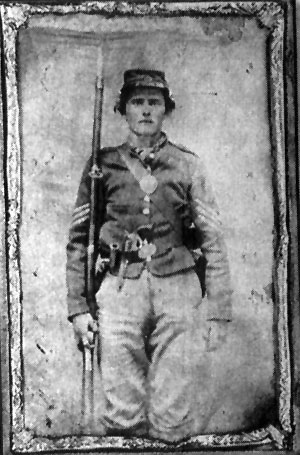
SARAH ROSETTA WAKEMAN (1843 – 1864) Female Soldier in the Civil War

In American History, Biography, Civil War, Female Soldiers, Feminists, History, People, Trivia, U.S. Army, Uncategorized, women on June 28, 2010 at 9:24 PM

Female Soldier in the Civil War

The lyrics to the Four Seasons’ song “Walk like a man. Talk like a man,” would have been good advice for Sarah Rosetta Wakeman.  Since she was a girl, she didn’t come by that naturally.  But learning how to do just that gave her a purpose and an adventure way beyond the family farm in Chenango County, New York.

By the time Wakeman was 17 years old, she had had some schooling, but  it was necessary for her to work as a domestic to help support her eight younger siblings and help her father pay off his debts.  Her future wasn’t looking too bright, so she decided that dressing like a man would increase her options.

When she was 19 she donned her disguise and worked as a coal handler on a barge on the Chenango Canal.  For four trips, she made $20.  At the end of her first trip she met some soldiers who tried to recruit her to sign up with the 153rd Regiment, New York State Volunteers.  She had three more river trips to think about it and decided that the $152 signing bonus for enlisting was too tempting. 

 PRIVATE LIVES                                                                                                            Wakeman changed her first name to Lyons and lied about her age, instantly maturing to 21 years old.  The rest of the information on her regimental descriptive roll was true: five feet tall with a fair complexion, brown hair, blue eyes and the occupation of “boatman.”  Wakeman’s gender was probably accepted at face value because of the cursory physical examination soldiers were given at the time of enlistment, often nothing more than a firm handshake.  Since there were a lot of pre-adolescent boys that edged their way into both the Confederate and Federal forces, it wasn’t unusual to have beardless recruits with higher pitched voices.

In corresponding with her family, Wakeman initially signed her letters “Rosetta,” confident her secret would not be detected.  She described army life and inquired about life back home.  She promised her father she would send money from her $13 a month salary for him to buy food and clothes for the family.  Unfortunately, she had to explain later that she had naively lent it to the first lieutenant and sergeant and received a promissory note in return for the whole amount including interest.  She sheepishly admitted that she had been taken advantage of by these officers and that she had learned her lesson. 

About three months into her military career, Wakeman got the measles and was hospitalized for seven days.  There didn’t seem to be any lasting effects of the disease, and she often expressed how much she enjoyed being a soldier, in contrast to her life on the farm. She had good clothes, enough food and no responsibilities except to handle a gun.

 AN EASY JOB                                                                                                                          In July 1863, the 153rd Regiment moved from Alexandria, Virginia to Washington, D.C.  to help protect the capital against potential riots in connection with the newly instituted draft.  Wakeman appreciated the spacious barracks, the well water for drinking and the salty river water for bathing.  She complained that Colonel Edwin Davis was so strict that the soldiers were hoping to be sent to the front lines, away from his command.

A month later, Wakeman was assigned to guard the prison that housed Rebel prisoners and officers.  With easy duty and a comfortable environment, she felt invincible.  She didn’t believe it was possible for her to die in battle, but if that was God’s will, she would submit to it.  She reminded her parents that she was “as independent as a hog on ice.”

In October, Wakeman reported that her days were filled with drilling exercises: company drill in the morning and battalion drill in the afternoon.  She enjoyed doing them and was proud that she could drill as well as any man in her regiment, and definitely better than the soldier in Company C who fell down, got a bayonet in his leg and “bled like a stuck hog.”

Home was feeling increasingly distant, and Wakeman stopped believing she would ever see her family again.  This spurred a confession that she had sinfully given in to lots of temptations in the army.  She admitted to getting into one fight, and after Stephen Wiley hit her, she gave him three or four good punches in return, putting him in his place.  God’s spirit had since worked in her, she believed, and she prayed that she wouldn’t go astray again.

FIGHTING THE ENEMY                                                                                              With the new year came new orders, and finally the 153rd was going to see some action.  They left Washington on February 18, 1864 and marched to Alexandria, Virginia.  From Alexandria they continued on to New Orleans, finally settling at Camp Franklin in Algiers, Louisiana, just across the Mississippi River. 

Wakeman’s regiment fell under the command of Major General Nathaniel P. Banks.  His mission was to establish a strong Union presence in Texas, and he planned to follow the Red River north to Shreveport, near the Texas border.  An order went out saying that no women (nurses, laundresses, officers’ wives, etc.) would be allowed to accompany the command except by written authority from Headquarters. The commanding officers still had no idea that at least one member of the rank and file was in direct defiance of that order.

Wakeman’s group marched 16 days, over 300 miles, making stops to unload supplies.  When they encountered Confederate forces lying in wait, the two-day Battle of Pleasant Hill ensued.  On the second day, Wakeman was in the front lines under fire for four hours, until the fighting was halted by darkness. She spent the entire night lying on the battle field listening to the cries of the wounded and dying. 

Wakeman’s life was spared, but the Federal troops were still in danger.  On April 21, 1864, General Banks ordered a forced march totaling over 100 miles back to Alexandria with the enemy on their tails.  Two days into the march, Wakeman’s brigade was ordered to lie along the river and wait for the opportunity to attack Confederate forces.  As the enemy came closer and surrounded them, the only way out was to fight. Wakeman’s group charged the enemy and defeated them.  The next morning, the regiment continued back to Alexandria only to get lost in the woods.  Exhausted, they finally arrived there on April 25. 

Wakeman had proven herself a worthy soldier, but her prediction about not coming home came true.  She was admitted to the hospital on May 3 with chronic diarrhea, the most deadly disease of the Civil War.  She was sent to the Marine U.S.A. General Hospital in New Orleans on May 7 but didn’t arrive until May 22.  Thanks to a Rebel attack which destroyed river transportation downstream of Alexandria, access on the Mississippi River was shut off for over a week.  Wakeman was 21 years old when she died one month later on June 19.  There is no record of any hospital staff discovering her real identity, and she was given a soldier’s burial in New Orleans.

QUESTION:  In today’s society, is it easier to be a man or a woman?  Why?

©2010 Debbie Foulkes All Rights Reserved

Sources:

Wakeman, Sarah Rosetta (Lauren Cook Burgess, ed.).  An Uncommon Soldier: The Civil War Letters of Sarah Rosetta Wakeman, alias Pvt. Lyons Wakeman, 153rd Regiment, New York State Volunteers, 1862-1864.  Pasadena, Maryland: The Minerva Center, 1994.

WILLIAM PRICE (1800 – 1893) Performed the First Legal Cremation in Britain

In Biography, Cremation, People from Wales, Trivia on June 21, 2010 at 9:36 PM

Dr. William Price

Like everyone, William Price came into this world naked. Unlike everyone, that’s how he walked around the hills near his home in Wales. If that wasn’t enough to irritate the clergy and the neighbors, the echo of his voice reading poetry aloud gave them more than enough to gripe about. And those weren’t his only irksome idiosyncrasies.

Price’s father was an Anglican priest, but he never earned his living from the ministry. Perhaps this gave William Price senior the courage to defy authority in his own way, by marrying his love, Price’s mother. By doing so, he was forced to forfeit a college fellowship since it required celibacy.

Defiance seemed to run in their genes. Father taught son to speak exclusively Welsh, but junior also became fluent in English and conversational in Latin and several other languages. Price didn’t start school until he was ten, but at age 13 he was pursuing a curiosity and studied privately with an apothecary.

When Price was 20 he refused to follow his family’s advice to be a teacher and went to London to study medicine. He began his practice at an iron works back in Wales. He became very sympathetic to the workers who were forced to endure dangerous conditions for very low wages. As a result he became a Chartist. Chartism was a movement that sprang from the working class in Britain. Members advocated election reform and social change. At this time, it was wrong for a Christian to participate in political matters as it meant being too involved with worldly affairs.

Price had already proven himself disloyal to the Church, and he was involved in the Newport Rising in 1839, a march demanding release of Chartists who were imprisoned. The leaders of the march were charged with treason and sentenced to hanging. Price fled to Paris to escape a similar fate. There he became a practitioner of Druidism, a mystical philosophy believing nature is sacred, and a self appointed archdruid.

THE DOCTOR IS IN                                                                                                          When Price returned to Wales he resumed his medical practice, which was as controversial as he was. He believed in preventing illness with a vegetarian diet, exercise and fresh air. He had contempt for other doctors who he claimed only treated symptoms, and he refused to treat patients who smoked. He also was opposed to vaccinations.

Price’s diagnoses and treatments were also unconventional. He told one woman who complained of headaches that her hat was too heavy, and he counseled a farmer who was afflicted with stiffness to wash away accumulated grime. Price’s prescriptions were herbal medicine aimed at treating the causes of illness along with some druidic chanting. He was known as a brilliant surgeon but rarely performed operations. Often he treated his patients for free, only accepting payment if they confirmed being cured.

The doctor’s personal eccentricities continued to be worthy of gossip. When he did clothe himself, his typical outfit consisted of bright red trousers and a red shirt. He wore a fox-skin headdress with the legs and tail hanging down past his shoulders and the fox’s head resting on top of his white hair. His beard was over a foot long. He refused to wear socks believing they were unhygienic. He washed every coin he was given. Again parting ways with Christian doctrine, Price advocated free love and was against marriage because he believed it was a form of enslavement for women. As a druid he was also against burying the dead, convinced that a decaying body polluted the environment.

PRACTICING WHAT HE PREACHED                                                                   Price was a man who lived by his beliefs. When he was 80 years old, he took up with his housekeeper, Gwenllian Llewellyn, who was 60 years his junior. Three years later they had a son. This was Price’s second child; he had also fathered an older daughter. Perhaps out of pure defiance, he named the son Jesus Christ.

At the age of five months, the son died. Price was determined to follow the druidic ritual of cremation even though it was illegal in Britain. He prepared his son’s body, wrapped it in linen, put it in a casket and set it on top of a pyre. The authorities didn’t appreciate this contempt, snatched the child’s body off the growing flames and arrested Price for illegally disposing of a body while his neighbors threw stones at his house.

Wearing his habitual costume accessorized by a tartan shawl, Price defended himself in court. He asserted that burial was a waste of good land, polluted the earth, water and air and presented a danger to living creatures. The judge bought his argument and ruled in his favor, declaring that cremation was not illegal if it wasn’t a public nuisance. Since Price had cremated his son on his own property, he was acquitted. This was the precedent ruling that led to the 1902 Cremation Act that finally made cremation legal in Britain. Price was then free to cremate his son’s body properly.

In 1884 Price, aged 84, and Llewellyn had another son which they also named Jesus Christ. Three years later they had a girl, Penelopen Elizabeth. Both children survived.

WHAT A WAY TO GO                                                                                                        Price wrote into his will in 1891 that his body should be cremated. He specified that he be put upright in his uncle’s old chair and placed on top of a cord of wood and two tons of coal. He wanted to be cremated at noon and have his ashes scattered to help grow grass and flowers.

In 1892 Price fell from a carriage when the horse slipped on ice, but he recovered from his injuries. One year later, however, he took a turn for the worse and died. His habitual drink was cider, but on his death bed, when presented with his favorite beverage, he spoke his last words, “Give me champagne!”

Price’s family sold tickets to his cremation, and it is estimated that a crowd of 20,000 witnessed the ritual. Because Price was such a controversial, eccentric personality, when the fire was exhausted, attendees picked through the ashes for souvenirs.

QUESTION: Do you think it is more important to do things to fit in or to express your individuality?

© 2010 Debbie Foulkes All Rights Reserved

Sources:

http://www.billgreenwell.com/lost_lives/index.php?key_id=590

http://www.theage.com.au/articles/2002/09/15/1032054710047.html?oneclick=true

http://www.statemaster.com/encyclopedia/William-Price-(doctor)

http://www.worldwidewales.tv/html/movie-46.php

http://en.wikipedia.org/wiki/Chartism

http://en.wikipedia.org/wiki/Newport_Rising

http://www.reference.com/browse/druidism