forgottennewsmakers

Archive for the ‘Biography’ Category

JUAN BELMONTE (1892 – 1962) Spanish Bullfighter

In Biography, Bullfighting, Matadors, Spanish History, Sports, Uncategorized on August 24, 2010 at 9:55 PM


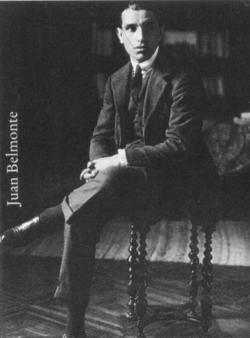
Juan Belmonte

The legs Juan Belmonte was born with were weak and deformed, not at all appropriate for a sport where you come face to face with an angry beast.  But instead of backing away from his one dream in life, to be a bullfighter, he invented a new technique for a torero* and was considered by many to be the “greatest matador of all time.” 

Belmonte was a rambunctious child who hung out with a gang of mischief makers.  On a dare, he climbed a wall in order to touch the exposed breasts of a statue, and fell off, cracking his head open.  His punishment was to have to go to school, which he did from ages four to eight.  In that short time he became literate, but it was a struggle.  

The young boy’s education continued outside the classroom.  As the oldest of eleven children, Belmonte was expected to help his father in the shop, but his shy, insecure personality was no match for the hagglers who bargained down the prices. His dad berated him for losing money the family desperately needed, but he also took some responsibility for his son’s maturity.  Every day until he was eleven, Belmonte went with his dad to the café and observed the other men, learning from them how a man with self esteem behaves.  From hanging out in the streets with his buddies he learned to smoke, drink, play cards and be with women.  

One group of Belmonte’s friends owned a printing press, and their love of cheap detective novels rubbed off on him.  He could read well enough to keep up with them, and the group would dramatically act out the stories.  This began his life-long passion for reading.  

GETTING AN EARLY START          Belmonte’s fascination with bulls started when he was a toddler.  While his family was dining in a restaurant, he wandered outside to a pen that had several calves.  He tried get a stubborn one to charge and was disappointed when the animal didn’t respond.   As he got a little older, he started playing around with a cape and found that it gave him the confidence that he lacked naturally.    

Bullfighting soon became a way to avoid working. He was easily tempted by his pals to go out to the country and find bulls to practice with.  After a while they had to go out on moonless nights so they wouldn’t be caught by the Guardia Civil patrolling the pastures and corrals.  The first time he found himself at the mercy of a bull, Belmonte was sporting the new suit his family bought him for Holy Week.    There was a lone bull in a ring, and Belmonte jumped in with it, even though he couldn’t see where it was.  He managed to lead the animal through two successful passes, but on the third one the bull hit him and threw him into the air.  The rookie tried to find the fence to escape, but the bull sent him airborne again.  The third time the bull made contact, Belmonte was sent flying, and he hit the fence on the way down, managing to crawl away.  For him, being knocked around by the bull was not nearly as bad as ruining his new suit. 

TURNING PRO                                           Belmonte’s first contract to fight was as a last minute substitute under a different name.  The posters were already printed with the name Montes II.  By the time he rented his costume and paid his banderillero, there was no money left for him.    

The technique Belmonte developed was contrary to every other torero, and to common sense. Because of his weak legs, he planted himself and forced the bull to go around him instead of moving away from the bull as it made its pass.  The bulls would go by so close that there would be hairs  stuck on Belmonte’s jacket.  

HIS FIRST KILL                                       In July 1910, Belmonte made his first kill.  All was going well, and he was ready for the final moment.  With the muleta in his left hand and the sword in his right, the torero cited the bull.  It passed so close that the horn went into the fighter’s forehead and ripped his eyebrow.  With blood blinding his vision, Belmonte reacted with a frenzied anger.  He pulled the dangling flap up skin back up to his forehead, instinctively got into position and thrust the sword into the animal’s neck.  When the bull started sinking to the ground, he knew he had made a perfect hit, and the crowd exploded with their approval.  Since he was the only bullfighter on the program that day, he was taken to the infirmary for some slap-dash surgery.  The doctor sterilized the wound by drinking some mineral water, mixing it with saliva and spitting it onto the fighter’s face.  After a few rough stitches, Belmonte took to the ring for his second bull, with considerably less luck.  

Belmonte could finally call himself a matador, the term for the bullfighter who kills the bull. His star was rising until an affair with a married woman became a total distraction.  He was used to casual relationships with fawning ladies, but now a lack of sleep and improper diet left him emotionally and physically unfit to face a bull. During a corrida before a demanding crowd in his native Seville, he got two warnings for a bad performance with the first bull.  When he tried to kill the second bull he couldn’t make contact, and in a fit of exhaustion screamed at the bull to just kill him.  Belmonte was removed from the ring in humiliation which led to his first retirement.  He worked as a day laborer until he could regain his passion practicing at night in the moonlit pastures, naked. 

By 1917, Belmonte’s reputation was firmly rooted in his success, although his career was not without injuries.  He was gored in the thigh numerous times and wounded in the chest at least once.  He often defied the odds and physical pain, always fighting two or three bulls during every corrida, and sometimes fighting every day, leaving little time to recover. But to Belmonte bullfighting was a spiritual practice, and strength of spirit was more important than physical strength.   He got invitations to fight in Mexico, Cuba and South America, and whenever he traveled he brought a trunk full of books with him. 

In Lima, Peru he met a woman at a party and fell in love.  He brought her back to Spain with him, where they were to get married.  Belmonte never stopped being shy and hated any kind of ceremony.  While he was fighting in Venezuela he arranged to be married by proxy.  

NEVER GONNA GIVE IT UP             In 1919 Belmonte was at his peak.  He was in 109 corridas and killed 234 bulls, a record he held until 1965.  He earned about $9,000 for an afternoon of battling two bulls. The following year he could feel his passion waning, and he took some time off when his professional rival and close friend, Joselito, died in the ring.  After ten years of his career, he could finally buy a ranch he called La Capitana.  He spent some down time there but got bored and started fighting again.  

During the season of 1927 he was forced to seriously consider retirement after spending a month in the hospital.   He lived on the ranch full time, farming, reading and fighting in a few charity events.  He came out of retirement again in 1934 and was gored 14 times.  In 1935, a bull split his collarbone, but he pulled himself together to fulfill his contractual obligations.  

Back at La Capitana, Belmonte enjoyed years of sparing with his own bulls, teaching future bullfighters and hanging out at the local bars.  In 1961 his weak health turned into a severe heart condition.  The following spring, the doctor told him to stop all his activities including riding his beloved horse.  He decided he would rather die.  In April 1962, he took one last ride around the property then locked himself in his study and shot himself in the head. 

 Videos of Juan Belmonte fighting bulls:  http://www.youtube.com/watch?v=QJ681LYgcOE 

 http://www.youtube.com/watch?v=bZZFDQYC-8Y 

torero – a bullfighter 

    matador – a bullfighter who has killed a bull 

    corrida – a bullfight where one or two matadors each fight two or three bulls in an afternoon 

    muleta – a oval cape on a stick used in the last part of the bullfight leading up to the killing of the bull 

    banderillero – a matador’s assistant who places colorful darts in the bull 

 QUESTION:  What’s something that you have become good at because you didn’t give up? 

©2010 Debbie Foulkes All Right Reserved 

Sources: 

Belmonte, Juan and Nogales, Manuel Chaves, Juan Belmonte, Killer of Bulls. New York: Doubleday, Doran & Company, Inc., 1937. 

http://www.time.com/time/magazine/article/0,9171,873563,00.html 

http://sportsillustrated.cnn.com/vault/article/magazine/MAG1073716/index.htm 
http://en.wikipedia.org/wiki/Juan_Belmonte 

http://www.time.com/time/covers/0,16641,19250105,00.html

MARY SEACOLE (1805 – 1881) Nurse and Businesswoman

In Biography, Crimean War, Entrepreneurs, Feminists, Florence Nightingale, History, Nurses, People, People from England, Trivia, Woman on August 16, 2010 at 10:37 AM


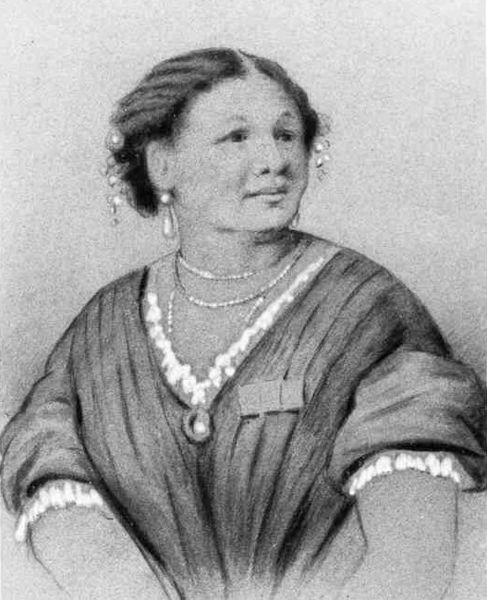
Mary Seacole in watercolor at about 45 years old

Mary Seacole believed that when someone wants to minister to the needs of others, she should be able to do so without interference.  So when she was headed to Crimea during the war to help Florence Nightingale nurse sick and wounded soldiers, she was determined not to let racism deter her from her mission. 

A native of Kingston, Jamaica, Mary Ann Grant’s father was a Scotch army officer. Her mother was a local healer who owned a boarding house and treated military officers and their families.  That didn’t seem to be a place for a child, so Seacole lived with an older lady and her grandchildren.  She often hung out with her mom, however, and played doctor with her dolls and the neighborhood pets. 

When her nanny died in her arms, Seacole moved back in with her mother and learned her Creole medicine techniques.  As her life unfolded, it’s evident that Seacole derived her greatest inspiration from that relationship.

Seacole remained single until she was 31 years old when she married Edwin Seacole, a Brit.  They opened a store in Black River, Jamaica, but after eight years of marriage they had to move back to Kingston for Edwin’s health.  He died one month after their return.  To compound Seacole’s grief, her mom died, and she assumed responsibility for the hotel, using work to cope with her loneliness.

Seacole’s stubbornness was one of her best and worst qualities.  In 1843 there was a devastating fire in Kingston which burned down Seacole’s house.  Defending it almost cost her her life because she didn’t leave until it was in flames.  She rebuilt and continued to live alone despite many potential suitors.  A cholera outbreak in 1850 gave her the opportunity to practice the healing skills she had learned.

FOLLOWING IN HER MOTHER’S FOOTSTEPS       Finally needing a change, Seacole went to Cruces, Panama to visit her brother.  Her experience had prepared her well to deal with the cholera epidemic that hit shortly after she arrived.  The only medically trained person who lived in the area was a dentist, so it was left to Seacole to diagnose and treat the afflicted.  She did save many patients, but the number who died was still devastating.  The most difficult death for her to deal with was an infant who died in her arms.  Seacole snuck to the gravesite of the baby before it was buried and conducted her own autopsy in order to learn more about the disease. 

Seacole opened a restaurant where the Americans loved to hang out and drink copious amounts of tea and coffee.  She took her brother’s advice to add a spoonful of salt after the sixth cup to curtail their intake.  After a while she got bored and decided to return to Kingston.

She bought a ticket on an American steamer, but because she was Creole she was told to get off the ship.  This was the first time she personally experienced blatant racism.   In order to keep the peace, the captain gave Seacole her money back, and she agreed to get disembark.  Two days later she traveled home on an English ship.

DETOURS ON THE ROAD TO HER DREAMS           When she was 49 years old Seacole’s restless, adventuresome spirit took her to England, and she landed in London in 1854.  The Crimean War was young, and she wanted to contribute her talents.  She applied to the War Office to be a hospital nurse.  She was rejected and told to apply to the medical department.  That was also a dead end, so she changed her tack.  She craftily found out the address of the Secretary-at-War, went to his house and waited patiently to speak to him.  When he did deign to see her, the Secretary said there were no nursing positions available.  Finally, she applied to the managers of the Crimean Fund to do anything that would get her to the war zone.  Even that didn’t work.  The obvious racial prejudice with which she was treated made her even more determined.

Seacole had one more option.  She and Thomas Day, a relative of her husband, created a partnership, Seacole and Day.  They planned to open a store and hotel in the area near the military camps in Balaclava on the coast of the Crimea, a peninsula at the southern part of modern-day Ukraine.  

FULFILLING HER DESTINY                                         En route from England, Seacole’s ship had a layover in Scutari, Turkey for one night.  She needed a place to sleep and wanted to be of service as well.  Florence Nightingale worked at a hospital there.  Seacole had a letter of introduction from a friend in Kingston to give to Nightingale.  When she was finally ushered in to meet Nightingale, she was not exactly embraced as a colleague.  Nightingale suggested that the only available bed was next to the washerwoman.  Seacole and her roommate got along great and talked for hours.  The bed itself was less accommodating as it turned out to be a flea infested couch, and Seacole was eaten alive during the night. 

In Balaclava, Seacole and Day built the British Hotel which included an apartment for each of the partners, a general store and stables for the animals.  A war zone is a dangerous place even for civilians.  Thieves, led by the night watchman, stole 40 goats and seven sheep during one night, and dozens of horses, mules, pigs and chickens over time.  The rats were huge and one attacked a cook while she was sleeping.  But none of this deterred the proprietress from her purpose: to serve the British army.

“Mother Seacole” was not shy about going to the front lines if necessary to tend to wounded soldiers.  The allied army planned to attack the Russians  at Cathcart’s Hill.  Seacole made sandwiches, packed up food, drink and medical supplies and on horseback led a caravan of two pack mules up the hill to the camp three and a half miles away.  She cared for their physical needs in as many ways as possible.  Since water was in short supply, she had to wash her hands in sherry. When bullets whizzed by overhead, Seacole hugged the ground until she got the “all clear.”  Once when she was protecting herself, she dislocated her thumb, which she never bothered to set.   

Seacole didn’t discriminate when it came to helping the needy.  In addition to British soldiers, she helped French, Sardinians and even some Russians into ambulances so they could get proper medical treatment.  One Russian thanked her by taking off his ring and giving it to her as he was being lifted into the vehicle.

LIFE AFTER WAR                                                             It was both a positive and negative thing when the Crimean War ended in February 1856.  The area was evacuated so fast, that Seacole and Day lost all their business virtually overnight. Russians raided the British Hotel which made Seacole furious.  In a desperate act, she smashed the crates of wine, wasting it instead of letting the enemy enjoy their booty. 

Upon returning to England Seacole and Day were forced to declare bankruptcy, and the war finally took its toll on Seacole’s health.  Several prominent people contributed to funds to help Seacole and her partner become solvent.  She wrote her autobiography describing her adventures and raised enough money to get out of debt.  During the final years of her life she worked in London as a masseuse and confidant to members of the royal family.  Seacole died in 1881 with an estate of over £2,500.

QUESTION:  Have you ever been discriminated against?  How did you handle the situation?

©2010 Debbie Foulkes All Rights Reserved

Sources:

Seacole, Mary.  The Wonderful Adventures of Mrs. Seacole in Many Lands. http://www.gutenberg.org/ catalog/world/readfile?fk_files=588279

http://www.maryseacole.com/maryseacole/pages/aboutmary.html

http://en.wikipedia.org/wiki/File:March_to_Sevastopol_1854.png

http://en.wikipedia.org/wiki/Mary_Seacole

http://en.wikipedia.org/wiki/Crimean_War

GUTZON BORGLUM (1867-1941) Sculptor of Mount Rushmore

In American Artists, American History, American Presidents, Artists, Biography, Mt. Rushmore, People, Sculpture on August 3, 2010 at 1:11 PM

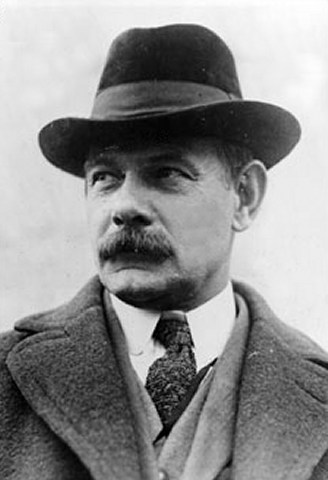
Gutzon Borglum

John Gutzon de la Mothe Borglum’s father, a Danish Mormon, was a bigamist.  He was married to Borglum’s mother and her sister.  Their life in Idaho and Utah was accommodating, but when they moved to Nebraska, Borglum’s dad decided to restructure his family to fit in better.   He divorced Borglum’s mom but stayed married to his aunt.  It’s hard to know how this influenced the young man, but as an adult he was very independent with an ego as big as a mountain.

When he was sixteen, the family moved to Los Angeles where Borglum started to express himself artistically.  He teacher was Elizabeth Jaynes Putnam, an accomplished painter who was 18 years older than her student.  Their relationship soon turned personal, and they were married in 1889 when Borglum was 22 years old. 

Borglum had great success early on, and his portrait of General John C. Fremont led to his first patron, Fremont’s wife, who introduced him to Leland Stanford and Theodore Roosevelt.

CARVING OUT A CAREER           When the Borglums went to Paris, he studied at the École des Beaux-Arts and the Académie Julian. Both he and his wife mounted successful exhibitions. The biggest artistic influence was his encounter with Auguste Rodin, and he abandoned painting for sculpture.  Since his brother Solon was a sculptor, sibling rivalry also could have been a factor in changing his medium. 

When Borglum and his wife returned to California the state was in a deep financial depression, and artists weren’t able to get commissions.  In 1896 they ventured to London where he had some of his art on display in Windsor Castle for Queen Victoria. 

As Borglum’s career started to out shine his wife’s, the marriage suffered.  He left Europe in 1901 alone to return to the United States.  Onboard the ship bound for America, Borglum met Mary Montgomery, a younger woman returning from Berlin.  She was one of the first two women to ever earn a doctorate in Berlin and had mastered six languages. He respected her intelligence and passion and the balance she brought to his life.  Finally, in 1909, Putnam granted Borglum a divorce and he and Montgomery were married.  The couple moved to Connecticut and settled on a farm they called “Borgland.”   Three years later a son, Lincoln, was born followed by a daughter, Mary Ellis.

Borglum grew increasingly famous as he developed his own style of “American” art. His sculpture Mares of Diomedes was a gold medal winner at the 1904 St. Louis Exposition, and it was the first sculpture by an American artist accepted at the Metropolitan Museum of Art.  His greatest notoriety came with a bust of Abraham Lincoln which was originally displayed in Theodore Roosevelt’s White House and is currently exhibited in the rotunda of the Capital building.

PLAYING POLITICS                       Art was not the only contribution Borglum made to American society.  He was outspoken about his political opinions and tried to wield some celebrity influence by campaigning for Roosevelt’s reelection in 1912.  During the Wilson administration Borglum, in a departure from his usual focus, investigated malpractices in aircraft manufacture and reported his findings directly to President Wilson.  Borglum and the president disagreed about how the artist became involved in such an investigation, and their dispute became public. Borglum was adamant that President Wilson specifically appointed him to the task and published letters in the New York Times defending his involvement.  The president, in letters to Borglum and the Secretary of War which the White House also released to the New York Times, tried to distance himself from Borglum appreciating his discoveries but apparently not wanting to be linked too closely to the man. 

MOVING A MOUNTAIN                It was Borglum’s bust of Lincoln that led to his first mountain carving.  He was invited by the Daughters of the Confederacy to carve a bust of Robert E. Lee in Stone Mountain, Georgia.  Upon visiting the site he declared that doing just the head of Lee would be as impressive as a postage stamp on a barn door.  Instead, he created a design of a more appropriate scale that incorporated Lee, Jefferson Davis and Stonewall Jackson on horseback in front of a row of soldiers.  He started carving the piece in 1923 with chisels and jackhammers until he learned the art of using dynamite for detail work from a Belgian engineer.   

Borglum joined the Ku Klux Klan while he was developing this project.  It’s not clear if he did it as an expression of his core beliefs or to patronize the backers. He was known to shun anyone who could not directly help him through money or influence.  Borglum’s artistic temperament clashed with the patrons and he was kicked off the job.  Another artist was hired to complete the monument, and ultimately none of Borglum’s work survived.  He did benefit from the work he did, however, by developing techniques he used on later projects.

BIGGER IS BETTER                       While Borglum was working on Stone Mountain, the state historian from South Dakota tempted him with the idea of creating a sculpture in the mountains of the Black Hills.  The sculptor saw the potential for more national recognition than the Georgia project afforded him, so he agreed to the challenge and uprooted his family, moving them to Keystone, South Dakota.  His original subjects were Washington and Lincoln.  The Louisiana Purchase by Jefferson and the acquisition Panama Canal by Roosevelt expanded the story of the monument to the Manifest Destiny of the United States, and those two profiles were added to the design.  Borglum began carving the mountain in 1927 when he was 60 years old. 

Borglum is responsible for creating the model and picking the site for the carving.  During the sculpting he was often more supervisory than hands-on.  He would climb all over the mountain to find the best angle for the features of each bust, often insisting on the accuracy of details that could not be seen from ground level.  

For long periods of time he turned the reigns over to his assistants, including his son Lincoln, while he traveled to Washington D.C. to get more funding or to Europe to work on other commissioned projects.  Whenever he returned to Mt. Rushmore, he would resume micromanaging the workers. 

BITING THE HAND THAT FED HIM      Again his artistic temperament got him into trouble.  John Boland was chairman of the Mt. Rushmore executive committee and responsible for all the finances on the project. He was both a friend and nemesis to Borglum.  When money became tight for the artist, it was Boland who guaranteed bank loans so he could keep his home.  On occasion, the businessman even kept Borglum afloat with a personal loan. 

But Borglum didn’t like being beholden to anyone.  He fired some of the best workers and frequently butted heads with Boland, always insisting on doing things his way. These clashes led to a rift in their relationship.  Eventually, however, their wives intervened and conspired to effect a successful reconciliation between the two men.

Borglum never got to see the Mt. Rushmore project completed.  He died in 1941 at the age of 74 from complications related to surgery.  His son, Lincoln, took charge, working one additional season, but the monument basically remained the way his father left it.

QUESTION:  What is your favorite kind of art?  Would you rather observe someone else’s art or make it yourself?

©2010 Debbie Foulkes All Rights Reserved

 Sources:

http://www.pbs.org/wgbh/amex/rushmore/peopleevents/p_gborglum.html

http://www.pbs.org/wgbh/amex/rushmore/peopleevents/p_mborglum.html

http://www.pbs.org/wgbh/amex/rushmore/peopleevents/p_boland.html

http://www.tfaoi.com/newsm1/n1m582.htm

http://encyclopedia.stateuniversity.com/pages/222/-John-Gutzon-de-la-Mothe-Borglum.html

http://www.nps.gov/moru/historyculture/upload/Sculptor%20Gutzon%20Borglum%20A.pdf

http://query.nytimes.com/mem/archive-free/pdf?_r=1&res=9C06E3D61F3FE433A25754C0A9639C946996D6CF