forgottennewsmakers

Archive for the ‘Biography’ Category

PAUL POPENOE (1888 -1979) First Marriage Counselor and Eugenicist

In American History, Biography, Doctors, People, Trivia on October 27, 2010 at 9:06 AM

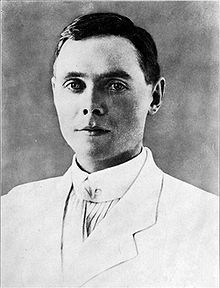
Paul Popenoe, age 27

In 1888, Paul Popenoe was the first of four children born in Topeka, Kansas.  When his parents moved the family to Pasadena, California, Popenoe found fertile ground for his seemingly disparate interests: growing date palms, eugenics, and marriage counseling.

The Victorian values of the late 19th century were embedded in Popenoe, but he took a progressive stance on many issues, making his life a contradiction.  He was a Sunday school teacher in his youth but later eschewed religion and became a secular humanist.  When he was 17, he fainted after eating a steak dinner and became a strict vegetarian long before that was popular.  But, true to his Victorian roots, he did not believe in any kind of sex outside of marriage, and he was a virgin on his wedding night.

About 1908, Popenoe dropped out of college after three years to work and care for his sick father.  After working as a newspaper editor for a few years, he quit his job and made a six-month tour of Europe.  Popenoe’s father worked as a nurseryman when he retired, so on his dad’s behalf, Popenoe learned Arabic, one of eight languages he knew, and traveled around the Middle East collecting date palms.  This lead to his first book, Date Growing in the New and Old Worlds, published in 1913, which became a manual for horticulturists.   

A CERTAIN KIND OF PEOPLE PERSON         Later that year, Popenoe moved to Washington D.C. to edit the new publication the Journal of Heredity. He idolized Charles Darwin and believed that improving humanity would happen by applying science to society.  His focus turned to heredity and eugenics, an extension of natural selection.  Eugenicists believe in improving the genetic makeup of the human population specifically by sterilizing people with genetic defects or undesirable traits, thereby keeping them from reproducing.  This was a very progressive point of view subscribed to by the intellectuals of the time, including Alexander Graham Bell, Margaret Sanger and Theodore Roosevelt.  Popenoe’s self study in a group of like-minded scientists and intellectuals eventually resulted in his book Applied Eugenics, published in 1918. 

During World War I, Popenoe was a captain in the vice and liquor section of the War Department Commission on Training Camp Activities.  He was responsible for eliminating liquor and prostitutes from around the army training camps, the perfect job for a teetotaler with his puritanical upbringing.  After the war he went to New York and worked as the Executive Secretary of the American Social Hygiene Association.  Their mission was to use public education to promote premarital abstinence, but they were broadminded enough to promote sex education and birth control. 

BECOMING HIS OWN CASE STUDY               It was while he was in New York that Popenoe married Betty Bowman, a dancer 13 years his junior, after a six month courtship.  The couple moved to Coachella Valley, California where Popenoe retreated to his first love and established a date farm until the agricultural market collapsed and forced them to move to back to Pasadena.

Popenoe’s lack of experience with women made his marriage rough going at first.  He was, however, determined to understand the unique world of women, and his efforts resulted in the book Modern Marriage, A Handbook for Men, published in 1925.  Fifteen years later he revised the book to include advice for women based on his personal and professional experience. 

Despite his lack of a college diploma, in 1929 Popenoe was awarded an honorary doctorate from Occidental College, where he had done two years of study twenty years earlier.  He used the title Dr. Popenoe professionally.

STAYING TRENDY                       The application of his philosophy of hereditarianism shifted with the tide of social thought, and he changed his focus from genetic improvement to family improvement.  In 1930 Popenoe founded the Institute of Family Relations (later the American Institute of Family Relations) in Los Angeles, bringing marriage and family counseling (a concept that started in Germany a decade earlier) to America.  He maintained that “…to improve the race, we should first start with the family.  And since the family often suffers problems which threaten its stability, we must treat those problems.  In other words, we should establish a marriage counseling center where maladjustments might be brought, studied, classified–and helped if possible.”1  Part of his counseling was to encourage fathers to take an active role in the lives of their children. 

In the ensuing decades, the Institute had up to 70 counselors and claimed in 1977 to have counseled over 300,000 men, women and children.  He required the counselors to be married and never divorced.  Even though Popenoe was not religious, in the 1960s and ‘70s many of his assistants were ministers and other religious people, including Dr. James D. Dobson, founder of Focus on the Family.  His office moved to Sunset Boulevard in Hollywood and Popenoe became the marriage counselor to the stars, although Lana Turner went to his house for her sessions to maintain privacy.

REACHING THE MASSES              Popenoe’s influence extended beyond the Institute.  He wrote a daily newspaper column called “Your Family and You,” and he counseled couples on a reality TV show called “Divorce Hearing.”  He was a popular lecturer on college campuses and wrote a total of 17 books and numerous popular and scientific articles on marriage relations.  Television host Art Linkletter asked Popenoe to help him create a way to successfully match men and women, a forerunner to today’s dating services.  Popenoe created a questionnaire of 32 items including race, religion, politics, and pets.  Over 4,000 people responded to a newspaper ad to be matched.  A Univac computer analyzed the surveys and picked a couple who were introduced to each other on Linkletter’s television show People Are Funny.  It was a good match, and the couple got married. 

In 1953 Popenoe started the advice column “Can This Marriage Be Saved” in the magazine the Ladies Home Journal, using actual case studies from the Institute in his articles.  Still a feature of the magazine, the column has been called “the most popular, most enduring women’s magazine feature in the world.”1

Popenoe’s own marriage was not without its challenges, but he practiced what he preached.  Within the relationship the duties fell along traditional gender lines: Popenoe worked and took care of the yard and Betty was a stay-at-home mom who raised four boys.  Their youngest son wrote that Popenoe was a strict disciplinarian who, despite a heavy work schedule, gave his children lots of attention.

In his 1926 book Conservation of the Family, Popenoe predicted what the family of the future would be like.  He expected better mate selection, greater understanding leading to a stronger permanence of love, more intelligent consideration of children, more concern for individual development, especially for women, and more democracy within the family structure.1

QUESTION:  What do you think makes a good marriage?

©2010 Debbie Foulkes All Rights Reserved

Sources:

1http://www.popenoe.com/PaulPopenoe.htm

http://ghr.nlm.nih.gov/glossary=eugenics

http://dictionary.reference.com/browse/eugenics

http://www.time.com/time/magazine/article/0,9171,867279,00.html

http://en.wikipedia.org/wiki/Paul_Popenoe

Popenoe, David, War Over the Family.  New Jersey: Transactions Publishers, 2005   http://books.google.com/books?id=FhZeJwLSu74C&pg=PA238&lpg=PA238&dq=obituary+paul+popenoe&source=bl&ots=iH3CDQf5Ut&sig=qWwi-eyeC2zp23l5EpqalGP91eg&hl=en&ei=GiLHTJOMAoyssAPKps2oDQ&sa=X&oi=book_result&ct=result&resnum=1&ved=0CBcQ6AEwADgK#v=onepage&q=obituary%20paul%20popenoe&f=false
SOPHIE BLANCHARD (1778 –1819) First Women to Fly Solo in a Hot Air Balloon

In adventure, Ballooning, Biography, Feminists, French History, People, Pilots, Uncategorized, women on September 15, 2010 at 9:34 AM

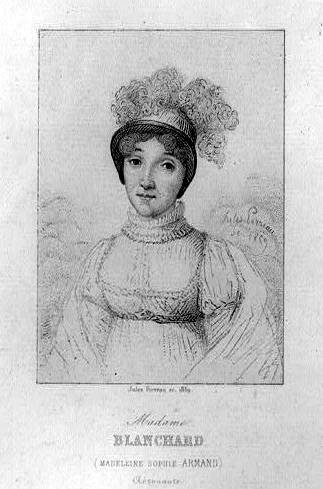
Sophie Blanchard

In the 1960s, The 5th Dimension sang, “Would you like to ride in my beautiful balloon?”  When Sophie Blanchard’s husband said that to her, she said, “Yes,” and they were Up, Up and Away.  Sophie felt most comfortable in the air, but what goes up must come down.

Marie Madeleine-Sophie Armant came to the world’s attention when she married Jean-Pierre Blanchard, an inventor and pioneer in French aviation, specifically ballooning.  Other than the fact that she was born to Protestant parents in western France, almost nothing is known about her young life.

Blanchard was about 16 years old when she married, 35 years younger than her husband, becoming his second wife.  She was described as a small, nervous woman who startled easily when she heard loud noises.  When she started flying with Jean-Pierre, she felt more at home in the quiet, peaceful sky than on terra firma.

TAKING TO THE SKIES                Blanchard made her first balloon ascent in 1804 with her husband as a stunt to raise money.  Even though Jean-Pierre was the world’s first professional balloonist and had made demonstration tours all over Europe, he wasn’t a very good businessman.  They hoped that having a woman in the basket would attract more fans.  Blanchard wasn’t the first woman to ride in a balloon.  Three other women had gone up in tethered balloons, and two women had previously gone up untethered, but seeing a woman aloft was still a novelty.

In 1809, Jean-Pierre was flying over The Hague when he had a heart attack and fell from his balloon.  He died from his injuries.  He had adopted the Latin phrase Sic itur ad astra (“Such is the path to the stars”) as his personal motto.  Blanchard decided to follow her husband’s path and became the first woman to fly solo in a balloon.

Blanchard still needed to pay off the debt left by her husband, so her balloon of choice was a hydrogen-filled gas balloon.  The benefits of using gas (instead of hot air) generally outweighed the risks.  She wouldn’t have to tend to a fire to keep the balloon airborne and, since she was a petite woman, she could use a small basket about the size of a chair and minimal gas to inflate the balloon.

WORTH THE RISK                          Even though ballooning had been popular for almost 30 years, the inherent dangers still made it a risky endeavor.  Blanchard passed out during several flights because of the high altitude, and she encountered freezing temperatures when she cruised at 12,000 feet.  In 1811, she had to stay airborne for over 14 hours to avoid a hail storm.  And sometimes landing was just as risky.  One time her balloon made a crash landing in a marsh, and she almost drowned.

Blanchard’s husband had experimented with parachutes, dropping dogs out of the basket to demonstrate floating down to earth safely.  One time when flying solo his balloon ruptured, and he was grateful for the parachute as his only way to escape.  None of Jean-Pierre’s mishaps deterred Blanchard from her own desire to be a pilot.  When she had the opportunity to fly solo, Blanchard also tested the flotation devices using dogs, but she never had the occasion to need one herself.  When she flew exhibitions at events, she spiced things up by attaching small baskets of fireworks to parachutes to light up the sky as they were falling.

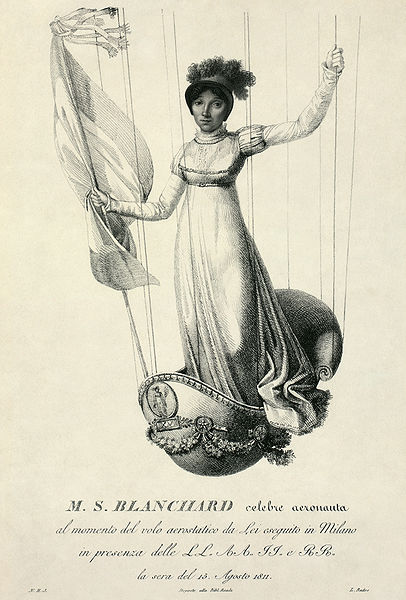
Engraving of Sophie Blanchard in 1811

GETTING OFFICIAL RECOGNITION      Napoleon was a big fan of Madame Blanchard, and he appointed her as the “Aeronaut of the Official Festivals,” making her responsible for organizing balloon demonstrations at official events.  In 1810, she flew over the Champs de Mars (today near the Eiffel Tower) in honor of Napoleon’s marriage to Marie-Louise of Austria.  To commemorate the birth of their son, Blanchard flew over Paris dropping announcements of the birth.  One year later, Blanchard made an ascent over the palace Château de Saint-Cloud during the official celebration of the boy’s baptism, and she set off fireworks from her balloon.  There’s speculation that she also devised plans with Napoleon to use hot air balloons for an aerial invasion of England, which were never carried out.

Blanchard’s popularity outlasted Napoleon’s rule.  When Louis XVIII returned to Paris in 1814 to regain the throne, she participated in the official procession, making her ascent from Pont Neuf.  King Louis was so impressed by her performance that he named her the “Official Aeronaut of the Restoration.”

Blanchard was also known throughout Europe, and large crowds came to watch her.  For the opening night of the opera in Frankfurt in 1810, she was allegedly responsible for a poor audience, as most of the city turned out to see her rather than attend the opera’s debut.

AN UNPLANNED DESCENT          In 1819, when Blanchard was 42 years old, she made an ascent over the Tivoli Gardens (now the site of the Saint-Lazare station), an area she was very familiar with.  She was warned repeatedly about the dangers of using pyrotechnics in her exhibitions.  She had never had an incident, but on the night of July 6, she was uncharacteristically nervous.  She went ahead with the demonstration, wearing a white dress and white hat topped with ostrich feathers and waving a white flag.  There was a strong wind and the balloon had difficulty rising.  It bounced off a tree in the attempt.  Blanchard threw ballast overboard, reducing the weight but also jeopardizing her stability.

When she had cleared the trees, Blanchard began her show using “Bengal Fire” fireworks to illuminate the balloon.  While she was still rising, the hydrogen caught on fire and the balloon started to fall.  The wind carried her off course, and Blanchard continued to eliminate ballast to become lighter and keep from plunging to the ground.

The balloon drifted above the rooftops of the Rue de Provence where the hydrogen gas finally burned up, causing the balloon to drop onto the roof of a house.  Blanchard was tossed out of her small basket, fell to the street below and was killed.  Speculation after the fact determined that the pyrotechnics were knocked out of position by the tree the balloon hit on the way up.

The crowd was stunned, and the rest of the event was cancelled.  The owners of Tivoli Gardens donated the admission fees to the support of Blanchard’s children.  When they found out that she didn’t have any children, the money was used to build a memorial to her over her grave, which was engraved with epitaph “victime de son art et de son intrépidité” (“victim of her art and intrepidity”).

QUESTION:  How do you feel about flying?  Would you like to be a pilot?  Why or why not?

©2010 Debbie Foulkes All Rights Reserved

Sources:

http://en.wikipedia.org/wiki/Sophie_Blanchard

http://www.mindensoaringclub.com/int2/index.php?option=com_content&task=view&id=115&Itemid=1

http://en.wikipedia.org/wiki/Jean-Pierre_Blanchard

http://www.eballoon.org/history/history-of-ballooning.html

http://en.wikipedia.org/wiki/Louis_XVIII_of_France

http://www.latin-dictionary.org/Sic_itur_ad_astra

http://www.songfacts.com/detail.php?id=2059

LARRY HARMON (1925 – 2008) Bozo the Clown & Businessman

In Biography, Bozo, Clowns, People, Trivia, Uncategorized, USC Alumni on September 7, 2010 at 9:01 AM

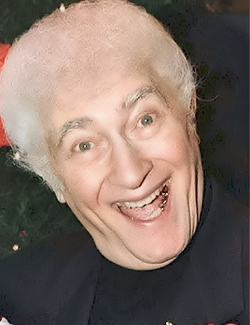
Larry Harmon

Larry Harmon was born Lawrence Weiss in Ohio, the older of two boys.  His mom worked in an office, and his dad took anything he could find, from handyman to salesman. These humble beginnings were no match for Harmon’s vision and determination.  When Bozo decided to run for political office, people thought he was just clowning around, but Harmon had a mission.  Making people laugh and learn was no laughing matter.

As a young boy Harmon stuttered, and he knew he would have to overcome that to be successful.  He figured he could help prepare himself for his destiny by imitating what he heard on the radio. Whenever his parents listened to a program, their ambitious son copied all the sounds and patterns of the voices, from speeches by President Roosevelt to opera. 

THE BEAT OF A DIFFERENT DRUMMER     Harmon had a keen ear, and he heard rhythm in everything.  Beating on things was a natural outlet for a kid with rhythm.  He started with the pots and pans, banging out patterns with spoons.  When he was six he wanted a more sophisticated sound.  His first drum set was made up of a wooden breadboard, a cast-iron skillet, a metal mixing bowl, and an empty coffee can.  For drum sticks he upgraded to his mom’s butcher knives.  For his safety, his parents finally gave him a pair of real drumsticks and lessons with the renowned Charley Wilcoxon. 

In eighth grade Harmon was captivated by listening to the USC marching band perform during the Rose Bowl on New Year’s Day.  The announcer described the drum major in his colorful uniform and commanding showmanship, and Harmon decided that he would be a drum major as soon he got into high school.  Never mind that had never seen one and the position was always held by a senior.    

Through annoying persistence, a trait that often served him well, Harmon convinced the high school band director to let him audition at band camp that summer.  To earn the money to go to camp, Harmon, only 14 years old, talked his way into a job at the local dry cleaners.  On the last day of camp, Harmon fell, tore a tendon and was in a cast for the audition.  He made up for his immobility with a grandiose ending that got him the job, the only freshman in the history of the school to be drum major.

After a stint in the army Harmon had another dream come true.  He was accepted to USC where he studied theater and became the drum major for the Trojan marching band.  When he graduated he was ready for a career in entertainment and started using the stage name Larry Harmon.  His first gig was as Commander Comet in a kid’s show on NBC.  Television was still in its infancy, and Harmon not only played the spaceman, he also did the voices for six puppets, read the commercials and booked the guests, including pilot Chuck Yeager.

As busy as the actor was on his first show, he also needed a day job.  During that time he worked as a private investigator, home decorator, manager of a wholesale brokerage company and, when his parents moved to California, he opened a jewelry store with his father.  At night he played with a jazz combo.

SEND IN THE CLOWN                                         In 1952 Harmon auditioned at Capitol Records to be one of the Bozo the Capitol Clowns in public appearances.  He got the job and felt as comfortable in the oversized costume as in a favorite pair of jeans.  For a few years he played Bozo and maintained his survival jobs until one night he had an epiphany.  He envisioned transforming Bozo from just a clown to the World’s Most Famous Clown.  In 1956, he negotiated buying the rights to the character at a time when the clown was losing his relevance for the direction Capitol was going.

Immediately Harmon revamped the character into its iconic image.  He made him smart and energetic with the wisdom of an adult and the wonder of a child.  He changed the voice and created a laugh that crescendoed with each syllable.  He redesigned the costume, replacing the mop-like wig with a red wig made from yak hair and coated with Krylon.  He traded in his shoes for a size 83AAA.

Bozo the Clown

Once the new character was set, Harmon needed a TV show for him to appear in.  It was too expensive to produce a program on a major network, so he decided to create a show for the local market airing in Los Angeles on KTLA.  He added other characters and hired a different actor to play Bozo so he could concentrate on the production aspects.  To round out the program, Harmon wanted cartoons to give Bozo the opportunity to do crazy things a live actor couldn’t.  He borrowed money and opened a small animation studio.

It didn’t take long for Bozo to become a hit, and Harmon started stage two of his business plan.  He franchised the show at local stations all around the country, allowing it to adapt to regional differences and giving the kids in each market the opportunity to participate in the audiences. Advertisers had the advantage of buying time on a show that catered to the customers in their area.

In 1959 Harmon started licensing the Bozo TV shows, and he traveled around the country to train hand-picked actors to play the character.  Eventually, over 200 men in the US and other countries, including Thailand, Greece, Brazil, Puerto Rico, Mexico and Australia, completed the rigorous training to learn the specifics of playing the world’s most famous clown.  And, playing Bozo launched at least one show business career.  In Washington, DC, Willard Scott wore the red wig and nose before becoming a celebrity weather man. 

FINDING OPPORTUNITIES                               Harmon occasionally played Bozo himself, and he used his alter ego to educate children as well as entertain.  This gave him the opportunity for some unique experiences, always in costume.  He flew in the zero gravity aircraft that trains astronauts.  He went scuba diving with Navy frogmen.  He threw out the first pitch for a Cleveland Indian’s baseball game.  He jumped out of a window while being chased by flames to demonstrate fire safety. 

Much of Harmon’s success was because he refused to take “no” for an answer.  Harmon persuaded an Australian bush pilot to drop the clown and a two-person film crew into the jungle of New Guinea so he could meet the cannibalistic aborigines and prove that laughter is a universal language.  When he came face to face with the chief, Bozo tried to explain that he came in peace, but he was at a loss for words.  After some tense moments, the two men discerned that they had something in common, an unusual headdress.  Then Bozo broke the ice with a magic trick which led to spending two days making friends with people the rest of the world feared. 

In 1984, Harmon was encouraged to use Bozo’s influence to get people to vote in the presidential election.  To do this he declared himself a write-in candidate for President of the United States and hit the campaign trail.  He had no delusions about winning, but some citizens feared his candidacy was more than symbolic.  There were three serious attempts to kill him. 

When Harmon was 60 years old he had a heart attack, the first in a long list of heart ailments.  He continued working on the business aspects of his enterprise for over 20 years supported by his second wife Susan. On January 1,1996 Harmon became Bozo for the first time in a decade to appear in the Rose Parade in Pasadena, California. 

In 2008 his heart gave out.  But even though Harmon has passed on, the laughter and lessons from Bozo live forever.

QUESTION:  What could you do if you refused to take “no” for an answer?

©2010 Debbie Foulkes All Rights Reserved

Sources:

Harmon, Larry & McKenzie, Thomas Scott, The Man Behind the Nose: Assassins, Astronauts, Cannibals, and Other Stupendous Tales. New York: Igniter Books, 2010.

http://bozotheclown.org/blog/

http://www.imdb.com/name/nm0363528/bio

http://www.findagrave.com/cgi-bin/fg.cgi?page=gr&GRid=28022262

http://en.wikipedia.org/wiki/Larry_Harmon