forgottennewsmakers

Archive for the ‘American History’ Category

JACK PARSONS (1914 – 1952) Rocket Scientist & Occultist

In American History, Biography, California History, Millionaires, Occult, People, Rocket Science, Trivia, Uncategorized on May 10, 2010 at 9:39 PM

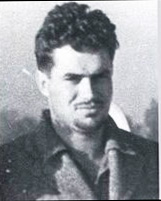
Jack Parsons


Marvel Whiteside Parsons did not like the name he was given, but it did describe his life: it was quite a marvel.  He changed his first name to be more common, but nothing about him was conventional. 

Parsons was born into a wealthy family living on “Millionaire’s Mile” in Pasadena, California.  After graduating from a small, private high school, he shunned the upper class society of his parents. His mother divorced his father after finding out about an affair, and she turned Parsons against his dad.  

When he was 14 years old, Parsons started experimenting with fuel that could be used to propel rockets. He didn’t graduate from college but opted to work for Hercules Powder and then Halifax Explosives which was in the Mojave Desert. Professionally he went by the name “John.”   

Helen Northrup, a local girl, was the one thing that could distract Parsons from his scientific endeavors, and they married in 1935.  In his personal life, Parsons preferred to be called “Jack.”  Eventually that was the name that stuck. 

Parsons and his best friend Edward S. Forman got their kicks from experimenting with potential rocket motors in the Devil’s Gate Dam area of the Arroyo Seco in Pasadena.  They made connections at the Guggenheim Aeronautical Laboratory, California Institute of Technology (GALCIT), and in 1937 they exploited those friendships to get lab space at Caltech for their experiments.  As it turns out, scientists using explosive materials don’t make good neighbors.  After an explosion that damaged some of their equipment, they became known on campus as The Suicide Squad.  After the second explosion, they were sent back to the Arroyo.  Their outdoor laboratory is where Jet Propulsion Laboratory (JPL) was founded, and the current campus is virtually on the same spot.  

Since Parsons and his colleague from Caltech, Frank Malina, lived so close to Hollywood, they channeled their experiences into a screenplay.  Their story was about some guys trying to develop rockets in California, and they didn’t try very hard to disguise the similarities between themselves and the characters.  At the end of the screenplay, Parsons’ character meets an untimely death by accidentally blowing himself up while trying to stop an experiment. Nothing came of this venture, however. 

In 1939, Parsons was introduced to the works of Aleister Crowley, an occultist writer, practitioner of black magic and founder of the religion of Thelema. Crowley’s writings resonated with Parsons, and he joined the Ordo Templi Orientis (OTO), an international secret society led by Crowley.  Parsons joined the OTO’s local group called the Agape Lodge, which was based in Pasadena and led by Wilfred Smith.  Parsons assumed yet another name, “Frater 210,” but he only used it in the context of his occult practices.     

Parsons pursued both his scientific and spiritual interests with equal zeal.  In 1942 he, Forman, Malina and Theodore von Karman founded Aerojet Corporation whose first product was the Jet Assist Take Off (JATO) rocket motors.  Their immediate application was to give extra boosting power for military planes during World War II. 

With the money he was getting from Aerojet, Parsons could support his spiritual activities. He got a huge house on South Orange Grove Blvd. in Pasadena and relocated the Agape Lodge to the downstairs.  He and Helen lived in the largest room upstairs and turned it into a temple. The other rooms were used by Smith and many unconventional renters.  

Again, the neighbors didn’t appreciate Parsons’ activities. There was once a rumor that a naked lady was jumping through fire in the back yard, but whenever the police came to investigate such allegations, Parsons intercepted them at the door. His good looks, charming personality, sense of humor and claims of being a respected scientist at Caltech convinced them there was nothing to be concerned about.  

Drugs and illicit sex were routine.  With so many people living in such close quarters, it didn’t take long for Smith and Helen to have an affair and a son.  Parsons divorced Helen and immediately took up with her younger sister, Sara Elizabeth Northrup, known as Betty.   He convinced Betty, 11 years his junior, to drop out of USC and live with him, but they never got married.  They followed the OTO belief that jealousy was an emotion not felt by enlightened people, and even though they were committed to each other, they each had many lovers. 

In 1944, GALCIT became the Jet Propulsion Laboratory, and Parsons is credited with being one of the founders.  After World War II, Aerojet was bought out by General Tire.  Parsons didn’t see much of a future in rocket fuel without a war, and money wasn’t a big priority for him, so he sold his stock.  For two years he worked for Vulcan Powder Company in Pasadena. 

About that time a man named L. Ron Hubbard came on the scene.  He received a medical discharge from the Navy after having been at the Pasadena Area Station Hospital.  Hubbard and Parsons met through a common interest in science fiction and became friends.  Hubbard was looking for a place to land and moved into the house despite having a wife and two kids in Washington State.  It didn’t take Hubbard long to integrate himself into the life and practices of the group, including poaching Parsons’ girlfriend, Betty.  Parsons found it very difficult to keep his jealous feelings at bay, but that didn’t seem to jeopardize his friendship with Hubbard.  

Parsons engaged in an 11-day, multi-stage, ceremonial ritual called Babalon Working to manifest the “Scarlet Woman,” fulfilling a prophecy of Aleister Crowley.  Hubbard joined Parsons in the rituals primarily acting as the scribe and recording his visions.  When a red haired woman named Elizabeth Cameron showed up at the house one day, Parsons was convinced he had successfully conjured her. 

Parsons needed income, so he and Hubbard and Betty started a new business venture called Allied Enterprises.  They were planning to buy sail boats on the East Coast and bring them to California for resale.  Hubbard contributed about $1,100 to the company against Parsons nearly $21,000.  In April 1946, Hubbard and Betty left town with the majority of Allied’s money and were found living on a boat in Miami with no intention of returning to California.  Parsons high tailed it to Florida and discovered that Hubbard had actually bought three boats.  Parsons sued Hubbard who was ordered to give Parsons two of the boats and repay the money he absconded with, which he never did.  

This was a turning point for both men.  Hubbard married Betty, although he hadn’t divorced his first wife, and when Parsons returned to California, he married Cameron.  Parsons was ready for something different spiritually, too. He separated from OTO and sold the house. 

Parsons found work at North American Aviation Company and later Hughes Aircraft. While at Hughes Aircraft, Parsons was working with Israel to design and build a plant to develop explosives and armaments.  He used his clearance to take home confidential documents.  He claimed they were old ones he was using to add to his resume, but the FBI started investigating him for spying.  This got him fired from Hughes. 

He and Cameron left Pasadena for a while but returned to live in the carriage house on the Orange Grove property he once owned.  Parsons worked as a consultant for the movies and at a gas station, and he continued to experiment with explosives at home.  

On June 17, 1952 there was an explosion which the neighbors a mile away heard.  Parsons’ arm was blown off, and he died shortly after arriving at the hospital.  He died the same way his character in the screenplay did, foreshadowed almost 15 years earlier. He was only 37 years old. His mother lived nearby, and they had always maintained a very close relationship.  She was distraught about the death of her son, and she immediately overdosed on sleeping pills and died in her chair. 

Parsons legacy included many patents for liquid and solid fuel for rockets.  A specimen of one of his solid fuel motors is on display at the Smithsonian Air and Space Museum.  In 1972 he was honored by having a crater on the moon name after him.  It seems appropriate that the crater is on the dark side. 

QUESTION:   What role does religion play in your life? 

©2010 Debbie Foulkes All Rights Reserved 

Sources: 

Canter, John, Sex and Rockets, The Occult World of Jack Parsons.  Los Angeles: Feral House, 1999. 

http://en.wikipedia.org/wiki/John_Whiteside_Parsons 

http://www.bibliotecapleyades.net/bb/babalon004.htm 

http://reason.com/archives/2005/05/01/the-magical-father-of-american 
http://www.aerojet.com/about/history.php

JOSEPHINE COCHRANE (1839-1913) Invented the Dishwasher

In American History, Biography, Entrepreneurs, Feminists, Inventions, Millionaires, People, Trivia, Victorian Women, women on April 20, 2010 at 9:03 AM

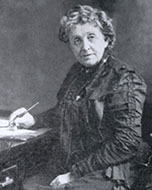
Josephine Cochrane

Josephine Cochrane believed that if you want something done right you better do it yourself.  But when it came time to doing the dishes, she really didn’t want to, so she invented a machine to wash them for her.

Cochrane’s early childhood is not known.  After her mother died and her sister moved out, she lived with her father, John Garis, in Ohio and Indiana.   He worked as a supervisor in mills and as a hydraulic engineer, perhaps instilling in Cochrane an instinctive knack for the mechanical.  She attended a private high school, but when it burned down, Garis sent his daughter off to live with her sister in Shelbyville, Illinois. 

After high school graduation, Cochrane’s life took a traditional turn.  At age 19 she married 27 year old William Cochran.  In 1857, after a disappointing four years trying to strike it rich in the California Gold Rush, he returned home to Shelbyville and made his mark and fortune in the dry goods business along with other investment opportunities.  No doubt the comfortable life he could offer his bride was one thing she was attracted to. 

In spite of her young age and the societal norm at the time, Cochrane was guided by her independent nature and personal confidence.  She assumed her husband’s name but preferred spelling it with an “e” on the end, a point of contention with his family. 

The Cochrans had a busy social life, and in 1870 when they moved into what could be considered a mansion, they had the perfect house for entertaining.  They threw dinner parties using heirloom china allegedly dating from the 1600s.  After one event, the servants did the washing up and carelessly chipped some of the dishes.  Cochrane discovered this the next morning while she was putting the dishes away.  She was furious and refused to let the servants handled the china any more. 

She may have regretted her decision, but she didn’t give in.  The morning after every subsequent dinner party she begrudgingly endured dishpan hands wondering why someone hadn’t invented a machine that could clean dirty dishes.  This was, after all, the late 19th century, and if someone could invent a machine to sew clothes and cut grass, then how hard could it be? 1 

One such morning while she was up to her elbows in soap suds, she had an epiphany.  Why not invent a dish washing machine herself?  Consumed with the idea, she immediately went into the library to think it through, forgetting she was holding a cup in her hand.  Within half an hour Cochrane had the basic concept for the first mechanical dishwasher.  Just like she had been doing by hand, it held the dishes securely (in a rack) while the pressure of spraying water cleaned them off.

William Cochran was a rising star in the Democratic Party, but too much alcohol led to a violent temper and illness.  While Cochrane was busy with the details of her invention, William went away for a rest. Unfortunately, he didn’t get well, and he died two weeks later in 1883.  

While the Cochrans appeared to be successful socialites to their friends, all was not well at home.  Her husband left Cochrane with a mound of debt and only $1,535.59.  Now, developing the dishwasher was not only for convenience, it was for survival.

Her creation had wire compartments for plates, cups and saucers.  They were put inside a wheel that lay flat inside a copper boiler.  A motor turned the wheel pumping hot soapy water from the bottom of the boiler over the dishes.  Cochrane showed her design to a few men for their input which ended up being a frustrating experience.  “I couldn’t get men to do the things I wanted in my way until they had tried and failed in their own,” she said.  “And that was costly for me. They knew I knew nothing, academically, about mechanics, and they insisted on having their own way with my invention until they convinced themselves my way was the better, no matter how I had arrived at it.” 2   Finally she got help with the construction from mechanic George Butters and received her first patent on the Garis-Cochran Dish-Washing Machine December 28, 1886. 

Cochrane’s first customers were not the housewives she thought she was helping. They didn’t want to spend the money on something they didn’t really need, so she turned to hotels.  After selling a dishwashing machine to the Palmer House hotel in Chicago, she had one recommendation.  Then she did one of the hardest things she’d ever done: she made a cold call to the Sherman House hotel in Chicago, waiting in the ladies’ parlor to speak with the manager.  “You asked me what was the hardest part of getting into business,” she once told a reporter. “…I think, crossing the great lobby of the Sherman House alone. You cannot imagine what it was like in those days … for a woman to cross a hotel lobby alone. I had never been anywhere without my husband or father —the lobby seemed a mile wide. I thought I should faint at every step, but I didn’t—and I got an $800 order as my reward.”2

In 1893 Cochrane convinced restaurants at the World’s Columbian Exposition in Chicago to use her invention, and it was an exhibit in Machinery Hall.  That success led to her opening her own factory in an abandoned schoolhouse.  Her customers extended to hospitals and colleges for whom the sanitizing effects of the hot water rinse were important.  Homemakers finally started using it, too.

In 1912, at 73 years old, Cochran was still personally selling her machines.  She died in 1913.  In 1916, her company was bought out by Hobart which became KitchenAid and is now Whirlpool Corporation.  Cochrane is considered the founder.

 QUESTION:  Which modern convenience do you think it would be impossible to live without?

                       ©2010 Debbie Foulkes All Rights Reserved

 Sources:

 1 http://www.enchantedlearning.com/inventors/1800a.shtml

 2http://www.americanheritage.com/articles/magazine/it/1999/2/1999_2_54.shtml

  http://www.invent.org/hall_of_fame/256.html

MATTHEW HENSON (1866-1955) First Person to Reach the North Pole

In adventure, American History, Arctic, Biography, Explorers, History, North Pole, People, Trivia on April 12, 2010 at 9:51 PM

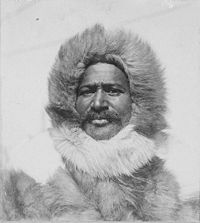
Matthew Henson

When Matthew Henson left home at age eleven he never looked back.  He didn’t have much to return to so he kept going, to the end of the earth. 

Henson’s parents were free-born tenant farmers who finally settled near Washington D.C.  His mom died when he was seven, and his father remarried. His father subsequently died and left young Henson and his siblings to their stepmother’s care. The problem was, she was burned out on farming and child care, so she often beat the children into compliance. Late one night after a severe beating, Henson made good on his promise to run away.  He used his brother’s knife to cut his wool blanket into squares that he wrapped around his feet as makeshift shoes. 

Fear of being caught and returned home kept Henson hiding in the woods until nightfall.  Then hunger and the cold forced him to seek refuge.  Janey Moore, the owner of Janey’s Home Cooked Meals Cafe, took him in and gave him food, shelter and a job.  Henson saved the $1.50 a week he earned and bought himself the first new clothes he’d ever had. 

A year later, Henson was ready to move on.  It wasn’t that he was ungrateful, but he dreamed of being a sailor.  “Aunt Janey” pressed a dollar into his hand and begrudgingly let him go. 

Henson walked from Washington D.C. to Baltimore where he ultimately met up with a Captain Childs and became his cabin boy on the ship Katie Hines.  For five years Henson traveled with Childs and learned literature, math and navigation.  Henson was 17 when Childs died, and he found himself doing odd jobs and bouncing around New England.

Henson was working as a clerk in a store in Washington D.C.  when Robert Peary, a lieutenant in the U.S. Navy, came in and learned of Henson’s maritime experience. Peary hired him to be his personal valet on a trip to Nicaragua.  Upon returning to the States, Peary kept Henson on as an errand boy in his office at the League Island Navy Yard.

 In 1891, Peary made his first of several trips to Greenland with Henson on the crew.  During these excursions, Peary mapped Greenland and made plans to find the geographic North Pole. Henson spent extensive time with the Inuit people, learning their language, customs, survival skills and gaining their respect and a permanent connection. 

While in the States, Henson married Eva Flint. He wasn’t too keen on the fact that she got pregnant while he was in Greenland, so he divorced her. Then he married Lucy Ross, but they never had children.  While in Greenland, however, Henson wasn’t deprived of companionship. He had a relationship and a son with an Inuit woman, his only offspring. 

In previous attempts at reaching the top of the world, Peary and Henson had collected the world’s largest meteorites and went the farthest north any human had ever traveled.  This was not, however, satisfying enough to stop trying to find the North Pole.

Peary and Henson made the final attempt in 1909 on the specially build ship the Roosevelt.  Accompanying them were several other Caucasian explorers, 39 Eskimos*, who traveled in families, and the husky dogs that would be pulling the sledges (sleighs).

Time on board the ship was used by the natives to make suits of reindeer skin and polar bear skin.  Henson was responsible for making the sledges, shaping the runners to curve up like a canoe to break through the ice.

On March 1, 1909, at 6:30am, Peary, Henson and the others left the comfort and security of the Roosevelt at Cape Sheridan at Canada’s northern tip to cross 413 nautical miles of ice to find the Pole.  Three days earlier the temperature had been 57 degrees below.  Only one mile into the trip Henson’s sledge broke, and he had to stop and fix it in gale force winds, exposing his hands to bore new holes and securely rethread the sealskin ties.

Every night they built igloos to sleep in, and they ate an Inuit specialty: dried meat pounded into powder and mixed with dried fruit call pemmican, and tea.

The explorers weren’t able to travel as fast as they’d have liked due to natural obstacles known as “leads,” a gap where the ice has suddenly split to expose water. On March 4 a lead opened up that made them waste seven days of good weather.  Finally, on March 11, with the temperature at 47 degrees below, the ice drifted back together, the lead closed, and they carried on with their journey.

On March 20, Peary started cutting the crew for the final push to the Pole.  By April 1, the only ones to make the last five marches over the ultimate 130 miles were Peary, Henson and four Inuits.

Despite the cold and exhaustion, they managed to sustain a relentless pace.  On April 3, Henson had a horrifying experience.  While he was pushing his sled, the ice underneath him broke away, and he slipped and fell into the freezing water.  He tried to grab the ice and pull himself up, but his gloves couldn’t get a grip.  While he was flailing about, the Inuit Ootah reached down, grabbed Henson by the nape of the neck and pulled him out.   Henson quickly changed into dry clothes, and when he caught up with the others, learned that Peary had also taken an unexpected dip.

With Henson in the lead breaking the trail, on April 6, 1909 they finally reached their goal, after 36 days of trekking over the ice. After they set up camp, Peary planted the American flag and Henson led a spontaneous cheer. Peary took measurements to confirm and document their location.  As it turned out, they had overshot the Pole. After retracing their steps, 49 year old Henson was actually the first person to step on the geographic North Pole.  It was a balmy 29 degrees below. 

This frozen tundra was not a place to just hang out. The six men scurried back to land in a quick 17 days.  Once back on the Roosevelt, Henson got his strength back by doing nothing but eating and sleeping for four days.  It wasn’t until July 17 that weather conditions allowed them to head home. They made it to Etah, Greenland on August 17, and they arrived back in New York on October 2.

When Peary and Henson returned to the States, Peary received all the credit and notoriety for the incredible accomplishment. Henson, being African American, was ignored. He slipped into obscurity working a non-descript job at the Customs House in New York.

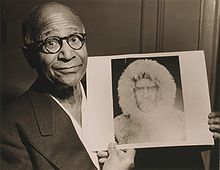
Eventually Henson received due recognition for his achievement.  Finally, in 1937, when he was 70 years old, he was granted an honorary membership in the prestigious Explorers Club.  Henson was also awarded several honorary degrees, and in 1954 he received a personal commendation from President Eisenhower for his role in discovering the North Pole.  A stamp from the United States Postal Service was issued in 1988 with the pictures of Peary and Henson.

Henson With a Picture of Himself

Henson died in 1955.  He was buried next to his wife in New York.  After some politicking from his biographer, in 1988 Henson and Lucy were reinterred next to Commander Peary and his wife in Arlington National Cemetery.  His Inuit son and family were in attendance at the ceremony.

 * Today in Canada and Greenland the term “Eskimo” is considered derogatory.  It is the term used by Henson in his memoir. The Inuit people are a group of Eskimos found in northern Alaska, Canada and Greenland. 

QUESTION:  What obstacles keep you from trying to do something you really want to?

                                 ©2010 Debbie Foulkes All Rights Reserved

 Sources:

 Henson, Matthew, A Negro Explorer at the North Polehttp://fliiby.com/file/208493/ajb1dly8gl.html

http://www.matthewhenson.com/index.html

http://en.wikipedia.org/wiki/Matthew_Henson

http://news.nationalgeographic.com/news/2003/01/0110_030113_henson.html

http://www.polarconservation.org/education/explorers/matthew-alexander-henson

http://www.matthewhenson.org/North_Pole_Trip2.htm