forgottennewsmakers

Archive for 2011|Yearly archive page

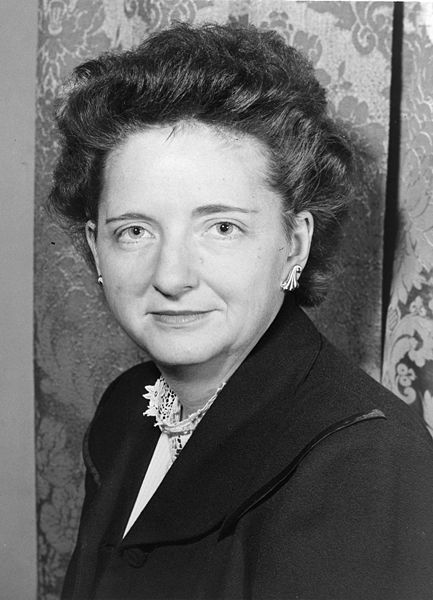
ELIZABETH BENTLEY (1908 – 1963) Communist Spy & FBI Informant

In American History, Cold War, Espionage, Feminists on April 25, 2011 at 9:13 PM

Elizabeth Bentley

For Elizabeth Bentley, with the Great Depression came the demise of the American Dream.  As a young woman caught up in spying for the Russians, she idealistically believed that the security of communism offered hope for restoring opportunity and creating a future for American citizens.  Since the USSR was an ally of the United States during World War II, handing over secret documents to Moscow was really advancing the common mission.  But after the war, the Soviet Union became the enemy, and Bentley’s idealism turned to fear.  She saved her life by ruining the lives of others, but she couldn’t save herself from her personal demons.

Bentley’s parents were a dry goods merchant and a teacher in Connecticut, and they had only one child.  They were staunch Republicans and Episcopalians, and her father founded a temperance newspaper that promoted the evils of alcohol.  It was a strict and sheltered childhood for the young girl whose unscrupulous life as an adult belied her upbringing.

After high school, Bentley got a scholarship to Vassar where she majored in English and minored in Italian and French.  Being an only child did not give Bentley a sociable personality.  She was primarily a loner, but she mingled for the first time with people who thought radically differently from how she was raised.  Her mother died while she was in college, and when she graduated, Bentley used her inheritance to travel to Europe.  She had her first romance on the ship en route.

When she returned to the States, the only thing Bentley was qualified to do was teach, and she got a job at Foxcroft School, a prep school for girls in Virginia.  She left Foxcroft in 1932 and attended Columbia University Graduate School until she got a fellowship to the University of Florence.  Her dad died before she left for Italy, but he didn’t leave her any money.

Perhaps to compensate emotionally for being orphaned in her 20s, Bentley became very promiscuous.  She soothed her depression with alcohol and had to borrow money for her expenses.  All of these distractions affected Bentley’s academic standing.  She failed a course and was suspended twice.  While she was researching her thesis she had an affair with her professor who ordered his assistant to write Bentley’s paper for her, although she claimed she had written it herself.

During the summer of 1934 Bentley returned to New York and enrolled in business courses at Columbia.  She lived down the hall from a woman who used the name Lee Fuhr, a Communist who invited Bentley to go to meetings of the Communist Party.  Jobs were scarce during the Depression, and Bentley couldn’t find work.  The tenets of communism were more attractive in light of this dire situation, and Bentley eventually embraced the new political point of view

As a new member of the Communist Party of the United States of America (CPUSA), Bentley had to go to four meetings a week, take classes in Marxism and Leninism, hand out fliers and go to rallies, and she served in several leadership roles.

I SPY             Bentley was able to work at a few part time jobs, but none of them had long term potential.  Her life opened up in 1938 when she decided to step up her involvement in the Party, and she met “Timmy” on a street corner.  “Timmy” was a Soviet operative.  His cover was the head of the World Tourists travel agency, but he actually supplied U.S. passports and other documents for Soviet spies.  Bentley knew “Timmy” for six months before she accidentally learned that he was really Jacob Golos (formerly Jacob Raisin), a Russian Jew who had survived a Siberian labor camp and, after becoming a United States citizen, helped found the CPUSA.  He was in charge of a network of spies and reported directly to the Soviets.  Golos was 18 years older and several inches shorter than Bentley.  He had a common law wife and son in Russia and was living with another woman when they met.  Even though operatives weren’t allowed to socialize together, it wasn’t long before they became intimate.  For the first time in her life, Bentley was in a real relationship and had meaningful work.

When Bentley was unemployed again, Golos decided she was ready for the next step and taught her how to be a spy.  He showed her how to properly use a pay phone, how to store important documents in her apartment, how to rig a book behind the door to detect a break in, how to burn or flush down the toilet important documents so they couldn’t be found, and how to lose a tail.

In April 1941, Golos had a heart attack.  He recovered, but the FBI was watching him, and he didn’t have much stamina.  Having been groomed to take over for Golos when the time came, Bentley was ready to step into his shoes.  A new cover company was formed, United States Service and Shipping Corporation (USS&S), and she became the vice president earning $200 a month, with frequent raises up to $800 a month and a very generous expense account.

CLEVER GIRL             Bentley also took over as supervisor for Golos’ network, and the Soviets gave her the code name umnitsa, meaning “Clever Girl.”  She became a handler supervising individuals, including William Remington who worked at the War Protection Board.  She was also in charge of the Silvermaster Group, one of the biggest spy networks in America.  Members of Silvermaster Group included her direct contact Nathan Silvermaster who worked in the Agriculture Department, and others who worked at the Department of Justice and the Department of Treasury, the most influential being Harry White, the undersecretary of the Treasury.

Golos died Thanksgiving night 1943, and Bentley comforted herself by drinking, most often to excess.  The following year the Silvermaster Group and an additional one, the Perlo Group, were taken away from her, and the Soviets weren’t quite sure what to do with her.  She was told to report to a new contact, “Al,” Anatoly Gorsky, the first secretary at the Soviet Embassy in Washington D.C. and the local head of KGB operations.

In 1945, Gorsky ordered Bentley to relinquish all her contacts and to quit working at USS&S.  Since some of the contacts knew her phone number and address, she had to move for security reasons.  She obeyed orders but then defiantly went back to USS&S because her replacement was doing a terrible job and she needed work.  She was acting hostile toward Gorsky, and he tried to get her to go to Moscow. She refused to go without the proper legal documents because she knew that if she did, she would never return.  Gorsky’s last attempt at calming Bentley down was to order her to take a vacation, and he started looking for an acceptable husband for her.  He appreciated her need for income, so he patronizingly gave her $2000.

Bentley could feel her life getting more difficult, and the intrinsic rewards for spying weren’t feeling so rewarding.  It was dawning on her that the Soviet priority was not to create more social equality in the United States, and the FBI was starting to investigate USS&S.  Bentley’s life was falling apart, so she took the recommended vacation in Connecticut.

As she later described a life changing experience, Bentley was walking around one day and stopped into a church to pray for guidance.  She heard a voice in her conscience that said “You must make amends.”  However, Bentley’s habit of exaggerating the facts for effect made fear and revenge more plausible explanations for her change of heart than a voice in her head.

CHANGING ALLEGIANCE             In August 1945, Bentley walked into the office of the Federal Bureau of Investigation in Connecticut using a fabricated reason for being there to test the waters.  The agent listened to her for two hours sensing that there was an underlying motive for her visit.  Bentley returned to New York and USS&S, and it wasn’t until October that she talked to the FBI again, continuing to misrepresent her intent.

During several subsequent interviews, Bentley finally revealed her story of espionage and named her contacts.  During the month of November she worked at USS&S during the day and talked to the FBI at night which resulted in a 107-page statement revealing 87 U.S. citizens and Russians who were spies in the U.S.  J. Edgar Hoover, the head of the FBI, was thrilled with Bentley’s report, and by December there were 72 special agents working to verify Bentley’s claims.  The only evidence Bentley had to support her accusations was the $2000 Gorsky had given her, and she surrendered it to the FBI.

The FBI gave Bentley the code name “Gregory,” but NKGB intelligence found out about her defection.  To minimize the damage she was doing to their networks, all espionage was stopped immediately and all Russian nationals were called home.  Now the Soviets wanted revenge, and Gorsky was part of the discussion about the best way to eliminate Bentley permanently.  He suggested poisoning her food, but the NKGB never did try to kill her.

One immediate effect of Bentley’s confession was that 24 of the 27 people she named who were still working in the federal government were no longer employed.  Then, after two years, the FBI got a lucky break in the investigation.  Army code breakers on a top secret decryption project called Venona were finally able to decode Soviet cables that detailed their spying activities in the United States.  When the names of the spies in the cables were cross referenced with Bentley’s statement, the FBI finally had the documentation they were looking for.  Although the existence of the cables remained secret, the agency had specific information to justify continuing their investigation.

While she was acting as an FBI informant, Bentley continued to work at USS&S until the president, John Reynolds, closed it down in early 1947.  Then she got some clerical jobs and started testifying in Grand Jury investigations.  Looking for work and testifying would be major preoccupations for the rest of her life.

DAMNING TESTIMONY             Bentley testified in front of grand juries, the House Committee on Un-American Activities (HUAC), and the Senate Internal Security Subcommittee (SISS), and she was the first woman to appear on the television show Meet The Press.  Her testimony was responsible for indicting or convicting many alleged spies, and she was an important witness in two high profile cases.  Whittaker Chambers, an editor at Time magazine, confessed to HUAC that he and Alger Hiss, a lawyer who worked in the State Department and helped establish the United Nations, practiced espionage as members of the Communist Party.  Chambers had immunity, but Hiss was convicted of perjury.   Bentley corroborated his story.  Bentley also testified at the trial of Julius Rosenberg, who was ultimately convicted along with his wife for passing information to the Soviets about the atomic bomb.  She said that, although she had never met him, she had received phone calls from him.  The judge in Rosenberg’s appeal trial said that it was Bentley’s testimony that connected the Communist Party to the Soviet Union.

Part of Bentley’s personality that made her a good spy also served her well on the witness stand.  She stayed very calm and confident under intense scrutiny, often contradicting a cross-examiner if she felt it was necessary.  As valuable as she was to the FBI, however, she had no friends or reliable income.  She was characterized as a psychopath in rumors around Washington and received death threats.  Underlying her strong public persona was a woman who needed to self medicate her insecurities with alcohol, and the bottle became the most reliable thing in her life.

Bentley tried to mitigate her financial circumstances by writing her autobiography.  She holed up in a rented room in Westport, Connecticut while she poured her life out onto paper.  She reinvented herself as she wanted people to think of her: a woman who worked as a spy because she was in love with Golos and blindly idolized and obeyed him.  She conveniently failed to mention her own idealistic drive, the alcoholism and her numerous affairs.  The book, called Out of Bondage, was serialized in McCall’s magazine before it was released.  The magazine articles were more popular than the book, and the fabrications and unsubstantiated allegations made it difficult to determine what was fact and what was fiction.

SEEING THE LIGHT             In 1948, Bentley discovered another form of relief.  She had a religious awakening, and on November 5 she was baptized into the Catholic Church by Monsignor Fulton Sheen.  She considered this her ultimate break with communism.  Not everyone believed that Bentley’s new found faith was sincere, however, since there were many people in the Catholic Church who were anticommunist and could help her.

Monsignor Sheen did, in fact, help Bentley.  She never got paid for giving testimony for the FBI, so she needed a job.  Sheen got her a teaching job at Mundelein College, a Catholic women’s college in Chicago, for $3,500 a year.  Openly living with a man out of wedlock and alcoholism did not make her a good role model for her students, and she agreed to resign.

OLD HABITS DIE HARD             For Bentley there were other jobs, more boyfriends, and new opportunities to testify, but nothing could make her happy or pay her bills.  She knew how much the FBI valued her in exposing and bringing down Communist infiltrators, and she used that to her advantage.  She created reasons for them to continue to need her by embellishing her stories with new facts and allegations, and when she got really desperate she would threaten to stop cooperating.  In order insure that Bentley would continue to be a favorable witness, the FBI would capitulate to her demands by giving her money, driving her to appointments, reducing a hit and run traffic violation and getting rid of a violent suitor.  When she owed the Internal Revenue Service $3,700 in taxes for creative distribution of her book royalties, she threatened to “blow the lid off the administration” if she didn’t get help.  Once again her contacts rallied and she got her IRS debt reduced to $1,000, the U.S. attorney got her reinstated to a teaching job, and the FBI chipped in $100. In return for their generosity, the government agents had to deal with an increasingly irrational and ungrateful woman,

Bentley had a hard time making the connection between her behavior and reputation and losing teaching jobs, and in a disillusioned moment, she left the Catholic Church.  She desperately turned again to the only source she could trust.  Bentley wrote a letter directly to J. Edgar Hoover essentially asking for a character reference to help her get another job.  He responded with a letter that simply confirmed that the testimony Bentley had given was true, not a glowing recommendation.

In the fall of 1959, Bentley did get one more opportunity to work, at the Long Lane School in Middletown, Connecticut.  At this reform school for girls, Bentley had more in common with this population of misfits than any previous student body.  She continued to write directly to Hoover, and he answered her letters not as a friend, but in case the FBI needed her to testify in the future.

In 1960, while teaching at Long Lane, Bentley received a master’s degree in education from Trinity College.  For three years her life was the most stable it had ever been, and she enjoyed her privacy away from public scrutiny.  The week before Thanksgiving 1963, Bentley went to the doctor complaining of severe stomach pains.  On December 2 she had exploratory surgery, and the surgeons found her abdominal cavity was so full of cancer there was nothing they could do.  They closed her up, and she died the following day, one month before her 56th birthday.  Even though there were lengthy obituaries written about her in the New York Times and the Washington Post recounting her valuable contribution to the government’s effort to eliminate communism in its ranks, only a handful of colleagues and FBI agents attended her funeral.

QUESTION:  Have you ever done something you really regretted later?  How did you deal with it?

©2011 Debbie Foulkes All Rights Reserved

Sources:

Kessler, Lauren, Clever Girl: Elizabeth Bentley, the Sy Who Ushered in the McCarthy Era. New York: Harper Collins Publishers, 2003.

Olmsted, Kathryn S., Red Spy Queen, a Biography of Elizabeth Bentley. Chapel Hill, North Carolina: The University of North Carolina Press, 2002.
http://homepages.nyu.edu/~th15/who.html

http://www.atomicarchive.com/Bios/Rosenberg.shtml

WILLIAM ROBINSON (1861 – 1918) Magician

In Chinese history, Magic, People from China, Vaudeville Acts on April 4, 2011 at 4:09 PM

William Robinson

For a magician, deception and misdirection are the respected skills of a master.  For William Robinson, the layers of deception in his personal life were as confusing as his tricks, making audiences and friends question what was real and what was illusion.

Robinson was born in a trunk, as they say, in New York.  His father, James Campbell Robinson, was a versatile performer touring with minstrel shows.  He performed as Jim Campbell, and he specialized in ventriloquism, magic and singing in several dialects.  He also worked as a stage manager at the Houston Street Concert Saloon, filling in on stage when necessary.

Young Billy Robinson, as his family called him, wanted to follow in his father’s footsteps.  He was tall and handsome with alluring eyes like his dad, but he lacked vocal talent and charisma.  Singing was out for him, so he set his sights on becoming a magician.  The young man used his father’s props to practice illusions in front of a mirror.

Robinson started out performing at private parties and school assemblies.  His first assistant was his younger brother, Edward.  He opened with a short introductory speech and then he proceeded to mystify the audience with card and coin tricks and other sleight of hand.

BEHIND EVERY GREAT MAN IS A WOMAN        When Robinson was 21 years old he met 16 year old Bessie Smith, and they married in February 1883 after only a couple months’ courtship.  Theirs was not exactly a mutual relationship.  Smith was love struck and happy to be married.  Robinson was happy to find a new assistant.  In December a girl, Annie, was born, but the new Mrs. Robinson was not the mother.  Robinson took custody of the girl, and his parents raised their first grandchild, perhaps as a way to save face for the family.

Robinson created a larger-than-life stage persona in the tradition of the great magicians and toured around New York with his devoted assistant.  They were billed as “Robinson, the Man of Mystery, The World’s Marvelous Enchanter, Assisted by Mlle. Bessie.”  He tried to look the part with a handle bar moustache and black knickers and tails, and he started signing his correspondence “Mystically thine, W. E. Robinson.”  When he added ventriloquism and mind reading to the act he promoted himself as “Robinson, The Man of Many Voices” and “The Famous Spiritualist.”  For all his effort, reviews of the act were just tepid.

Bessie gave birth to a baby boy, Elmore, in early 1885.  Being a magician’s assistant required more than just handing props and hiding in boxes.  It involved hours of intense rehearsal to perfect the illusions and a demanding schedule.  Now, with an infant to care for, she needed to stay home, and Robinson needed to find a new assistant.

A slim, diminutive showgirl with a young face struck Robinson’s fancy during one of the variety shows he performed in.  She was the perfect size to hide in a box and had experience with the rigorous life of a touring performer.  Her name was Augusta Pfaff, but she performed as Olive Path, and Robinson affectionately called her Dot because she was so small.  She was just what Robinson was looking for as an assistant and a lover. 

WHAT’S YOURS IS MINE        During a European tour Robinson was introduced to a new style of magic, Black Art, where black fabric and lighting were used to conceal objects.  When he returned to America he immediately incorporated this new technique into his act.  He copied the idea of adopting the persona of an Egyptian mystic from the originator of Black Art.  Hiding behind an elaborate costume and the assumption that he didn’t speak English, Robinson found a new comfort level on stage.

The magician and his assistant spent all their time together building, rehearsing and perfecting each illusion, and Robinson willfully ignored his family.  Since he was Catholic, divorce wasn’t an option, so he and Bessie just pretended that they weren’t married.  Robinson and Path started going by Mr. and Mrs. Robinson, and no one questioned them.

Two of the most renowned magicians in America were Alexander Herrmann and Harry Kellar.  As bitter rivals they competed for the most dramatic illusions and best talent to join their shows.  Keller wanted Robinson to join his act to perform his Black Art illusions.  Robinson accepted the offer for sixty dollars a week which included Path as the assistant and Robinson working backstage to set up the illusions.  Keller changed Robinson’s character to Nana Sahib, the “East Indian Necromancer in Oriental Occultism.”  During his tenure with Keller, Robinson developed a levitation illusion using a special harness and derrick he developed with machinist Benjamin Keyes.

The troupe rode the wave of popularity for two seasons until Robinson got a better offer from Herrmann.  He took his special harness and his assistant and joined Herrmann’s company.  Both Robinson and Path played supporting characters in Herrmann’s illusions and also performed some of Robinson’s Black Art tricks.  Herrmann did not approve of Robinson’s previous character name, so he became Abdul Khan. 

During the summer while Herrmann vacationed in Europe, Robinson and Path developed their own show, performing in the Catskill Mountains and in Boston.  He revived the persona of great magician in tails, but he still didn’t feel comfortable as himself on stage.  He had to admit that his best role was as an assistant.

After two years with Herrmann, Robinson heard from Keller again.  Keller had just returned from London with many new tricks, and he used the sketches for new illusions to entice Robinson to come back.  He was hopeful that Robinson would take the bait and bring with him Herrmann’s best illusions.  Robinson couldn’t resist.  For the Black Art act, Robinson’s character went back to Keller’s name: Nana Sahib.

In 1894 Herrmann, who usually preferred his older tried and true tricks, incorporated some new ones into his act.  Two of them were virtually identical to ones that Robinson had developed with Keller.  Now there was no doubt that part of Robinson’s value was because he stole secrets. 

He had plenty of secrets in his private life, too, that he wasn’t so eager to share.  He and Path still maintained that they were married, but they weren’t.  Robinson didn’t care about a family, so the legality of relationships was incidental.  Bessie had “remarried” without a legal divorce from Robinson.  Their son, Elmore, didn’t really fit into either family, so he was placed in an orphanage.  Robinson’s life, like his illusions, was not all that it appeared to be.

REINVENTING HIMSELF         One of Herrmann’s new tricks was the Marvelous Bullet Catching Feat.  He caught six marked bullets fired from rifles in the audience on a plate in front of his chest.  Because of the risk and high dramatic value, he only performed it seven times for charity shows.  Robinson was an indispensible assistant on this illusion as the person who ensured that the bullets in the gun were actually blanks.

In 1896, Herrmann died, and Robinson decided it was time to have his own show.  He tried to resurrect his vaudeville act, but he couldn’t overcome his bad teeth and shy voice.  For a while, he and Path worked for Mrs. Herrmann who tried to continue her husband’s act to pay off the debt he left her.  Robinson also wrote journal articles giving advice and leaking secrets to magicians.

After two years of struggling, Robinson attended the Trans Mississippi Exposition in Nebraska and came face to face with his future.  At the fair, Chinese magician Ching Ling Foo performed illusions he brought from China.  He didn’t know English, so he performed in silence, using pacing and broad gestures to connect with the audience.  Later, when Foo was the headliner in New York, Robinson spent countless nights studying every detail of Foo’s act from the back of the theater. 

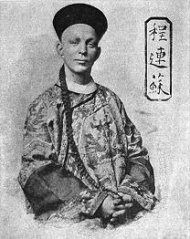
In 1899 Robinson left Mrs. Herrmann’s company, and, with another stolen idea, set out on his own again.  He reinvented himself as Hop Sing Loo, a Chinese speaking magician.  He shaved his moustache and his hairline and donned a wig with a long braid in back.  He used greasepaint to change his skin tone and purchased a costume from Chinatown.  Path added to the deception by become a Chinese princess, and Robinson hired a real Chinese juggler, Fee Lung, to round out the performance.

Robinson got an invitation from a manager, Ike Rose, in France to bring Hop Sing Loo and the troupe to Europe.  Robinson sold his levitation illusion and collection of books to finance the trip.  In March 1900, Hop Sing Loo appeared on stage for the first time, and the show was a disaster.  Loo’s magic was slow and deliberate, and a trick involving a large bowl of water went awry, sending a cascade into the orchestra pit and drenching the musicians.  Despite the opening night mishap, Rose managed to convince the theater owner to keep Hop Sing Loo on the bill for the contracted week, deducting the damages to the theater from his salary.  Robinson settled into the role and refined the illusions, and he felt more confident as Hop Sing Loo than he ever had as himself.

The next stop on the tour was London, and Rose made only one major change in Robinson’s act.  He hated the name Hop Sing Loo and insisted Robinson change it.  Ching Ling Foo was gaining in popularity in America, and since Robinson had already appropriated Foo’s character and a couple of his tricks, why not go all the way and imitate his name?  Robinson became Chung Ling Soo, and Path became Suee Seen.

There was virtually nothing in Soo’s act that was authentically Chinese.  Since Soo (as he was known in the press) didn’t speak English, even talking to the press was another gimmick.  A reporter would ask Fee Lung a question which he would repeat to Soo in actual Chinese.  Soo would respond in Chinese-sounding gibberish which Fee Lung would translate back into English.

Chung Ling Soo

Even though fellow magicians and other performers knew that Robinson was Chung Ling Soo, the public embraced his talent and accepted the guise along with it.  Soo became such a crowd-pleaser that he was earning about $5,000 a week with bookings two years in advance.  The troupe grew to 14 people, including a new juggler/stage manager, Frank Kametaro, who was Japanese.  Kametaro spoke Japanese and English but not Chinese.  During interviews, he would translate the questions to Soo in his own version of gibberish Chinese, often sounding quite different from the fake Chinese his boss was speaking.  None of the reporters seemed to notice as nothing was ever written about it.

WILL THE REAL CHINESE MAGICIAN PLEASE STAND UP        In 1904 Ching Ling Foo began a European tour in London.  He was getting limited bookings because of Soo’s act.  Foo challenged Soo to a duel of magic to prove who the real Chinese illusionist was.  Foo set the terms.  He would win if Soo failed to do ten out of twenty of Foo’s tricks, or if he failed at any one of Soo’s illusions.  Robinson accepted the challenge.

Robinson knew that losing could cost him his career.  He solicited help from an old friend for an ace-in-the-hole trick.  Magician Harry Houdini agreed to teach Robinson one of his best illusions.

On the day of the event, Soo and his entourage arrived in pompous splendor.  The small audience consisted of theater managers, who were the judges, reporters and Houdini.  After waiting half an hour for his competitor to show up, Soo entertained the crowd with ten successive tricks, and he was pronounced the winner.  Robinson changed his publicity from “The Wonderful Chinese Conjurer” to “The Original Chinese Conjurer.”

FOR LOVE OR MONEY        After 20 years of being together, Robinson and Path, both in their 40s, decided to do the right thing, so to speak, getting married in a brief civil ceremony in March 1906 in England.  The truth was so nebulous by this time, however, that to legalize their relationship only added to the complication.  Robinson was technically still married to Bessie, although he claimed to be divorced, and his many affairs made his devotion to Path dubious.  One of the objects of his affection, Louise Mary Blatchford, was barely 21 years old, and a year after Robinson was married matters got more complicated when Blatchford revealed she was pregnant.  Path was furious because Blatchford insisted that Robinson acknowledge his baby and act like a father, and Robinson, now ready for a family, agreed.  He set Blatchford up in a home in west London, and in early 1908 a son was born.

Mr. and Mrs. Robinson stayed married for the good of the act and created a business partnership.  Path started receiving a weekly salary for being Suee Seen and all of her responsibilities behind the scenes.  The members of their troupe referred to them as Mr. and Mrs. Soo, and when Blatchford came for a visit, they called her Mrs. Robinson.  When the company wasn’t touring out of the country, Robinson would visit his family on Sunday while Path and Kametaro were responsible for moving the show to the next location and setting up.  Robinson built a workshop behind his house where he could build and test illusions.  After two more children were born, Robinson spent more time in the workshop than he did with his family.

A KILLER TRICK        Chung Ling Soo had incorporated Herrmann’s Bullet Catching Trick into his own act, although he performed it rarely.  In 1918, he added it to the repertoire for a week of shows near London.  On Saturday night he had a guest in his dressing room while he was preparing the guns, and he mentioned that he didn’t feel well.  While he stepped out for a moment, Suee Seen got the weapons and put them on the prop table backstage, and then the stage manager called, “Places!”

The audience was thrilled that they would be seeing Soo perform “Defying the Bullets.”  Toward the end of the show, about 10:45, two volunteers from the audience marked the bullets to be used, and Soo and his assistants got into position.  Immediately after the command to fire, Soo staggered backwards and blood started pouring out of his chest.  The audience wasn’t sure if this was part of the act until Soo said in perfect English, “Oh my God.  Something’s happened.  Lower the curtain!”  The curtain was dropped and they played a newsreel.

Suee Seen rushed on stage, and Soo impelled her to call for a doctor.  One stage hand ripped off part of the curtain to keep Soo warm.  It took about 45 minutes for doctors to arrive, and by then they could barely find a pulse.  A bullet had grazed the heart and fractured the fifth rib upon entering Soo’s body and then exited through the back.  It wasn’t until 2:30am that Soo was taken to a hospital, and he died about two hours later.

At the coroner’s inquest Path had to reveal the secret of the trick so the jury could understand what happened.  She also had to explain the triangle of her, her husband and the woman he was living with.  After testimony by Robinson’s other assistants, the coroner and a gun expert, the jury ruled Soo’s death an accident, calling it “death by misadventure.”

QUESTION:  Have you ever promised to keep a secret and then shared it with someone?  What happened?

©2011 Debbie Foulkes All Rights Reserved

Sources:

Steinmeyer, Jim, The Glorious Deception: The Double Life of William Robinson, aka Chunk Ling Soo, the “Marvelous Chinese Conjurer.” New York: Carroll & Graf Publishers, 2005.

http://www.hat-archive.com/chunglingsoo.htm

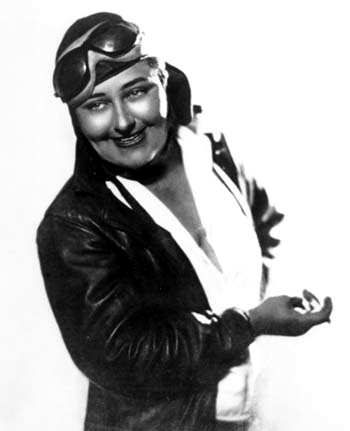
PANCHO BARNES (1901 – 1975) Pilot, Proprietor, Partier

In American History, Ballooning, California History, Feminists, Hollywood, Pilots, women on March 16, 2011 at 9:17 AM

Pancho Barnes

Pancho Barnes was a force of nature, and she didn’t do anything in a predictable way.  She was born into wealth, but couldn’t stand the obligations living in high society demanded.  Her first marriage was arranged, but subsequent ones were based on passion.  Her friends, mostly men, included movie stars, test pilots and anyone who could keep up with her adventuresome spirit.  There wasn’t anything she wouldn’t do except for one: conform to what other people expected of her.

Barnes’ grandfather, Thaddeus Sobieski Constantine Lowe, was an inventor and pioneer balloonist.  He was the first person to take photographs from a balloon and helped the Union Army with reconnaissance during the Civil War.  When he moved his family from Pennsylvania to Pasadena, California in 1888 they settled in a 24,000 square foot mansion on Millionaire’s Row.  Among other business ventures, he created the Mount Lowe Railway in the local San Gabriel Mountains which ended up costing him his entire fortune, and he died poor.

Barnes’ father was Thad Junior, the seventh child of ten.  He worked in his father’s businesses, but he preferred to spend his time outdoors and was an excellent horseman.  He married Florence Mae Dobbins, a staunch Episcopalian from another moneyed family who also had moved west from Pennsylvania.  The bride’s parents gave the couple a house in neighboring San Marino and eight years later upgraded it to a 35 room estate with servants, a pool, tennis courts and stables.  Barnes’ older brother, William Emmert, was constantly sick and died when Barnes was 12 years old.  While her mother cared for her brother, the rambunctious tomboy was spoiled by her father.

Barnes inherited her passions from her grandfather and father, and they treated her like the boy they wanted.  When she was three, her father gave her a pony.  For her fifth birthday, she got a Thoroughbred, and she won her first equestrian trophy that year.  When she was nine, her grandfather took her to the first American aviation exhibition near Long Beach.  From her mother, she inherited her name and, unfortunately, her masculine looks.

GIRLS JUST WANNA HAVE FUN       After a few years of home schooling, Barnes was enrolled in the Pasadena Elementary School, the only girl in a class of 23 boys.  She could run faster, spit, curse and fight better than most of her classmates.  Her behavior became an issue, but her parents didn’t know what to do about it, so they moved her to a prestigious prep school, Westridge School for Girls.  Barnes proved that she just wanted to have fun and didn’t care much about rules, so her parents moved her to a nearby Catholic boarding school, Ramona Convent.  During her second year there she ran away on horseback to Tijuana.  Now her parents were desperate, but the only option they could think of was to move their daughter away to the Bishop School in La Jolla, an Episcopalian boarding school.  Somehow Barnes managed to survive the two years until graduation.

After she graduated, Barnes announced that she wanted to be a veterinarian.  That was such an appalling idea to her mother that she promptly enrolled the teenager in Stickney School of Art for a more ladylike course of study.  This did not offer any real long term prospects, however, so Barnes’ maternal grandmother arranged for her to marry the rector of the local Episcopal church.  It seemed like a win-win situation, if not a perfect match.  The groom would be appeasing a major contributor to the church and get a new bell tower.  The bride would be able to stop living with her parents and have a shot at independence.

THAT’S NOT A LADY, IT’S MY WIFE          Barnes and Reverend C. Rankin Barnes were married in January 1921.  The first time the couple kissed was at the wedding, and the only time they were intimate was on the honeymoon.  Nine months later a baby boy, William Emmert Barnes (“Billy”), was born.

As was to be expected, Barnes was totally bored being a poor pastor’s wife, but she tried to fill the role for a while.  She taught Sunday school and bribed the kids in catechism class with jackknives to entice them to behave.  She had no maternal instinct, and nurturing a baby was asking too much of her.

Relief came from the burgeoning film industry in Hollywood.  Barnes started riding her horses in movies and was so adept she could carry a camera on her shoulder while riding.  She was earning at least $100 a day, and as soon as she could she hired a cook, housekeeper and full time nanny.  She was so successful Aimee Semple McPherson hired Barnes as her stunt double in shows.

When Barnes was 22 years old, her mother died.  Her father’s way of coping with the loss was to marry a woman only three years older than his daughter and move to Lake Arrowhead.  Barnes coped by running away, traveling across the country by herself for several months.  When she returned she took up with a college student and discovered how much fun physical intimacy could be.  Their affair lasted several months, and it was followed by another.  Barnes’ occasional attempts to act like a pastor’s wife didn’t overshadow her indiscretions, and she became an embarrassment to her upstanding family.  She left again, under pressure, on a cruise to South America.

A LONG WALK HOME          When she returned, she moved into her parents’ house, but she didn’t stay put for long.  When some friends got the idea to get hired on as crew on a banana boat bound for South America, Barnes, the only woman, didn’t hesitate to join them.  She dressed as a man and signed on as “Jacob Crane.”  As soon as the boat left the dock, the adventurers discovered they were running guns and ammunition to revolutionaries in Mexico.  When they arrived in San Blas, the ship was boarded by armed guards who used the vehicle to shelter the town’s money from the rebels.  The crew was held hostage for six weeks.  Barnes and the helmsman, Roger Chute, were the only two courageous enough to escape.

The pair stole a horse and burro and set out through the Mexican countryside.  Barnes quipped that her partner looked like Don Quixote, and he said that made her “Pancho.”  She corrected his reference, saying the character’s name was “Sancho Panza,” but Chute liked “Pancho” better.  Barnes liked the sound of Pancho Barnes, and the name stuck.

The journey continued on foot, and Barnes and Chute walked over 250 miles from Mexico City to Vera Cruz where they became stowaways on a boat.  With help from a connection at the American Embassy, they eventually got on another boat to New Orleans.  From there they walked, hoboed and hitchhiked to California.  For all of the challenges of the trip, Barnes saw it as a total adventure, and finally she knew who she was and what she was capable of.

TAKING FLIGHT         It didn’t take Barnes long to need another adventure, and she turned her attention skyward.  In spring of 1928 she started taking pilot’s lessons.  Her instructor was a World War I pilot, and the airplane had one instrument in it: an oil gauge.  A key chain hung from the control board to determine if they were flying straight, and they looked over the side to judge altitude.  To know how much gas they had, they dipped a string in the tank and estimated how far they could go.  Barnes was immediately hooked, and she bought herself a Travel Air biplane for $5,500.  She was more captivated by the thrill of the early days of flying than deterred by the dangers.  In 1928 on a trip to San Francisco her engine quit, and she had to make eight emergency landings.

The enterprising woman found various ways to earn income as a pilot: test pilot for airplane manufacturers, making promotional flights for Union Oil, and stunt pilot and technical director for the movies.  Barnes helped Howard Hughes capture authentic audio of planes for Hell’s Angels by flying past tethered balloons with sound equipment attached to them.

Her interests took a political bent when she founded the Association of Motion Picture Pilots (AMPP) in 1932 so the pilots could get fair wages for their often death defying work.  That year she also tried to parlay her popularity into a bid for Supervisor for the Third District in Los Angeles.  Even with an endorsement from fellow pilot Amelia Earhart, Barnes wasn’t able to convert her generosity and clout into political office.

Barnes worked constantly, but she was better at spending money than saving it.  Her home was party central, constantly full of flying and movie industry friends.  She had an open door, open bar policy, and she never expected her guests to help foot the bill.  In addition to spending lavishly, she used her house and other properties as collateral to buy more real estate investments without any regard as to how she would make payments.

STARTING OVER  By 1935 Barnes was broke.  Conceding that she would never become famous because she didn’t have the requisite good looks or personal backers, she decided it was time to reinvent herself.  She rented out the San Marino estate until she was ready to sell it, and she traded an apartment building in Los Angeles for a four-room house and hay barn on an 80-acre alfalfa ranch in the Antelope Valley near Muroc Dry Lake.  She moved her horses and airplane to the middle of nowhere.  The nearest town was 20 miles away from her Rancho Oro Verde, but there was an encampment for an Army Air Corps squadron to conduct exercises and bombing practice.

Barnes was by no means isolated in this desert wasteland.  She created an air strip out of the hard earth and built guest quarters so her friends could fly in for a visit.  By 1941 she had 360 acres with a farmhouse, stables and swimming pool.  She knew nothing about alfalfa farming, so she expanded her venture with dairy cows and pigs.  Billy had been living with his dad, but the teenager joined his mom to help out and enjoy new freedom, and Barnes tried to act more like a mother to him.  Barnes opened her home and heart to the local fly boys, and even Colonel Clarence Shoop, the commanding officer of the Flight Test Center, used Barnes’ facilities to host parties for visiting dignitaries.

In 1939 the Civilian Pilot Training Program was established to train pilots, and Barnes got a government contract to supply planes and instructors for the local school.  One of the students distinguished himself from the others.  Barnes had had many lovers, but she met Robert Hudson Nichols, Jr. (“Nicky”), about the time her husband asked for a divorce, freeing her and Nicky to get married.  The pilot training program lasted two years.  The marriage lasted two weeks.

After the bombing of Pearl Harbor, the government discontinued the civilian training program and the Muroc Army Air Base became Edwards Air Force Base.  With the influx of Air Force test pilots, there were even more guys who joined Barnes’ Hollywood friends to hang out, get a good meal and be entertained.  She could match them with flying stories, jokes, drinking, smoking and swearing, and they loved her.  Barnes was totally unaware of how much it cost her to host her friends.  She often ran out of money to feed the horses or pay bills, and she accrued several liens on her property.  But, if all you need is love, Barnes was happy.  In 1944 she met Don Shalita, a very handsome show dancer six years her junior.  His career was winding down so he moved to the ranch, and a year later they were married.  This time Barnes broke a longevity record for actually living with a husband: four months.

HAPPY BOTTOM RIDING CLUB            Barnes received an inheritance from her uncle, and after World War II she used it to improve her property, calling it Pancho’s Fly-Inn.  On 300 acres she opened her own airfield with two runways.  Anyone could tie down their plane for free, but they had to buy gas and oil from Barnes.  There was a hanger, repair shop and flight school.  She added rooms with air conditioning and private baths to her guest house.  Barnes built a racetrack, and there was even a fishpond in the shape of the Air Force emblem.  She advertised in the Los Angeles newspapers for families to enjoy her “modern flying dude ranch” for $49 a week, per person, meals included.

In the late 1940s and 1950s, the likes of General Al Boyd, Commander of Edwards AFB, and Chuck Yeager were regulars at Barnes’ place, but it had become so popular that she felt she was missing the spirit of the old days.  She converted the bar and grill into a private club for her Edwards AFB and Hollywood friends and called it the Happy Bottom Riding Club.

One of the newer Happy Bottom guests was pilot Eugene McKendry (“Mac”), who ended up at the ranch after returning from a tour of duty overseas.  His wife was divorcing him and giving him custody of their son, and Mac needed some encouragement and a place to live.  He found both with Barnes, and he was there for her when she needed support.

When Barnes was 45 years old, she suffered from hypertension and had a retinal hemorrhage.  She ignored the symptoms until she collapsed and a ranch hand called the doctor.  Barnes consented to experimental surgery called sympathectomy which destroys nerves in the sympathetic nervous system to increase blood flow.  It required two operations with 18-inch incisions on both sides of the spine and partial removal of four ribs.  Mac was by her side during her lengthy recovery from the operation and a bout of pneumonia.

Life at the Club continued to be one big party, and liquor was flown in illegally from Mexico.  Barnes sponsored air shows, rodeos and aerial treasure hunts with other airports.  She hired hostesses to wait tables and dance with the men.  Barnes denied that she was running a brothel, but the wives of the pilots resented that they spent their free time there, regardless of what they were doing.

In addition to the usual carousing, in June 1952 Barnes was involved in planning another bash, her fourth wedding, to Mac.  The bride was 51 years old, and the groom was 32.  Commander Al Boyd gave the bride away, and Chuck Yeager stood up as her attendant.  The 58 second ceremony was presided over by Judge J. G. Sherrill and witnessed by 650 guests.  Then the couple exchanged vows again in a Native American ceremony officiated by Chief Lucky and Little Snow White of the Blackfoot tribe.  The wedding banquet included four whole roasted pigs, 80 pounds of potato salad, 16 gallons of Jell-O and a 50 pound wedding cake.  One of the entertainers at the reception was Lassie.

DEALING WITH CHANGE    That same year the leadership of Edwards changed, and Brigadier General J. Stanley Holtoner took command.  He was all business and didn’t enjoy Barnes’ hospitality as his predecessors had.  In addition, the government was buying up all the property adjoining the air base.  This seriously jeopardized what took Barnes almost 20 years to build.  The FBI investigated Barnes for possible illegal activity, but the worst they could accuse her of was bad credit.  There were enough law suits and counter suits to keep both sides busy for a long time, and Barnes always acted as her own attorney.  The government finally got legal title to Barnes’ land and gave her $185,000.

A few months later, Barnes was driving home from shopping when she saw smoke coming from her property.  She lost everything in the house, barn and dance hall to the fire.  Conspiracy theories circulating around implicated the government, Barnes and even a drifter who was hanging around.

The disastrous fire was the beginning of the end for Barnes.  She tried to start over a few miles north in the Mojave Desert and took out mortgages on over 1,000 acres with a little café and gas station.  She treated herself to horses, a Stinson airplane and catamaran, but she lived in an abandoned rock building with a dirt floor and broken windows.  She had big plans for Gypsy Springs, but she still hadn’t learned to manage her money, and Edwards Air Force Base had grown into a self sufficient community and no longer needed her hospitality.

To compound her problems, Barnes had health issues and relationship issues.  She was diagnosed with breast cancer and had a double mastectomy.  Mac moved to Gypsy Springs and was there for her during the two surgeries, but their relationship was rapidly deteriorating beyond reconciliation.  In 1962, Barnes sued her husband for divorce.

In her late 60s, Barnes found herself alone.  An old friend offered to let her live rent free in a 20 by 25 square foot house.  She started breeding Yorkshire terriers, but they just contributed to the increased squalor that she lived in.  Her best asset was storytelling, and she was invited to speak at local clubs and banquets, regaling audiences with the spellbinding tales of her life.  In the summer of 1971 some of her old friends at Edwards, including Buzz Aldrin, threw a party for her 70th birthday on the base.

Barnes could not create a future for herself, and she ended up living off memories and dreams.  In the spring of 1975, she never showed up for a speaking engagement and was found dead in her home surrounded by putrid filth.  Two friends got permission to fly over the old Rancho Oro Verde and scatter her remains.  As the ashes started to drift toward the ground, a crosswind came up and redirected them back into the cockpit of the Cessna.  Even in death Barnes still loved a good joy ride.

QUESTION:  How are you different than what you think other people expect you to be?

© 2011 Debbie Foulkes All Rights Reserved

Sources:

Kessler, Lauren, The Happy Bottom Riding Club: The Life and Times of Pancho Barnes.  New York: Random House, 2000.

Tate, Grover Ted, The Lady Who Tamed Pegasus.  Maverick Publications, 1984.

Schultz, Barbara Hunter, Pancho, The Biography of Florence Lowe Barnes.  Lancaster, California: Little Buttes Publishing Co., 1996.

http://www.panchobarnes.com/index.html

http://www.centennialofflight.gov/essay/Explorers_Record_Setters_and_Daredevils/Barnes/EX17.htm

http://happybottomridingclub.com/#/home/

http://www.surgeryencyclopedia.com/St-Wr/Sympathectomy.html