forgottennewsmakers

Posts Tagged ‘History’

RICHARD LAWRENCE (1800?-1861) First Person to Attempt to Assassinate an American President

In American History, American Presidents, Andrew Jackson, Biography, History, People, Trivia, Uncategorized on March 2, 2010 at 9:11 AM

Jackson Assassination Attempt

Richard Lawrence’s attempt to assassinate President Andrew Jackson was not politically motivated.  Even though he had never met the president, he had a personal score to settle.  

Lawrence was born in England, and made his way to America when he was young.  He ended up working as a painter but became unemployed in the early 1830s.  This coincided with a decline in his mental stability.  He suffered from delusions of grandeur and believed that he was King Richard III of England, who, inconveniently, ascended to the throne in 1483.  His fallacies grew and started manifesting themselves physically.  He exchanged his normal conservative dress for more flamboyant outfits and grew a mustache, perhaps to create a disguise.  

 Lawrence convinced himself that his lack of work was inconsequential because the U.S. government owed him money, and that President Jackson was personally preventing him from receiving it.  He was confident that as soon he obtained the funds, he would be able to begin his reign as the King of England.  Lawrence also held the president directly responsible for killing his father in 1832.  Never mind that his father had died about a decade earlier and had never set foot on American soil.  

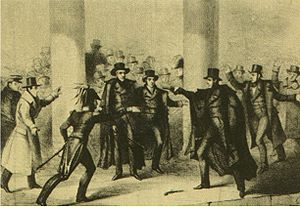
 In Lawrence’s mind, these grievances had to be avenged, leaving him no alternative but to eliminate his antagonist.  He plotted to assassinate President Jackson on a damp day in January 1835.  Leaving nothing to chance, he had two loaded pistols and a clear shot at point blank range.  

 On January 30 President Jackson was at the Capitol to attend the funeral of Congressman Warren R. Davis of South Carolina.  After paying his respects and filing past the casket, President Jackson exited the building. Lawrence was waiting for his opportunity behind a pillar. As the president walked past, Lawrence emerged from his hiding place, aimed and shot at his target. The gun misfired, and immediately Lawrence pulled the second pistol out of his pocket and pulled the trigger.  That gun misfired, too.  President Jackson heard a commotion and turned around to observe Lawrence being wrestled to the ground. The president himself further subdued his assailant by punching him in the stomach with his cane.  

 During the investigation Lawrence’s guns worked perfectly, and it was determined that the odds of both guns misfiring were 125,000 to 1.  The weapons Lawrence used were known not to be reliable in moisture, so it was the weather that actually saved President Jackson’s life.   

Two and a half months later Lawrence was brought to trial and prosecuted by Francis Scott Key, the writer of The Star Spangled Banner. The jury needed only five minutes of deliberation to find him not guilty by reason of insanity.  There was speculation that the toxic chemicals in his paints were a contributing factor to his irrational mental state.  Lawrence stayed in several institutions before he became a permanent resident of the Government Hospital for the Insane in Washington D.C. until his death in 1861. 

QUESTION:  What is the biggest or worst thing you’ve ever gotten away with?  

                                 © 2010 Debbie Foulkes  All Rights Reserved  

Sources:  

http://en.wikipedia.org/wiki/Richard_Lawrence_(failed_assassin)  

 http://www.americanheritage.com/articles/web/20070130-richard-lawrence-andrew-jackson-assassination-warren-r-davis.shtml  

 http://www.digitalhistory.uh.edu/historyonline/assassinations.cfm

ANNE BONNY (1698?-1782?) & MARY READ (1690?-1721) Pirates of the Caribbean

In adventure, Biography, Feminists, History, People, Pirates, Trivia, Uncategorized, women on February 24, 2010 at 3:25 AM

Anne Bonny

Anne Bonny and Mary Read were feminists long before that word came into common usage. They established themselves as successful pirates, breaking through the biggest glass ceiling of their day. In fact, history has romanticized them so much that in recounting their lives, it’s difficult to separate fact from speculation.    

Anne Bonny was allegedly born sometime around 1700 in Ireland, the love child of attorney William Cormac and the maid. When Mrs. Cormac found out about the affair, she exposed her husband’s infidelity and ruined his reputation. This forced Cormac and the maid out of town, and they moved way out of town to the United States, settling in Charleston, South Carolina. He reestablished himself as a lawyer, made a fortune, and bought a plantation.    

Stories differ about Bonny’s teenage years. One account says she stabbed a servant girl in the stomach with a table knife. Some claim that the source of her temper was the death of her mother. All agree that about age 16 she married James Bonny, a poor sailor, wanna-be pirate and opportunist. This charming fellow was not her father’s choice for a son-in-law, so he disinherited his daughter. Whether Bonny set the plantation on fire in revenge or not is disputed. We do know that at some point the Bonnys moved to Nassau in the Bahamas, a popular base for pirate operations.    

 Bonny became restless while her husband was away perfecting his pillaging and plundering and beefing up his resume as a buccaneer. She met John “Calico Jack” Rackham in one of the local bars, and they had an affair. James Bonny discovered his wife’s indiscretion and dragged her in front of the governor for punishment. Governor Rogers sentenced Bonny to flogging, but Rackham did the chivalrous thing and came to her rescue. Together they stole away on his ship, Revenge, and as a crewmember, Bonny began her career as a pirate.    

Mary Read was born about 1690 in England to an impoverished widow of a sea captain. When Read’s older brother died, her mom dressed her like a boy to trick her mother-in-law (who did not like girls) into providing financial support. Grandma was duped and gave them money until she died.    

 Cross-dressing proved so successful for Read that she used it to get work as a footman, and then become a soldier. She fell in love with a fellow soldier, disclosed her true gender, and they got married. Together they ran The Three Horseshoes inn in the Netherlands. Read adapted herself to the role of the wife of an innkeeper and dressed like a woman until her husband’s sudden death.    

On her own, Read relied on previous experience and used her husband’s clothes to disguise herself again as a man. She eventually ended up on a merchant ship bound for the Caribbean. That ship was captured by pirates and Read was forced to join them. This ended up being a dead end job, so the crew accepted the King’s Pardon around 1718, and continued operations as privateers.    

Bonny and Read met in Nassau. Even though they were the only two female pirates, they became friends instead of rivals. No less capable because of their gender, they quickly proved their worth to Rackham by helping him steal an armed sloop from the Nassau harbor. Onboard the ship both women donned the traditional male pirate attire for battle. Apparently they had the kickass, ‘take no prisoners” attitude to match as a fellow crewmate described them as being “very profligate, cursing and swearing much, and very ready and willing to do anything on board.” 1    

Bonny and Read loved to fight, and they deserved much of the credit for the successful exploits of Rackham and his crew. In October 1720, the crew of the Revenge was caught unaware while anchored off the coast of Jamaica. After celebrating recent victories with extensive merrymaking, the male crewmembers were below deck sleeping off their drunken stupor when the ship was attacked. Pirate hunter Captain Jonathan Barnet, an emissary of Governor Lawes of Jamaica, attempted a takeover, and it was left to Bonny and Read to defend the ship. Despite their valiant efforts, the two women were no match for the attackers and eventually surrendered. Rackham and his entire crew, including Bonny and Read, were captured, tried and sentenced to death by hanging. Bonny visited Rackham in jail before his execution, but she wasn’t feeling very sympathetic. Her final words to him were, “Had you fought like a man, you need not have been hang’d like a dog.”    

 At their sentencing, Bonny and Read “pleaded their bellies.” By declaring themselves pregnant they received a stay of execution until after the birth of their babies. It is most widely believed that Read died in prison either of illness or in childbirth.    

There is no record of Bonny’s execution or her release. However, most speculation supports the story that she was ransomed by her father, gave birth to Rackham’s son and was buried in Charleston, South Carolina. One source gives her the benefit of a true Hollywood ending by marrying a fellow Carolinian and having eight more children.    

QUESTION:  What career would you love to try? 

                            © 2010 Debbie Foulkes  All Rights Reserved     

Sources:    

1http://www.republicofpirates.net/Bonny.html    

http://www.republicofpirates.net/Read.html    

http://www.bonney-readkrewe.com/legend.html    

http://www.famtic.com/Person/187/Anne-Bonny    

http://www.wisegeek.com/who-was-anne-bonny.htm    

http://www.wisegeek.com/who-was-mary-read.htm    

http://en.wikipedia.org/wiki/Mary_Read    

http://en.wikipedia.org/wiki/Anne_Bonny    


EADWEARD J. MUYBRIDGE (1830-1904) Inventor of the First Moving Picture

In Horses, Inventions, Motion Pictures, Movies, Photography on February 16, 2010 at 9:10 AM

Eadweard Muybridge was not always “Eadweard Muybridge.”  He was born in England as “Edward James Muggeridge,” and after several attempts at creating a satisfying moniker, he settled on the surname “Muygridge” for a while.  Not only was he dissatisfied with his name, he wanted a different life, so he immigrated to San Francisco  in his 20s  and established himself in book publishing.

He was successful until fate intervened.  In 1860, a stagecoach accident left him with a serious head injury, and he returned to England to recover.  While he made a full recovery physically, his personality become noticeably eccentric, which manifested itself in some dramatic ways. 

 While convalescing in England, Muybridge was introduced to photography which he pursued passionately.  He returned to San Francisco in the mid-1860s and re-established himself as a photographer named “Muybridge.”  He specialized in landscape and architectural subjects and gained a reputation and following for his breathtaking reproductions of Yosemite.  This led to a government contract to shoot the new Alaskan territories, and he expanded his work to other locations in the West.

 With a burgeoning career, he was able to finally settle on an identity.  He changed the spelling of his first name in the 1870s to “Eadweard” and thus branded himself as “Eadweard Muybridge.” 

 Muybridge came to the attention of Leland Sanford, former governor of California, president of the Central Pacific Railroad and horse breeder.  Sanford solicited his help in solving a popular debate among the equestrian set.  Sanford believed that at some point while a horse is trotting, all four legs are off the ground at the same time, but he didn’t know how to prove it.  Legend has it that a $25,000 bet was a motivating factor in Sanford’s urgency to getting this question resolved.  

 Muybridge was intrigued by this challenge and pursued photographic evidence of the supposition whole heartedly until he was sidetracked by an inconvenient incident in his personal life.  Muybridge’s wife was having an affair, and Muybridge assumed the son she bore belonged to a Major Harry Larkyns.   Not wanting to be the fool, Muybridge went to Larkyns’ home, confronted him with his suspicion and then shot and killed him. 

 Fortunately, Muybridge’s life was not ruined even though he was tried for murder.  Thanks to his brain injury 14 years earlier, he had a defense: insanity.  Thanks to his relationship with Sanford, he had the money for a good lawyer.  Even though many friends testified to Muybridge’s mental instability, the jury didn’t buy it and dismissed the insanity plea.   Muybridge was acquitted, however, as the jury ruled his behavior as “justifiable homicide.” What good news for Muybridge: he wasn’t insane, and he got away with murder, literally!

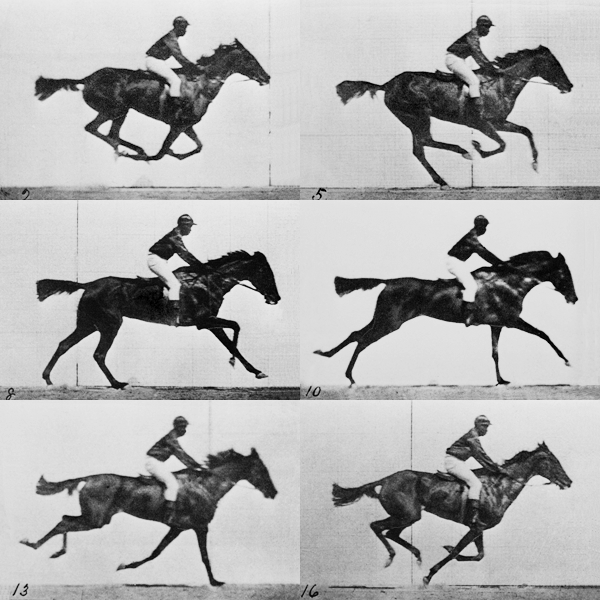
 After the trial, Muybridge let things cool down and spent some time working in Central America before returning to his collaboration with Sanford.  In 1877, Muybridge took a single photograph that proved that horses do indeed, briefly have all four legs off the ground while galloping.  As luck would have it, however, that negative was lost.   

 Sanford was a determined man, and he insisted on more definitive evidence.  Muybridge once again rose to the challenge.  He set up a series of cameras along the side of the track to cover the total distance of a horse’s stride.  Each camera had a trip wire attached to the shutter that was triggered by the horse’s hooves.

 The series of photographs was called The Horse in Motion and successfully proved that Sanford’s hunch was right.  (Click on photo to see animation.) All four hooves are off the ground at the same time, but not when the legs are fully extended front and back as most illustrators had pictured.  Instead, the horse is airborne at the moment when all four legs are under the body and the weight is being shifted from the front legs to the hind legs. 

 In order to view the photos, Muybridge created a contraption called a zoopraxiscope.  A strip of the successive images was mounted on a spinning glass disc and viewed through slits.  The swift rotation of images caused them to merge in the viewer’s mind thereby giving the illusion of movement.  In 1880 after a reporter had seen a public demonstration of the zoopraxiscope, he wrote in the San Francisco Call, “Nothing was wanting but the clatter of hoofs upon the turf and an occasional breath of steam from the nostrils, to make the spectator believe that he had before him genuine flesh-and-blood steeds.”

 Muybridge’s photos were published, and he hit the lecture circuit in the US and Europe. His curiosity didn’t stop at horses, and he replicated the technique of taking successive shots to record motion and documented people and animals moving in various ways.

 Muybridge’s invention became the inspiration for Thomas Edison (who holds the patent for the motion picture camera), Philip Glass (who wrote an opera in 1982 based on Muybridge’s murder trial), the music video for the song “Lemon” by U2 (“A man makes a picture – a moving picture/Through light projected he can see himself up close“), and the slow motion bullet special effect in the movie The Matrix.

QUESTION:   What invention would you like to see developed?  How would that help your life?

                               © 2010 Debbie Foulkes  All Rights Reserved 

Sources: 

http://www.masters-of-photography.com/M/muybridge/muybridge_articles3.html

http://en.wikipedia.org/wiki/Eadweard_Muybridge

http://www.masters-of-photography.com/M/muybridge/muybridge_articles2.html

http://www.newscientist.com/article/mg19726422.300-when-pioneering-photography-filled-the-theatres.html?full=true&print=true