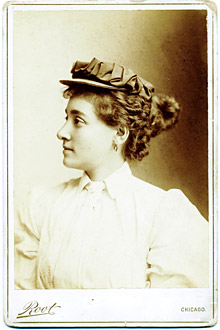
Annie Londonderry
Annie Kopchovsky left her husband and young children to circumnavigate the globe in order to prove women were as capable as men. Was she crazy and irresponsible or courageous and heroic?
Although Kopchovsky was born in Latvia, she became an American as a young child, moving with her family to Boston. At 18 she married Max Kopchovsky, a peddler, and within the next four years they had three children.
A master at self promotion, it’s not totally clear which details of the story are true or created by Kopchovsky to enhance her ability to make money. Nevertheless, the inspiration for this incredible journey is attributed to a bet. Two wealthy Bostonians were sitting around their club discussing the fairer sex. One asserted that the modern woman could do just about anything a man could, and his companion took the bait. They shook on a wager that a woman could ride a bicycle around the world in 15 months and earn $5,000 along the way. The precedent for this challenge was Thomas Stevens who completed a similar feat in 1887.
It’s not clear why she felt compelled to do this since she had never ridden a bicycle before, but Kopchovsky was likely caught up in the craze of women who were using the vehicle to express new freedoms. Susan B. Anthony was quoted in the New York World in 1896 as saying bicycling had “done more to emancipate women than anything else in the world.”
On June 27, 1894, 24-year-old Kopchovsky hopped on her 42-pound Columbia woman’s bike wearing the long skirt, corset and high collar of the time. Perhaps creating the first Mr. Mom, she waved goodbye to her husband and three small children and some fans from the local cycling club as she headed off for New York. One newspaper reported her departure saying she “sailed away like a kite down Beacon Street.” She carried with her only a change of clothes, a pearl-handled pistol and a lot of chutzpa. The Londonderry Lithia Spring Water Company offered her $100. In return for their sponsorship, she agreed to carry their placard on her bike and adopt the name “Annie Londonderry.”
From New York she rode to Chicago arriving on September 24th. By then she had lost 20 pounds and realized that if she was to continue, she would have to make some major changes. First, the bicycle was too heavy, so she switched to a 21-pound Sterling model with a man’s frame, one gear and no brakes. Second, it was impossible to ride a man’s bike in woman’s attire, so she first donned bloomers and then eventually wore a man’s riding suit for the rest of the trip.
Her original plan was to continue riding west, but the impending winter made it necessary for her to switch direction. She rode back to New York and sailed to Le Havre, France, arriving there in early December. Things did not go well at first. Her bike was impounded by customs officials, her money was stolen, and the French press declared that she was too muscular to be a woman, thereby assigning her to the category of “neutered beings.” Somehow she was able to turn things around, and, despite inclement weather, she made it from Paris to Marseilles in two weeks via cycling and train. In Marseille, Londonderry (as she was now known) boarded the steamship “Sydney.” Ports of call included Alexandria, Colombo, Singapore, Saigon, Hong Kong, Shanghai, Nagasaki and Kobe. To prove that she had actually been there, she had to get the signature of the United States Consul in each location.
Londonderry became a real entrepreneur. She kept herself going with income from displaying advertising banners on her bike and her person and telling her story. Telling the truth was less important than fundraising, and she concocted many stories about her background. In France she intrigued people with tales of being an orphan, an accountant, a wealthy heiress, a lawyer, a Harvard medical student, the inventor of a new method of stenography, the cousin of a U.S. congressman and the niece of a U.S. senator. In addition she sold promotional photos, silk handkerchiefs, souvenir pins and autographs.
Londonderry returned to America via the San Francisco harbor on March 23, 1895. From there she pedaled to Los Angeles and then through Arizona and New Mexico to El Paso. She headed north and arrived in Denver on August 12 and then continued on to Cheyenne where she jumped on a train that carried her through Nebraska. From there she hopped back on the bike bound for Chicago, where she arrived on September 12. It’s assumed that she rode the train home to Boston where she arrived on September 24, 15 months from when she left.
During her trip across America, Londonderry captivated audiences with stories from exotic places and earned enough money from her lectures to supplement the other earnings and make the $5,000 as required in the challenge. She described hunting tigers with German royalty in India and a brush with death, nearly being killed by “Asiatics” because they thought she was an evil spirit. She became involved in the Sino-Japanese war of 1895. On the front lines she fell through a frozen river and ended up in a Japanese prison with a bullet wound in her shoulder. Whether true or invented, audiences loved her tales and the press ate them up.
After returning to Boston, Londonderry was accused of traveling more “with” a bicycle than “on” one, but that didn’t dampen the enthusiasm for her achievements. On October 20, 1895 the New York World described her trip as “the most extraordinary journey ever undertaken by a woman.” Both the newspaper and Londonderry wanted to cash in further on her triumph, so she accepted the offer to write feature articles under the by-line “The New Woman.” Seeing more potential from her peddling adventure than in her husband’s peddling business, she moved her family to New York for her new journalism career. Her first article was about her round-the-world bicycle adventure. “I am a journalist and ‘a new woman,’ ” she wrote, “if that term means that I believe I can do anything that any man can do.”
QUESTION: What is the most interesting, daring or challenging thing that you have known one of your parents to do? How did it influence your life?
© 2010 Debbie Foulkes All Rights Reserved
Sources:
“Champion of Her Sex,” New York Sunday World, 2 February 1896, p. 10.
http://www.csmonitor.com/2006/0828/p20s01-algn.html
http://www.experienceplus.com/reading_room/books/around_the_world_on_two_wheels.html
http://www.annielondonderry.com/learn.html
http://en.wikipedia.org/wiki/Annie_Londonderry
http://cyclingsisters.org/node/5019
http://en.wikipedia.org/wiki/Thomas_Stevens_(cyclist)
http://www.ahands.org/cycling/thomas_stevens.html
http://nicomachus.net/writing/womens-liberation-through-cycling/


 FORGOTTEN NEWSMAKERS